
Mason & Dixon - Part 2 - Chapter 53: The Captive's Tale
Analysis of Mason & Dixon, Part 2 - Chapter 53: Doubt and Uncertainty, Captured, the Great Lakes, Jesuit College, Père de la Tube, Sky Messages, the Sisters, the Wolf's Lectures

Things in America have come full circle. The frame story (the LeSparks) began at Christmastide and the tale itself (of Mason and Dixon) has also reached Christmastide (2.52); Mason and Dixon began their westward journey starting at Harland’s farm, drinking excessively in taverns, and now have returned there to drink again. A bit over 100 miles (~161 kilometers) have been mapped so far and about 130-140 miles (~209-225 kilometers) remain. The Appalachians still remain unconquered, and the true west has yet to be found. Here, we will take a break from the story of Mason and Dixon for a chapter and a half (until the end of 2.54), and even upon returning to them, they will not begin travelling west again for another long while (until 2.59). This coming story does not even concern Mason and Dixon for now. We are not ignoring them as we did in Knockwood’s Inn while they listen on in the background, we are not seeing the doings of their camp, nor are we at the LeSparks (yet) during a mild anecdote from the storytellers and listeners. We are moving somewhere else entirely.
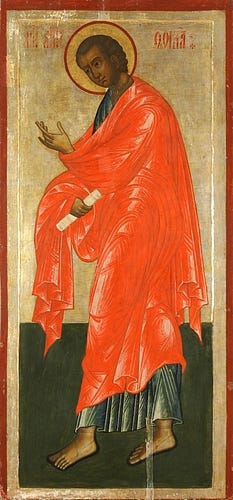
From Cherrycoke’s Undeliver’d Sermons, he starts off asking us to embrace doubt, for, even ‘The Ascent to Christ’ is filled with uncertainties. Which sect is the proper one to emulate? Protestantism? Deism? Catholicism (and of that, Roman, Irish, or which branch?) Orthodoxy (and of that, Eastern or Oriental?) What about specific religious groups? The Freemasons? The Jesuits? The Quakers? (And in our modern-day, we have other newer sects to deal with as well). What about, ignoring these sects, apocryphal texts? The Acta Tomæ (The Acts of Thomas), for instance, “is an apocryphal text,1 not to be confused with the ‘Gospel of Thomas’” (Biebel, 197).2 In it, Thomas the Disciple was said to be the twin of Jesus. Thus, uncertainty arises again. Why was this scripture, which is Biblical, said to be apocryphal? Who made this decision and why? Are all apocryphal texts entirely dismissed? and again, why? If the Apocrypha was at some point considered canonically Biblical text, then who but God was granted the power to deem it otherwise? Does doubt, therefore, lie within the religion? within those who made these decisions? within God Himself? And finally, what about that which is accepted by all Christian sects? The resurrection of Jesus does not have verifiable evidence. It simply must be accepted as fact for the faith to be given merit. Uncertainty certainly lies within the hearts of many believers. Is it mere allegory? If the answer is no, then must one accept the Book of Genesis to be completely factual as well? Does Noah build his Ark? Did the Tower of Babel rise and fall? Did the swarm of locust plague Egypt? Is the Earth a mere 6,000 years old? And if you, as a Christian, believe that these are mere allegory, does that not render the resurrection of Christ uncertain as well? If you answered yes, then some doubt must lie within.
All of this doubt and uncertainty brings us to “the America of the Soul” (511). If questions could be asked about the Bible, then why can they not similarly be asked about the history of this country? In terms of Christian sects, so too are there different belief systems that plague this country. If the means to move this country forward are believed to be different by various so-called ‘sects,’ how do we prove which is right? What are the feelings between and Irish and a Roman Catholic? In terms of apocrypha, why is the history that we accept as fact the only that we study? History is not just that which exists in textbooks as we saw last chapter (2.52). Are these forgotten historical events now thrown to the wayside? Do they hold less, more, or equal importance to understand the country in which we live? And finally, in regard to the formative moments of our country, just as the formative moment of Christianity is the resurrection of Christ, how can we verify, without concrete evidence, that the glory of this moment existed as such? Does doubt come into your mind? Are you uncertain? Hopefully, after making it over 500 pages into this novel, the answer is yes. But the point is not to reach toward uncertainty on what we have discussed so far. It is to do so over everything. This analysis should instill doubt. The structures which you view America under, whether traditional or not, should also raise doubt. There is no perfect or objectively correct way to view this country. There are no answers — just acts, questions which arise, and paths forward be they good or bad.
With these uncertainties brewing, we arrive at what is known as The Captive’s Tale — the longest digression of the novel.
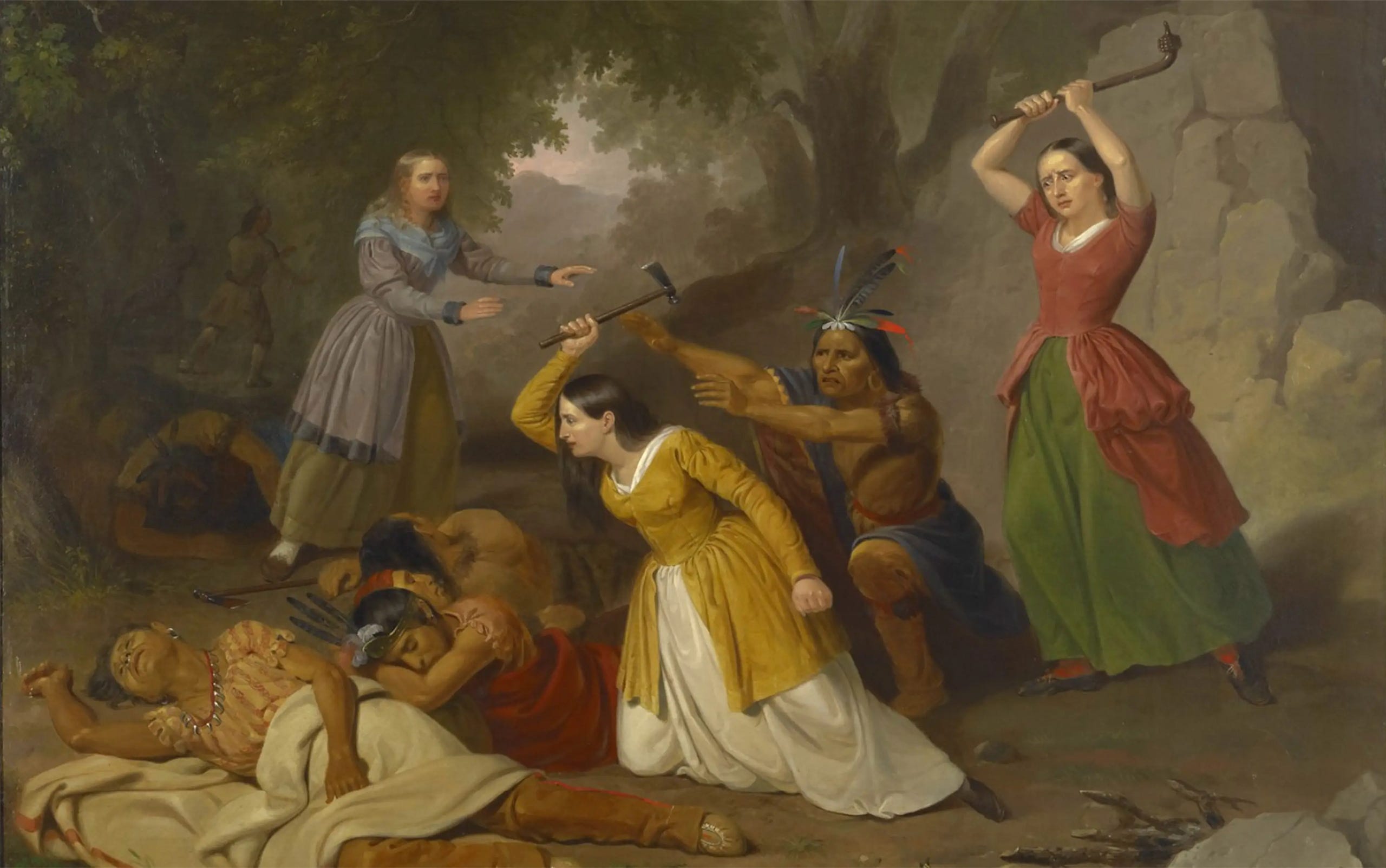
Currently unnamed, a new character is introduced as She. She was a typical woman of the time, finding pleasure in cooking, raising children, and keeping house. She did not, like Mason and Dixon, move against the day or with the day,3 she existed within it, flirted with it, loved it. Yet one day, while sitting at her window, “They came for her […] The unimagin’d dark Men. The Nakedness of the dark and wild men” (512). Who could these ‘dark Men’ be? She has her doubts. Looking into their faces, She questions how, in this time period, could they “come for her, this far East of Susquehanna[?]” (512). She, the reader, and history, would believe them to be Natives, crossing the Susquehanna and travelling east to capture her just as they broke treatises in the Enoch Brown School Massacre. In fact, not only does history teach us to expect this of the time period, but most stories do as well. Biebel reminds us that “The ‘captivity narrative’ (usually a story about a young woman being taken by Native Americans) has a long history as part of American storytelling, especially ‘Westerns’” (Biebel, 198). But, as per the epigraph, doubt should enter our minds. Is this the truth, or is it the tale we are being told? Is it accepted scripture, apocrypha, or something that was never accepted in the first place? The traditional American scriptures would love you to think that the American Indians are the ones who solely sought retribution, who enacted terror, who ‘captured,’ scalped, and killed. They were the savages, were they not? And even if, like in the Enoch Brown School Massacre, their so-called ‘savage’ nature could be justified given what they’ve experienced, is it not likely that tales (historical or fictional) were fabricated so that these ‘savages’ were deemed evil? or, more indirectly, so that we turned a blind eye to certain men in power and their vanguard?
Well, given these captors are described with Pynchon’s infamous capital-T ‘They,’ and given they are also described as ‘unimagin’d dark Men,’ it shouldn’t be too far off to recall the assailants in Pynchon’s The Crying of Lot 49. In that novel, Oedipa Maas sat watching the Jacobian revenge play, The Courier’s Tragedy, which coincidentally (thought I think it to be purposeful) bears the same acronym as The Captive’s Tale — even possessing the first article, the possessive noun, and the noun denominating a ‘story’). In The Courier’s Tragedy, at the climax, “in lithe and terrible silence, with dancers’ grace, three figures, long-limbed, effeminate, dressed in black tights, leotards and gloves, black silk hose pulled over their faces, come capering on stage and stop, gazing at him. Their faces behind the stockings are shadowy and deformed. They wait. The lights all go out” (The Crying of Lot 49, Chapter 3, pg. 57).4 In that novel, these black-clad men represented the underlings of Them. Specifically, they were the killers of a certain 20th-century American president, but more nonspecifically, they symbolized those who would be willing to root out and kill anyone willing to disrupt the project at hand. They arose not only in The Courier’s Tragedy, but throughout the history of which Oedipa learned about Tristero from the Pony Express to the W.A.S.T.E. mail system itself. And here, in the pre-Susquehannan 18th-century, “She risk’d looking at their Faces” (512) — their ‘shadowy,’ ‘deformed’ faces. Were they actually Natives? Or just disguised to look as such?
Her first uncertainty is how her community has fallen to something such as this. Has it not been built to prevent such a thing? Have these black-clad men not been either dealt with or appeased through certain deals? Well, even if that were the case, she “forget[s] that turns of Fortune in the given World might depend upon Events too far out of her Power” (512). Whatever she has been taught or told, the working of this world lie far outside anything that she has knowledge or power over. There are things going on in the interstices of this nation which she could never even imagine. So, she is taken. American mythos would have you believe that the Natives took her — desiring them rather than those in power to be blamed for these American ills. Films would be made of such a thing to tell us, the Elite are not to blame — it’s the savages you must watch out for. And who the savages are changes throughout the ages.
But nonetheless, whoever it may be that has captured her, she is taken west, across the path that Mason and Dixon mapped, evading the eyes of townsfolk via some form of invisibility, taken to the Susquehanna where “There were boats waiting,— [and yet] at the time she didn’t find that as curious as their origins, for they were not Indian Canoes but French-built Battoes, fram’d in Timbers, she was later to learn, that grow only in the far Illinois” (512). These plans are hidden away. Whatever it may be, it occurs invisibly — unseen to the eyes of the average spectator. The stories told of it will blame the savages, and yet, if one were to look closely enough, the tools which were given to these captors were built in distant lands by the men who were really funding this project (allegorically: American weapons in the hands of a foreign government or American candy bar wrappers found in the scrapheaps of a ‘terrorist’ base).
They then take her over Blue Mountain (the Blue Ridge Mountains which includes South Mountain from Mason and Dixon’s traversal in 2.49), and instead of continuing west, begin traveling to Juniata Crossing (around 40-50 miles NWW from South Mountain), and eventually “up into Six Nations Country” (513) — the Six Nations being “The Iriquois. The party is traveling north toward New York [State]” (Biebel, 198). On this journey north through the rolling hills — through the ‘Earth-Waves’ — she begins to notice the absolute beauty of the nature around her. She sees the “Chestnuts, Maples, Locusts, Sweet Gums, Sycamores, Birches, in full green Abandon,— the songbirds went about their lives, the deer fell to silent Arrows, the sound of Sunday hymns came from a distant clearing, then pass’d” (513). Taken from her home where she was that typical woman — cooking, cleaning, and caring for house and children, day-in, day-out — she now sees the beauty of the world that could have been. Was this a message intended to reach her by these Natives? Or was this a coincidental epiphany that occurred merely because of her presence in nature? Doubt sets in again. Yet the one thing that is certain is that “They were her Express,— she was their Message”5 (513).
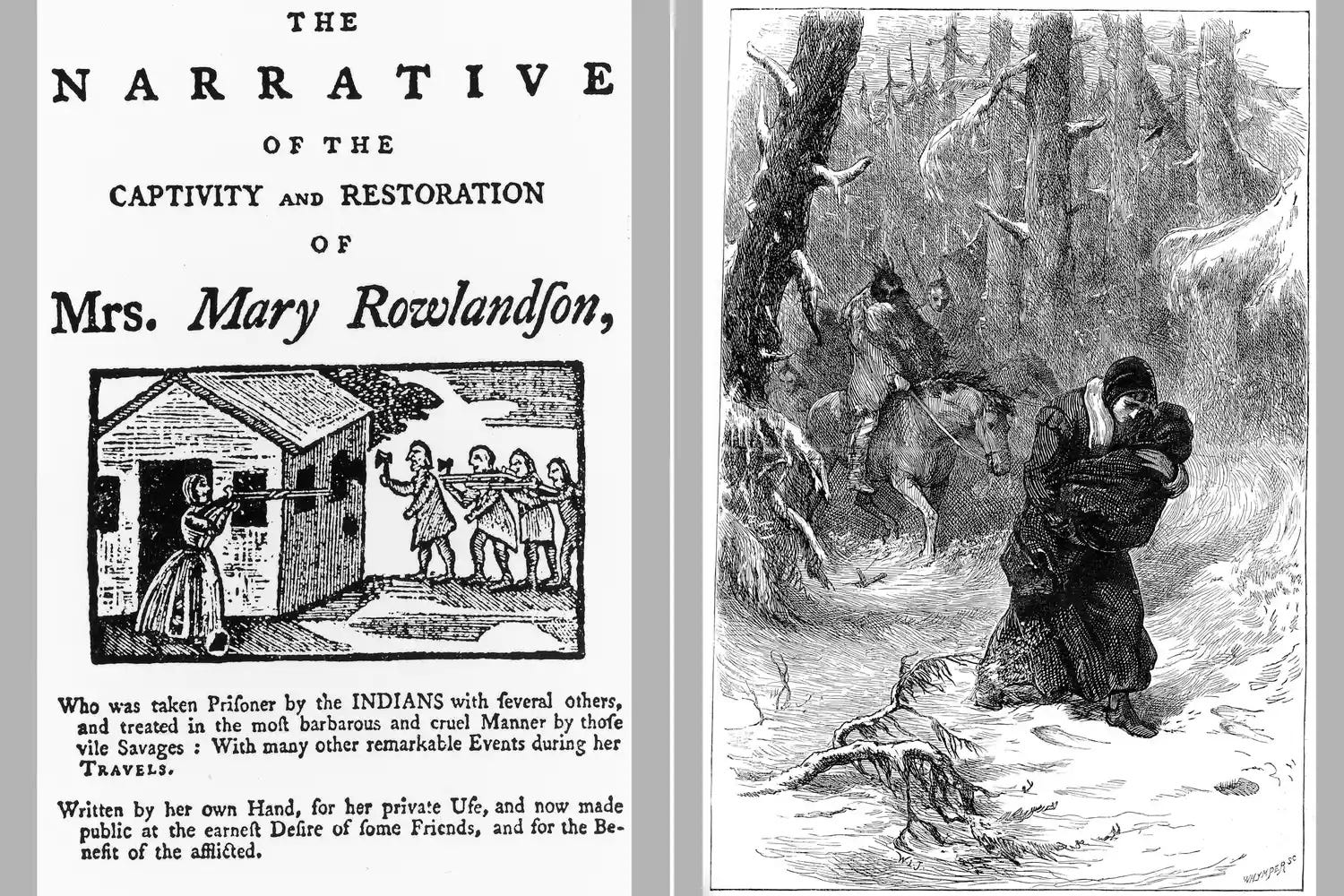
Whatever the purpose of this may be — evil or not — she continues to observe. She watches greenery, sunsets, snowfall, birds, and all sorts of animals, including “the Lemmings [who have] suicided in the North” (513). It is another appreciation and view of nature, but the suicide of the lemmings also references the same act in Gravity’s Rainbow, when Slothrop comes across a child named Ludwig outside of Rostock, Germany (Gravity’s Rainbow, 3.25, pg. 553) who was looking for his lemming, Ursula. Ludwig was terrified that his lemming had run over a cliffside given lemmings were known for committing suicide through this act. However, as stated in that chapter of the Gravity’s Rainbow analysis, this act of lemming suicide
is partially a myth, though they do accidentally [commit suicide] during seasons of migration. Slothrop, perhaps seeking to act as the guardian angel whom he could not spiritually be, travels around the Zone with Ludwig looking for Ursula. Ludwig’s love goes beyond the bounds of standard rationality, leading Slothrop to believe he was simply suicidal[, as well]. But maybe, something Slothrop has not been considering, this is similar to the butchered innocence of Ilse or Bianca now manifesting itself in a child’s simple love for his pet. His love and willingness to die for Ursula was as natural an act as the lemmings’ accidental mass suicide. It was a byproduct of their inherent nature — what should be. Not suicide, but the absence of a fear of death — the focus on love, life, connection, the spirit, the Earth.
She is seeing the world as it should be — where nature is slow, where tragedy occurs by chance and by happenstance, not by hate, greed, desire, or animosity. The suicide of the lemmings is not something to mourn. It is not brought about by the hatred of life due to the crafted suffering in our modern world. It is an unfortunate byproduct of life. It is sad, but rather than a tragedy, it is a tale of inevitability.
Yet, now reaching a ‘vast body of water,’ she is, for the first time, afraid. The body of water is Lake Ontario, and its vastness brings the other aspect of doubt and uncertainty. It is not that which she can worship like nature, but a more death-like uncertainty. Continuing north, she now is terrified, realizing that “Her Captors have told her when and where she may perform ev’ry single action of her life. It is Schooling, tho’ she will not discover this till later” (514).

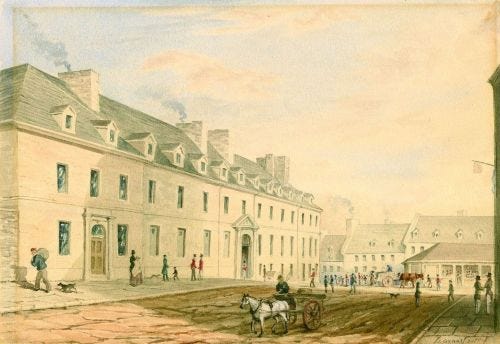
From Lake Ontario — which itself would have been pretty directly north of the Susquehanna River — the ‘great River’ that they take is the Saint Lawrence taking them northeast through Québec, passing Montréal and eventually getting to Québec City where they arrive at the Jesuit College.6 The Captive cannot, when later asked, describe the Jesuit College. There are various stories, labyrinthine halls, and “a Crypto-Porticus, or several, leading to other buildings in parts of the City quite remov’d” (514). It should be no surprise that the Jesuits, known for their religious power around the world at the time, have what appears to be a secret society. (Really, the Jesuits here and throughout the novel are meant to act as a proto-intelligence agency similar to what the CIA or MI6 would become later). She is brought within the building, where upon the table sits “an identical glaz’d earthen bowl of Raspberries, perfectly ripe,” and though she is not given them to eat, she is glad, thinking, “who knows what unholy Power might account for this unseasonable presence, in its unnatural Redness?” (514). We may say the same thing about the ripe strawberries lining our grocery store shelves mid-winter or the bouquets of perfectly blooming flowers that line florist shelves all times of the year in cities within arid deserts. This unholy power is the project we have been seeing arise from the novels first pages — global trade that could only ever be possible with the slave labor that in America and abroad import and export products that could never exist in other lands at the time they are consumed. So too does this College hold a series of automated processes taking the coffee bean through every step of its processing from roasting to grinding to brewing to pouring. One no longer has to go to a coffee shop and doesn’t even have to lift a finger to make the cup oneself. Instead, the product is brought in from lands far away and is prepared for you as long as the power stays on. But of course, at least for now, not everyone has access to things such as these.
The Captive is brought before a Jesuit named Père de la Tube — ‘Father of the Television.’ With him “sits a colleague whose relentless Smile and brightness of eye only the Mad may know. […] [A] world-known philosopher of Spain” who takes interest “in heretick Women who turn to Holy Mother the Church” (515). And a third man enters the room, a Chinese Jesuit messenger who drops off a letter with Père de la Tube.7
This College “is head-quarters for all operations in North America” (515) for the French Jesuits (again, aligning them with future intelligence agencies). Recall the discussion back at Mount Vernon with George Washington (2.28) where Mason, Dixon, and the Founding Father discussed the lead-plates that the French used to mark their territory near water. Some of the lead plates bearing markings in Chinese given the Jesuits often went to China as a part of their mission. These Jesuits, therefore, have succeeded in converting and bringing on some population of the Chinese to continue the project of spreading their power, influence, and belief across the world.
We see their technologies regarding communication networks advance as well, now using the Aurora as a form of sky-writing technology to get messages from one location to another. A complex series of techniques are used to create, maintain, and send these messages, requiring also, of course, the use of ‘Chinese’ and ‘Indians’ who have been either tricked, enslaved, or rendered dependent on these men throughout the Jesuit conquest of the world. The point, however, isn’t so much (at least in this chapter) what this system is built upon and whom it is built by, but what it is leading toward. For, this communication network is something that “Ev’ryone beneath, who can spell, now knows ev’rything there is to know about you” (516). More secretive methods must be developed to hide things such as this. And again, communication networks not only call to mind The Crying of Lot 49, but the very thing that the communication network within that novel represented: a surveillance state brought on by American intelligence.
Père de la Tube and the Spaniard bring her by the wiring that allows this system to work, speaking to each other and asking, “Do you think she understands?,” and responding with “She will understand what she needs to. If she seeks more...” (517).8 And what is it that she is seeing emerge? She is seeing the unholy nature of these terrifyingly ripe raspberries in the cold winter climate of Québec City, the inhuman automized machinery, the means of communication that can travel upon leagues of land, and Indian and Chinese servants... The Captive is seeing much of what Mason and Dixon themselves have seen over the course of their years of travel. And for some reason, it seems that Père de la Tube wishes her to understand some of this — some being a key word given he seems to threaten her if she seeks further answers. What then, is the point of this? Why allow her to witness such things? What comes from seeing them but not asking too many questions about them? Père de la Tube asks, “this isn’t like the Field, is it, Father, where occasions of Sin are so seldom met with,— no, here are rather Opportunities without number,— none of which may, of course, be acted upon” (518). Is she being allowed to see the possibilities of the future in order to pique her desire? while simultaneously not being allowed to question their true purpose to ensure she does not discover the evils that lay within them? He is, in fact, the Father of the Television, bringing the addictive and much desired technologies of the future (just as this College is doing with the communication networks, automation, and global trade), while attempting to keep the secrets of this progress, well... secret.
The Captive’s Tale, so far, has shown that in the future, the purpose of such a tale will be to place the blame upon the Natives who themselves, in the case of this story, have been contracted to capture her. They have become a mere piece of the plan, likely being forced or rendered dependent on what is being offered for their service. However, the job was to bring her to the true men in power — in this case, while not necessarily the British, the white men colonizing this continent and the intelligence agencies which would rise within it. Thus, the blame is placed on they who, while not entirely blameless in this case, are not where the focus should be. But what is the purpose of all of this? It could not simply be to increase a single individual’s desire for the progress that this nation will bring. So, what is it?
We are then introduced to a group of Sisters of the clergy, the first of whom is called Sister Blondelle. She tells our Captive of her one-time hatred for men, using a song to describe their historical abuse and manipulation since the dawn of time.9 Given she was working as a ‘Covent Garden Sprite’ (a prostitute), this is not surprising. However, Blondelle states that “just as I was about to give up Men, I discover’d Jesuits” (519). Blondelle is telling this all to our Captive while fixing her hair, also in the presence of Sister Grincheuse and Sister Crosier. Given this, it is apparent that Blondelle’s telling of her reacceptance of men must be to associate the Jesuits with some sort of goodness. If every man since Adam has lied, cheated, and harmed women like Blondelle proclaimed, then are the Jesuits really so good to change the entire perception of mankind? America would like you to believe that about the intelligence agencies and Elites running this world. And who better to tell you than a beautiful nun?
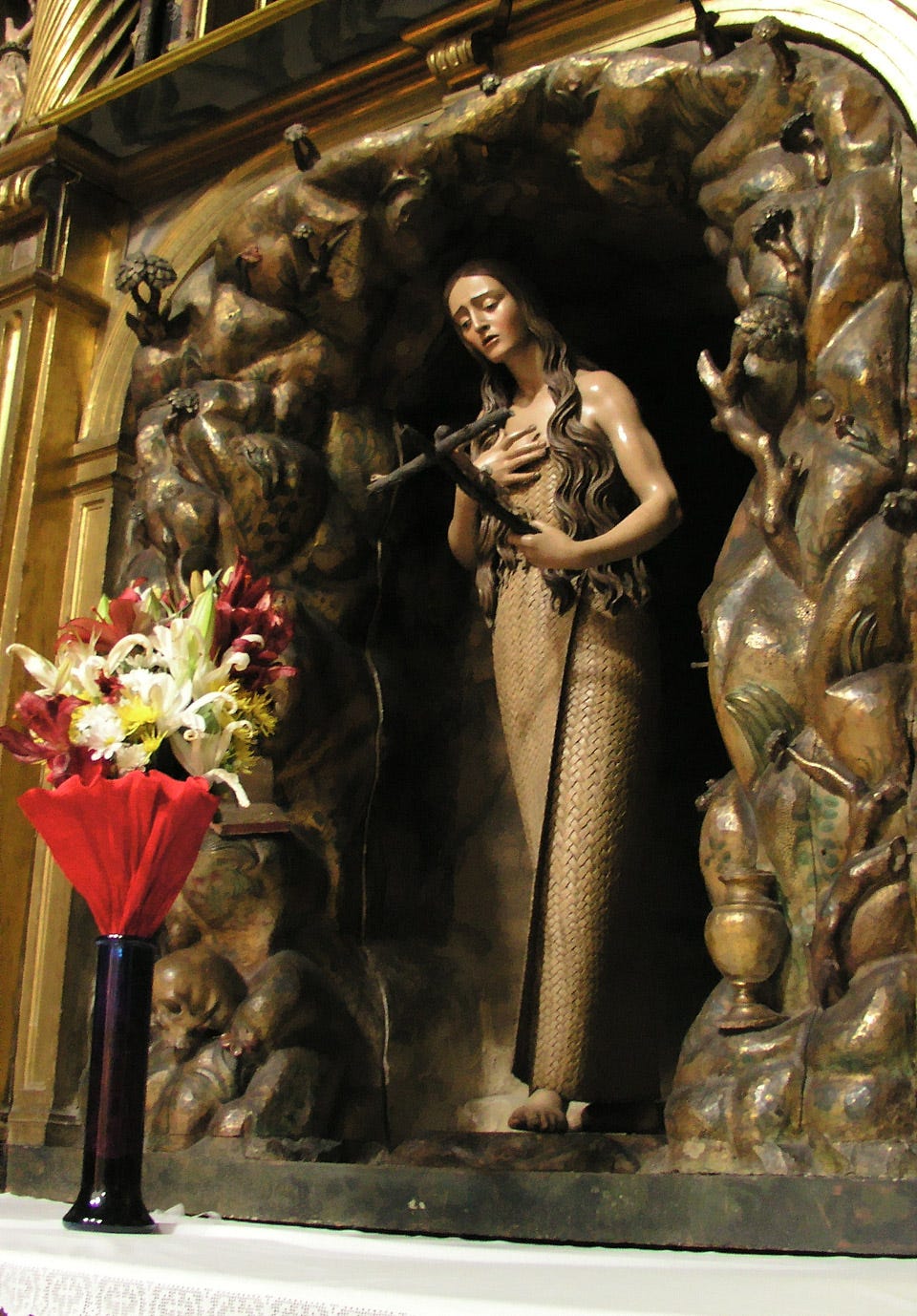
The Captive defends the Native American men who had brought her here, saying, “They were uncommonly gentle with me,” (519) and even that she was filled “with feelings of Desire” (520) for them. But Blondelle retorts, stating that a woman should ‘never discuss desire.’ The female mind, according to her and the other sisters, must remain on God and God alone. And to assist in keeping her mind on God, the Sisters present her with ‘The Las Viudas Cilice,’ what is essentially a labial crown-of-thorns — a device of sexual punishment meant to take one’s mind off desire. Along with this, the Captive is entirely shaved. She is told that one day, if she behaves and learns to act properly, she will be allowed a wig, taken from her now boyish looks to one with boyish hair, and eventually, if she continues to prove her worth, to a woman again.
One day, finding herself in the room full of wigs, she dares to try one on and is immediately caught by the sisters who seem to know that this would happen. They wished it to, in fact, so that the Captive would see the wigs set upon human skulls, thus associating the possibility of femininity with death.
All of this with the sisters has been a set-up to render the Captive’s view of her own femininity as something to be hated yet offered up. She was tricked into believing what Blondelle had to say by seeing the mutual hatred they had over the patriarchal society they live in, and the wrongs done to them by men in general. Yet, this absolute hatred is dispelled, showing the Captive that certain men out there (the Jesuits, in this case) do not fit that same mold. However, to enter that world of benevolent men — men who Blondelle knows that the Captive desires — she must repress her femininity unless it was directly desired by another man. Thus, the installation of sexual pain, the removal of feminine features, and the association of these features with death. The Captive is being led to the position of the traditional woman — one who only serves those trying to bring about this New World.

Leaving the Captive behind, we hear The Wolf of Jesus (the Spanish visitor from earlier in the chapter) give his students a lecture. He states in his lecture that
Walls are to be the Future. Unlike those of the Antichrist Chinese, these will follow right Lines. The World grows restless,— Faith is no longer willingly bestow’d upon Authority, either religious or secular. What Pity. If we may not have Love, we will accept Consent,— if we may not obtain Consent, we will build Walls. As a Wall, projected upon the Earth’s Surface, becomes a right Line, so shall we find that we may shape, with arrangements of such Lines, all we may need, be it in a Crofter’s hut or a great Mother-City,— Rules of Precedence, Routes of Approach, Lines of Sight, Flows of Power,—
(522)
This recalls a passage from Gravity’s Rainbow, where the Argentinian Anarchist, Squalidozzi, tells Slothrop that
In the days of the gauchos, my country was a blank piece of paper. The pampas stretched as far as men could imagine, inexhaustible, fenceless. Wherever the gaucho could ride, that place belonged to him. But Buenos Aires sought hegemony over the provinces. All the neuroses about property gathered strength, and began to infect the countryside. Fences went up, and the gaucho became less free. It is our national tragedy. We are obsessed with building labyrinths, where before there was open plain and sky. To draw ever more complex patterns on the blank sheet. We cannot abide that openness: it is terror to us. Look at Borges. Look at the suburbs of Buenos Aires. The tyrant Rosas has been dead a century, but his cult flourishes. Beneath the city streets, the warrens of rooms and corridors, the fences and the networks of steel track, the Argentine heart, in its perversity and guilt, longs for a return to that first unscribbled serenity . . . that anarchic oneness of pampas and sky . . .
(Thomas Pynchon, Gravity’s Rainbow, 2.7, pg. 265)10
The Wolf of Jesus is predicting this American future where the natural landscape will be cordoned off based not on rivers or mountains, but on abstract distances and random territorial claims, sectioned into parcels and right angles, hedges that will only ever be symmetrical with those across from them, cut in cuboidal shapes. He wishes for this New World to be taken from something natural to the most easily traversable and comprehensible plot of property; he wishes that the doubt which Cherrycoke elicited in his epigraph was rendered non-existent. If this world is to be built as the Elite wish it to be, we cannot allow for any accidents to occur simply because the land is not perfectly comprehensible to the post-European mind.
One of his listeners compares these right angles to the right angles that make up Jesus’ cross, leading the Wolf of Jesus to go through a series of musings on religion and the state. We learn that America is a safe haven for those like him, given Europe readily understands the desire for power that the Jesuits possess. His comment upon the so-called ‘Antichrist Chinese’ is reminiscent of contemporary American hatred toward the Chinese government, claiming that because it is even lightly socialist, it does not deserve an ounce of thought — it is anti-Christian. In America, the Wolf believes that “all the world’s expell’d and homeless be welcome here” (522). Whether he actually believes this to be true is not explicit, yet he does find it important enough to mention. His Western ideological desires necessitate the destruction of any Eastern ones. One could see this as a disparity between right- and left-wing ideologies, or material and spiritual ones. He wishes the New World to marry “both Empire and Church” (522-523) — the Church and State.
America was founded (partially) upon the separation between Church and State, though today we know this is utter falsehood. This scene, however, is where we see the origin of that lie. Already we have witnessed how the separation was only meant for those of random Christian sects and not those of any other religious foundation. But here we also see that the marriage of Empire and State is something that was always sought, not in the sense that law would be based on Biblical scripture, but that hegemonic ideologies that were prevalent in the Bible could be furthered here. For instance, the patriarchal structure which Sister Blondelle and Co. wished to impart above.
The students begin to question the Wolf’s sincerity, wondering how he can equate so many specifics with his own scattered ideology. He seems to believe in the unity of opposites such as “Light and Dark,— Earth and Sky, Man and Woman,” (523) yet chastises the Chinese for their Feng Shui even though that is a practice which essentially believes in the same thing. His reasoning, admitting that Feng Shui works, is because “It carries the mark of the Adversary” (523). He cannot allow such a thing to be perfected by the antithesis of the type of world that America is attempting to progress. The practice instead must be rooted in Western belief, in right lines that do not encompass doubt.

Finally, the students ask the Wolf, “What of those that we may Convert” (524) — essentially wondering if they too are worthy. They are asking, if we convert the natives, the Jews, the ‘English wives,’ or any unorthodox person to Christianity, is this enough for them to also be forgiven? That’s the point of this all, right? That is why we have been fighting the Natives since our first landing, asking them to believe in our One God. But again, the Wolf speaks the truth of the project: “once converted, all then re-vert. Each one, at the end of the day, is found somewhere, often out in the open, among ancient Stones, repeating without true Faith the same vile rituals” (524). The Wolf knows that the point of this is not the conversion. It is all a lie.
He does not believe that these ‘others’ can be accepted in this New World, nor does he want them to be. What the Wolf wants is for fake ideologies to be accepted. He wants doubt to be removed from the public conscience. For women to believe that they serve a sole purpose. For non-Christians and non-Westerners to believe that they too can enter this new world with a possibility of achieving their dream (a dream they, until recently, never even knew they had). For the populace to believe in the good of the agencies that run the world. And, in order to get this message far and wide, all of this story would be published and dispersed in the form of a Captivity Tale, proving that, if it doesn’t work, it was all the fault of the Natives. Not the white man. Never the white man.
Up Next: Part 2, Chapter 54.1 (ending on page 531 with the page break)
Next chapter will be split up into two parts because it’s a long one! I’ve tried to keep these types of posts to a minimum even though that’s made for some pretty long ones, so I hope you understand! After this week’s post… I need a break…
Biblical scriptures which are not accepted by major sects of Christianity.
Biebel, Brett. A Mason & Dixon Companion. The University of Georgia Press, 2024.
Paraphrased from Biebel’s A Mason & Dixon Companion.
Pynchon, Thomas. The Crying of Lot 49. First Harper Perennial Modern Classics, 1965.
Again, Express and Message are immense references to The Crying of Lot 49. The Pony Express referenced by Mr. Thoth (Chapter 4, pg. 73) and upon the plaque (Chapter 4, pg. 71) along with the Message being obvious enough.
The Jesuit College was later moved and renamed to St. Charles Garnier College. Its original location is where the current City Hall stands.
This Spanish man and the Chinese man will be incredibly important later. We’ll learn more about them next chapter.
This also reminds me a bit of the conversation that Oedipa has with her lawyer, Roseman, at the beginning of The Crying of Lot 49.
“Hey,” said Oedipa, “can’t I get somebody to do it for me?”
“Me,” said Roseman, “some of it, sure. But aren’t you even interested?”
“In what?”
“In what you might find out?”(Pynchon, The Crying of Lot 49, Chapter 1, pg. 10)
It is also discovered here that this whole tale, despite not having to do with Mason and Dixon, is being told by Cherrycoke, as well, when we see the parenthetical, “Tho’ I was not present in the usual sense, nevertheless, I am a clergyman” (519).
Pynchon, Thomas. Gravity’s Rainbow. Viking Penguin Inc., 1973.