
Mason & Dixon - Part 2 - Chapter 52: Forgotten Histories
Analysis of Mason & Dixon, Part 2 - Chapter 52: The Enoch Brown School Massacre, Winter Coats, Braddock's Expedition, the Weavers' Rebellion, Raby Castle, Sledding, Christmastide Again

Last chapter, we saw Mason and Dixon reach the house of Staphel Shockey (2.51), across South Mountain and somewhere north of Hagerstown, Maryland, though on the Pennsylvanian side of the border. That was near the very end of September, so we can now presume, though it isn’t entirely clear, that they are in October of 1765. They have now crossed the Conococheague Creek, which puts them just a few more miles west of where they found themselves last chapter. This creek is notorious for being incredibly near (just west of) the location of the Enoch Brown School Massacre. This massacre occurred on July 26, 1764, just about a year and a half before Mason and Dixon arrived here. The massacre occurred when a group of Lenape Native American men raided a small schoolhouse run by a man named Enoch Brown. On that day, he had eleven children in his schoolhouse when it was raided. Upon this raid, he was beaten, shot, and scalped. All eleven of the children were also attacked and scalped, with only one of them surviving their wounds. This led to the Black Boys — the vigilante group who attacked the illegal traders, sending them to hide out in Fort Loudon (2.50) — to further persecute Native Americans in this region. Prices for the scalps of ‘enemy’ Natives soared, both for those of women and men.
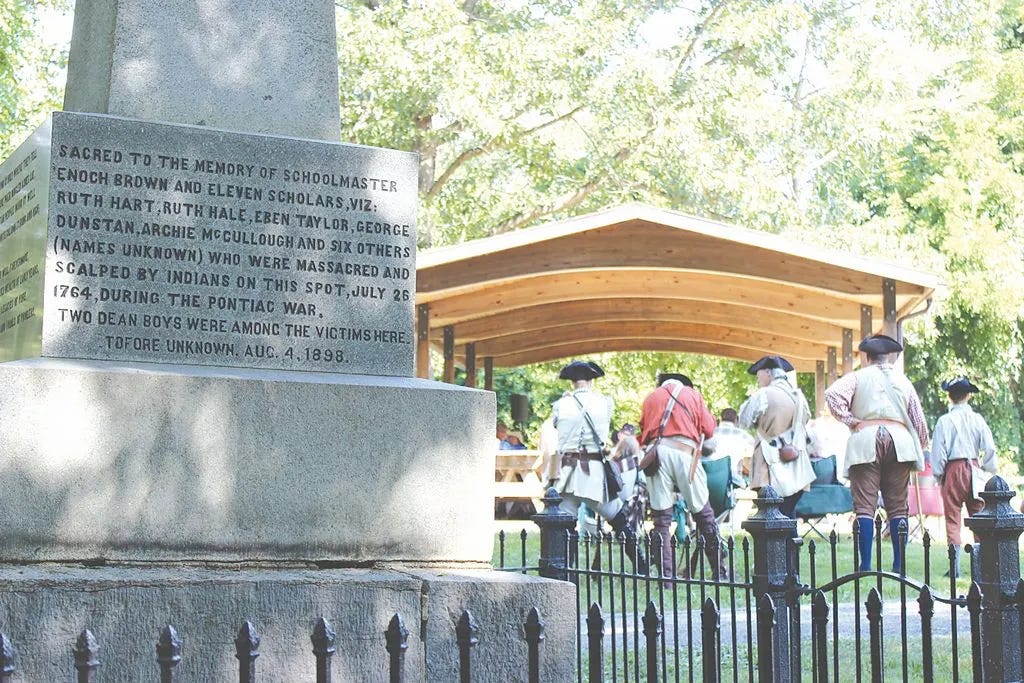
The Paxton Boy massacres were one thing, being “bearable because of the secular Town upon ev’ry side, pursuing its Business [and yet] […] out here in this sternly exact Desert might become an uncontrollable descent into whatever the Visto was suppos’d to deny” (499). The Lancaster murders, at least to our narrator, felt like something that was preventable due to its proximity to ‘civilization.’ Not only that, but given the murders consisted of whites against natives, the possibility or necessity of preventing them was not nearly as vital. Here, however, out in the rural towns west of the Susquehanna, west of South Mountain, and now even approaching the Conococheague, this so called ‘civilization’ has not even begun to be truly built. Since this nominable ‘Visto’ has not been fully formed, and now that massacres of the sort are occurring, will such events become unpreventable? Will they become naturalized in this westward line? And, if so, could anything be more terrifying to those who are paying for this line than for the rebellion of the natives of this land to be stitched into it? If the land could not be, as they would put it, ‘tamed,’ then the project would be lost. For, the entire point of this line’s formation was to ensure such a horrid event never occurred to Them, yet it turns out that such a thing is not preventable simply by creating borders. Those who had been wronged will retaliate. And even if this retaliation occurs to an extent that is as unjustifiable as the slaughter and torture of innocent children, one could not deny the anger that led to such an act, for acts such as this had been committed against the indigenous population in far greater numbers for quite literally no reason but the desire to possess land. Not retaliation, not anything of the sort. Just because of mere inconvenience for the progress of the project at hand.1
(Many comparisons could be made here between the Enoch Brown School Massacre and modern-day school shootings, but this essay is about to be long enough, so I’ll leave that idea just sitting here).
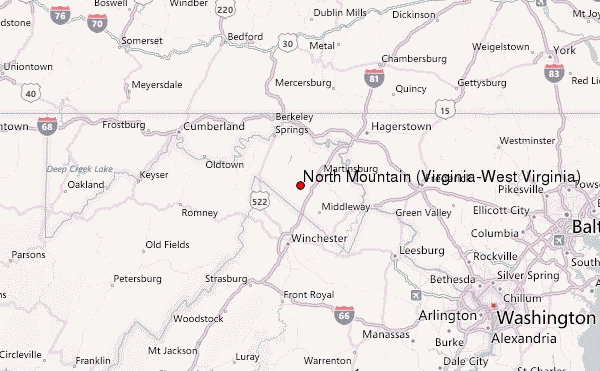
At a town still near Hagerstown, now near North Mountain,2 with the cold winters imminent, Mason, Dixon, and their survey party “pack the Instruments and leave them in [Captain Evan Shelby’s]3 Care, for the Winter” (499). They now head back east once again as they did when they were turned around from the Susquehanna to go back and map the northern segment of the Tangent Line (2.48). To get back east, again, they travel ‘against the day,’ moving toward the rising sun to review the land which they have brought into existence.
About to head back east, Dixon has an epiphany. William Emerson, his one-time teacher and the man who originally gave him the perpetual motion pocket watch, was known for wearing back-to-front coats — those being ones that opened in the back rather than the front.4 Obviously, as anyone would, Dixon thought this to be odd. However, now he sees the potential purpose as the wind blows back his hair and freezes his ventral side. As the ventral side (the belly) is more vulnerable both to damage and to cold temperatures, Emerson has a point in his advocacy for wearing coats as such. The oddity comes from the fact that it is not a social norm. But why, Dixon asks, “does ev’ryone else go about with Coats open in front?” (500). The answer, as Emerson responded to him sometime in the past when Dixon was his student, is the same as it is for all social norms: it most benefits and protects the Elite.
Emerson says, “The Modern Coat […] is bas’d upon the attire of the Nobility and Gentry […] who could ever afford Servants to put their clothes on for them. At such intimate moments, ’twas believ’d more prudent to keep a Servant in front of one, than allow him behind” (500). He continues: imagine if instead of buttoning the master’s coat in the front, the servant — or, worse yet, the slave — buttoned the coat, invisibly, from the back. The ventral side may very well be the more vulnerable, but the dorsal is where one cannot see. How many masters would have been cut down, their throats opened from behind, if servants and slaves were given free access to this invisibility? And if this sartorial norm stemmed from such a problem, what other norms are based entirely on the benefit of the ‘Nobility and Gentry’? Given Dixon is contemplating this as they travel back along the line they have mapped, seeing all the land that will one day be the boundary between free-man and slave and seeing the emergence of a world based on the desires and protection of the Elite class-status, the answer is: probably all of them.
The meditation on fashion and coats brings on a memory of the Weavers’ Rebellion of 1756-1757 — an event that is quite difficult to learn much about.5 Mason ponders if the Weavers’ Rebellions of 1756 were similar to the treatment of the ‘American Indians’ by one General Braddock. Let’s look at one event at a time and then compare the two.
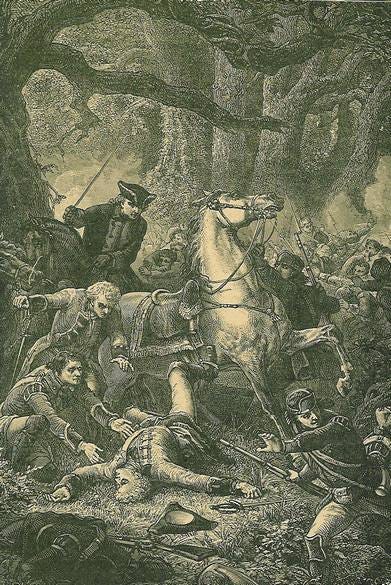
Braddock is not discussed much in this section of the novel (and is only referenced one other time later in the novel — again in 2.62), so we will begin there with a little history lesson. General Edward Braddock led an expedition (which would come to be known as the Braddock Expedition) in 1755 as a part of the French and Indian War. The objective of this expedition was to recapture Fort Duquesne — a fort in Pittsburgh which was currently under the control of the French who were working with the nearby Native Americans to protect it. In July, as the British army (including Braddock and a younger George Washington) approached the Fort, a group of Native Americans attempted to convince the British to conference with the French to leave the Fort without battle. However, instead, Braddock and his ~1,400 men attempted to take the Fort by force. On July 9, 1755, the Battle of the Monongahela occurred, where Braddock’s army clashed with a combined French and Native American armies ranging somewhere between 300 and 900 men. Despite the significant advantage in numbers that Braddock’s army possessed, they were defeated by these armies who used techniques that the British would consider ‘ungentlemanly.’ Basically, they were ambushed and attacked with brutal guerilla tactics that the Native Americans employed readily. (Vietnam, anyone?) On the army’s retreat, Braddock would subsequently die of his wounds. In a letter to his mother, George Washington would write:
We marched to that place, without any considerable loss, having only now and then a straggler picked up by the French and scouting Indians. When we came there, we were attacked by a party of French and Indians, whose number, I am persuaded, did not exceed three hundred men; while ours consisted of about one thousand three hundred well-armed troops, chiefly regular soldiers, who were struck with such a panic that they behaved with more cowardice than it is possible to conceive. The officers behaved gallantly, in order to encourage their men, for which they suffered greatly, there being near sixty killed and wounded; a large proportion of the number we had.
— a letter from Washinton on July 18, 1755
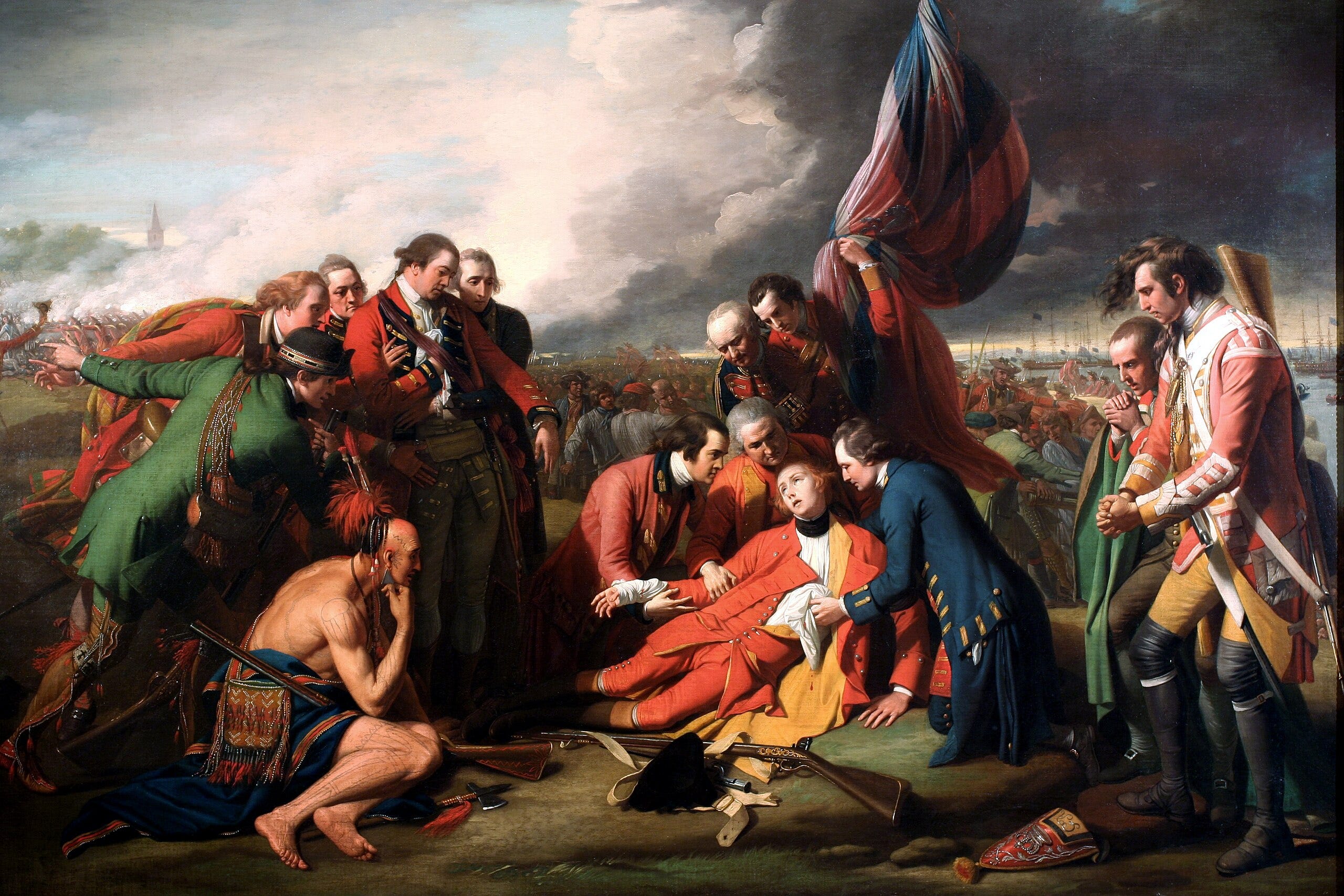
Next, the Weaver’s Rebellion of 1756-1757 occurred in England. A conversation between Mason and Dixon, while they are preparing to head back east, covers this event — though the event, as mentioned before, has been mostly forgotten to time. Mason describes these British Weavers to be mere men: “They’re people, Dixon, whom I saw daily, they work’d, they ate when they came off-shift, good for a Cob or a Batch-Loaf a day” (501). They were the epitome of the archetypal working-class man. So, too, did they have aspirations: “Some aspir’d to be master-weavers, most would have settl’d for a living wage, but their desires how betray’d, when in ’fifty-six the Justices of the Peace, upon easily imagin’d arrangements with the Clothiers, reduced by half the Wages set by law” (501). The weavers have been reduced to mere cogs in a system. They no longer have the ability to become pure artisans like the cobblers of times past who took a cutting of leather and created a piece of pure craftsmanship from start to finish. Instead, they were a single piece of the puzzle, a single gear in the machine. And yet, they hoped. This hope, however, was not merely destroyed because of the impossibility of this craftsmanship, but because of the slashing of wages.
Mason gives an aside: “Rebekah’s people were weavers” (502). Perhaps his care for this Preterite uprising is due to his nearness to it. Or because of the nearness between its purpose and his memory of the death of the spirit which he is striving to regain. Dixon also gives an aside, responding to Mason stating that the Weavers’ Rebellion started at High Street: “Been out upon the Pavement m’self... Tyne Keelmen, back in ’fifty” (502). This allusion to the Keelmen brings another Preterite uprising back to memory — one which we had heard about a number of chapters back (1.24). This was when the Keelmen (drivers of boats that carried coal), went on strike against something known as ‘overmeasure.’ Keelmen were paid per load delivered — no mention of how heavy the load was. Thus, “Management’s practice was to load down the boats with as much coal as possible, meaning Keelmen had to work harder to earn their wages” (Biebel, 113).6
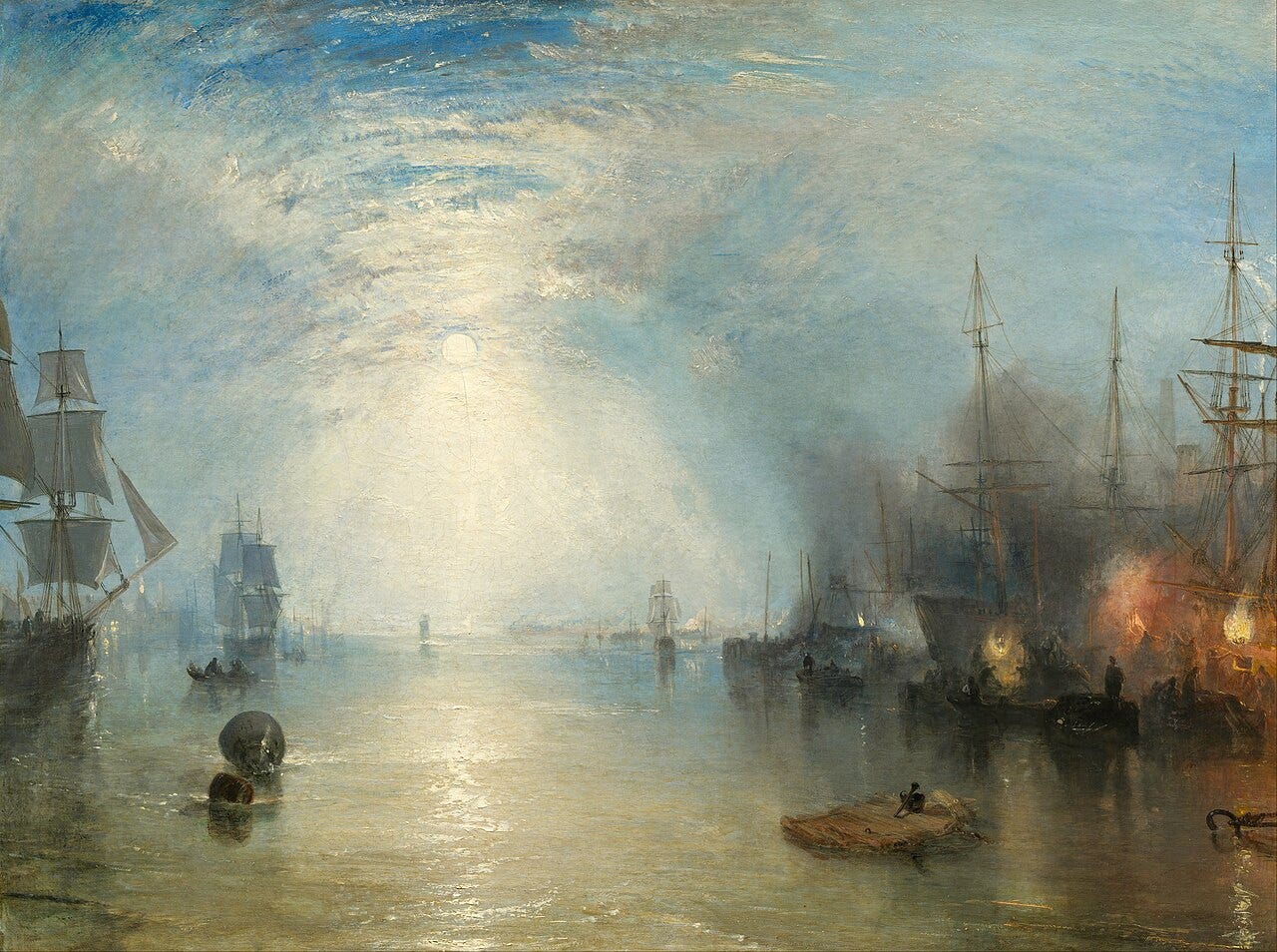
But back to the Weavers. In 1756, after another act was passed that would suppress the Weavers wages yet again, the strike occurred in which the aforementioned General James Wolfe helped suppress using six companies of men. Again, and again, and again — year after year — century upon century — the Elite, the Masters, the Gentry, would present their ventral side to those below them, forcing them to do their bidding, to button their coat, keeping a keen eye upon them and preventing any act of rebellion that may end the mere possibility of the Elite maintaining their status. Eventually, as the Weavers’ Rebellions would continue, Wolfe would kill many a striker. Even in times past when Mason and Dixon are currently talking, they would be executed for simply making a scene.7 And as Mason asks Dixon about what happened to the revolting Keelmen, Dixon responds that they were eventually transported to America — exiled for daring to utter a word against their masters. Dixon, back in England when first thinking of these men, believed that their exile to America was a decent punishment given he believed America to be the land where the Preterite could maintain their pride: “if this be America, then here they are, in company with Alehouse champions of Legend carrying their Black-jacks big as Washing-tubs, celebrated Free-for-all Heroes, Keel racers from the coaly Tyne, worshiped even Wearside” (1.24, pg. 244). But now, given what Dixon has seen, one could ask if he still feels the same.
So let us now compare these historical events. As Mason stated earlier, “For all we know, Wolfe may have felt the same contempt for British Weavers as did Braddock for American Indians,— treacherous Natives, disrespectful, rebellious, waiting in Ambuscado, behind ev’ry stone wall” (501). Mason’s idea here is that men in power will always despise and condemn those below them who use their justified anger and their unorthodox, ‘ungentlemanly’ tactics to save themselves. These Masters and Gentry likely believe that the Weavers (and the Keelmen) should be happy they are even paid. They can voice their opinions if this is not the case, but all-out rebellion signifies that this class is breaking the structure that was preordained by kings and queens living long before. Thus, this is where Wolfe’s hatred toward the Weavers for even thinking they should have a say in their position originates. And the Native Americans using their tactics of ambush and violent, ‘ungentlemanly’ warfare to protect themselves was similarly disgusting to Braddock. War, to him, should not be fought as such. It is fought with rules, with strategy — not all out bloodthirsty violence and ‘unfairness.’ One could imagine politicians in the time of this novel’s writing saying the same thing about Vietnamese guerilla warfare tactics in the Vietnam War, citing them as horrifying despite the fact that the American Army was invading a territory that did not belong to them for outright exploitative practices, willing to slaughter any innocent and burn any village or farm they came across. Thus, why would a Native population not fight back in the manner that the white man deemed unfair? Why would the worker attempt to help their class by writing a letter of dissatisfaction only to get a Letter of Reprimand in return? Gentlemanly tactics have never worked. The social norms that the Elite, the Masters, and the Gentry have deemed acceptable are only there to protect their own interests.
And often, none of this even matters. For, the Weavers were eventually suppressed. Fort Dusquene, despite not being reclaimed by Braddock, was eventually destroyed and reclaimed by the British anyway, only to be rebuilt as Fort Pitt, the same Fort Pitt discussed earlier as the place known for “Iron deposits, Coal as well, underground mountain-ranges of it,” (2.48, pg. 468) and for the weapons and munitions that it would produce. In the end, the Masters will get what they desire. Rebels will fight back against them, delaying them momentarily and increasing the hatred against each other. But until the class as-a-whole rebels, the Elite will eventually get what they want and use it for purposes that will prevent such a thing from occurring again.
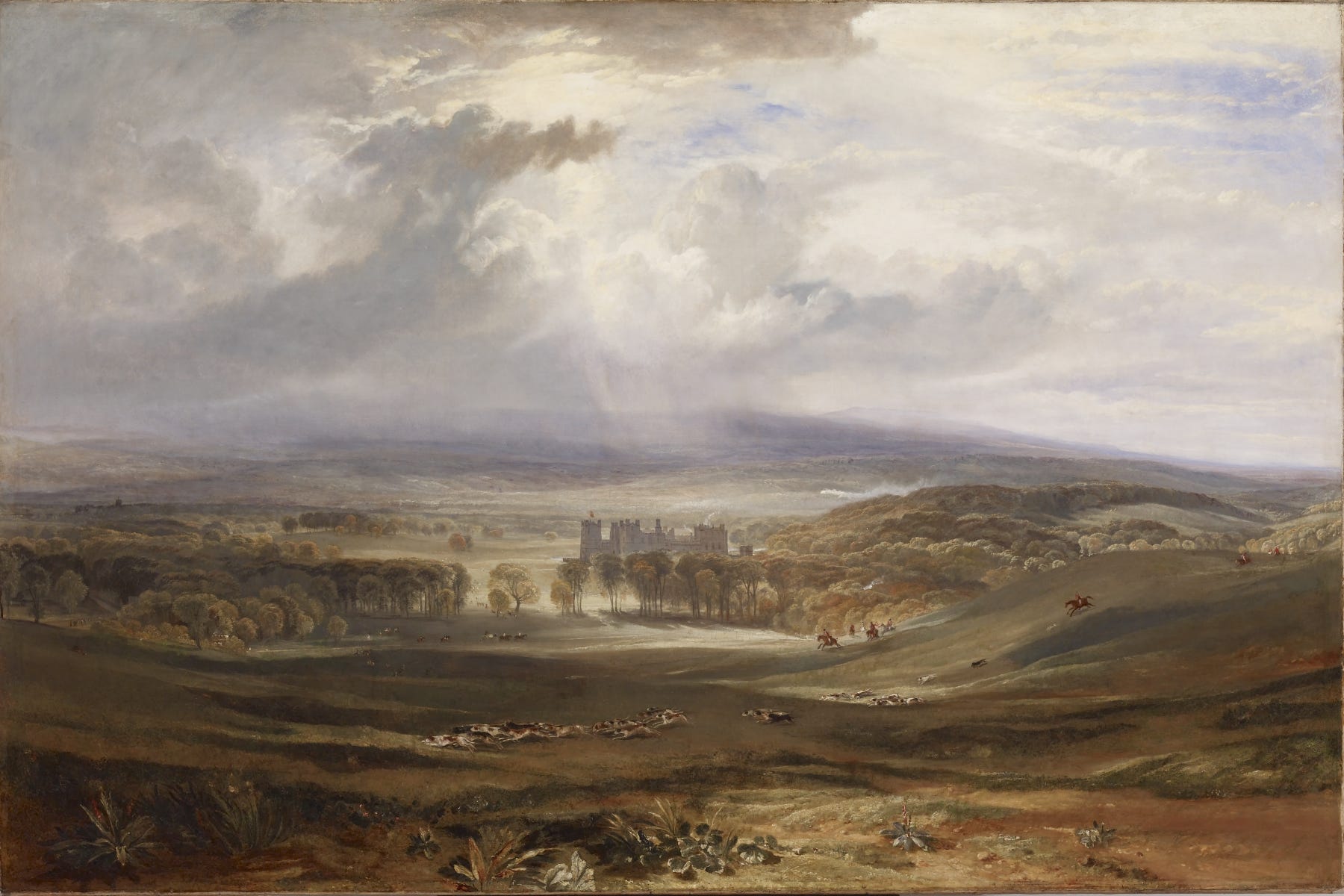
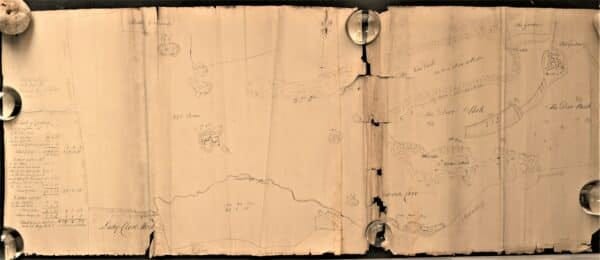
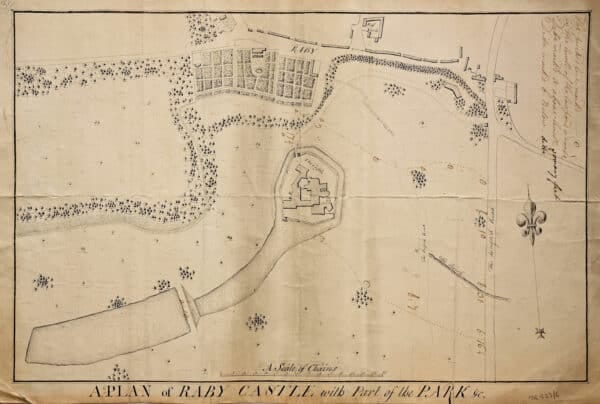
Moving on from this comparison, Dixon recalls his time at Raby Castle, the same castle where Lady Lepton came to visit and where he initially fell in love with her (learned about in 2.41). Raby Castle was where Dixon was surveying before he was scouted to observe the Transit of Venus with Mason later that same year. To Dixon, this place provided him “with an incentive, to enclose that which had hitherto been without Form” (504). It was the exact thing which Emerson did not wish Dixon to become — a man who sectioned off parcels of land for no purpose other than for men of power to claim them as their own (though, remember, Emerson may have outrightly stated his displeasure of things such as this, yet much of his teaching (consciously or not) had to do with the furtherance of education or societal structures of that exact sort).
Creating borders and lines decreases the fear that Dixon has, allowing him to ‘enclose’ these haunted and formless lands. Mason validates his feeling of this uncharted territory, saying that such land was “haunted by wild men and murderers, and its Wind never ceasing,— a source of limitless Fear” (504). Despite their previous epiphany about the project of the Elite leading to the suppression of any and all who dared try to make their own lives slightly more bearable, they still somehow view that which they are doing as a necessity. They believe that taming land will make the unknowable less horrifying. Yet, Mason also states that “When [he] got older and began watching the Stars, of course, ’twas another Story. The Sky was suddenly all there, in its full Display. [He] couldn’t wait for Night, to be out under it” (504). This terrifies Dixon. The night sky and the stars are a thing that cannot be so easily charted; they cannot be parceled off into states, counties, or countries (though Blicero from Gravity’s Rainbow would love to have a word here, showing that the goal 180 years from now would be exactly just that). Dixon, however, living in the 18th-century, is terrified by this idea, running to hide in a ‘Feed-Sack.’ All that he has learned and been raised with does not allow for the existence of something that cannot be reigned into the comprehension of human consciousness. The cosmos, no matter how advanced human technology and science becomes, will never be surveyed like these earthly parcels — like Raby Castle and environs.
In this frightful state, Dixon recalls another lesson by William Emerson. Emerson, stated that Maps provided the surveyor the ability of flight, seeing all that lay below them with a bird’s-eye-view, allowing such surveyorship to progress far more easily. So too, as Pynchon likely intends to convey, is history viewed. If it were to be viewed on the ground — looking at one potential path forward and merely attempting to see the other possibilities that arise — then comprehension would be
limited to our Horizon, which sometimes is to be measur’d but in inches.— We are bound withal to Time, and the amounts of it spent getting from one end of a journey to another. Yet aloft, in Map-space, origins, destinations, any Termini, hardly seem to matter,— one can apprehend all at once the entire plexity of possible journeys, set as one is above Distance, above Time itself.
(505)
One needs a bird’s-eye-view to comprehend what is really going on. But is such a view even possible for the cosmos? Maybe this is what terrifies Dixon. The concept of a bird and a map is only applicable to that which is on Earth. There is not land in the cosmos other than the planetary bodies. And even those are infrequent anomalies — particles of dust floating through the void of a room. One can fly higher and higher, never reaching a point where a map can be made. There is no land; you could simply rotate three-hundred-and-sixty degrees in any x-, y-, or z-plane, never finding an end to what exists. It is, objectively, incomprehensible. Why, then, are these earthly borders so important? Dixon does not wish to know.
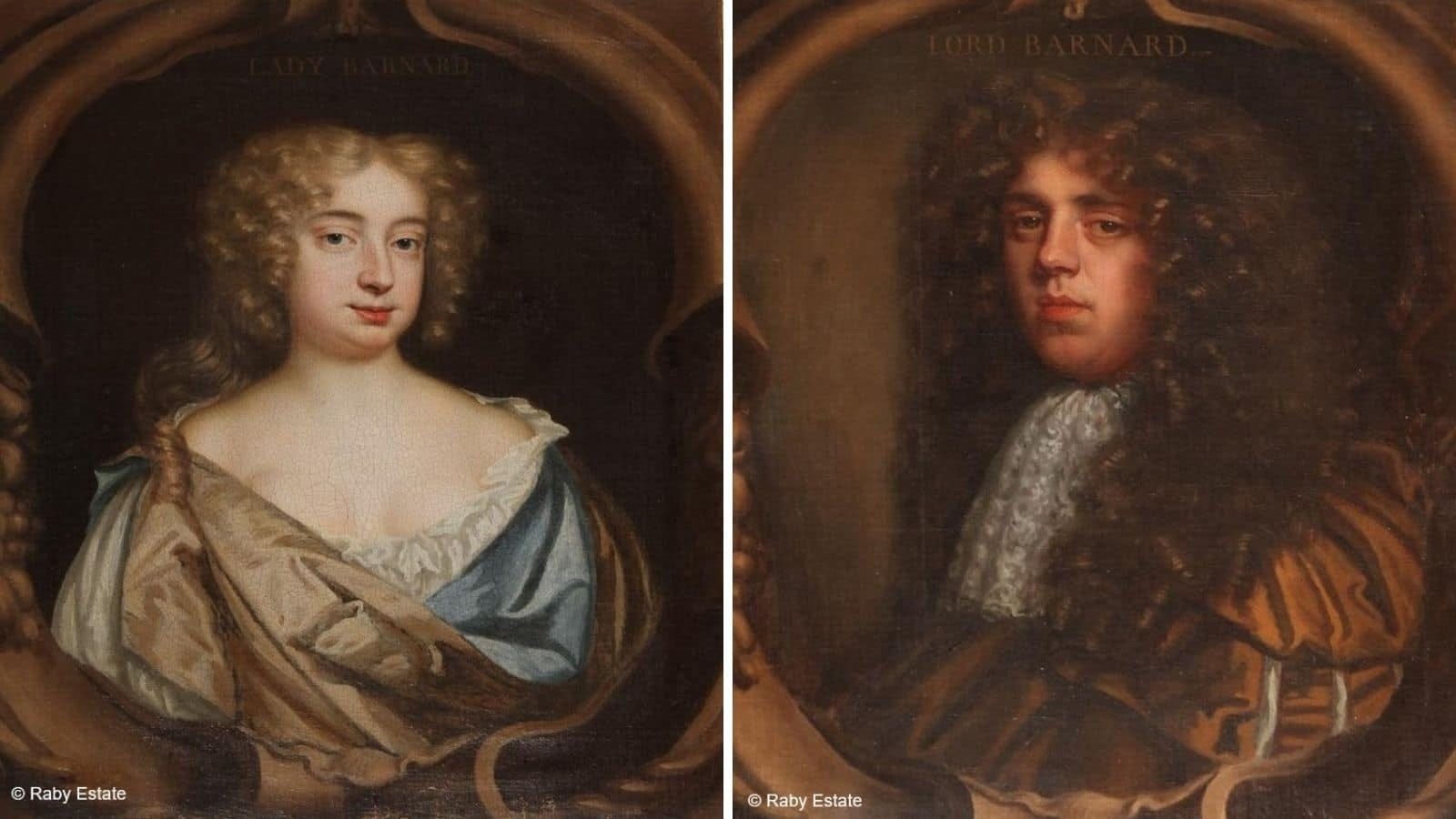
In this lesson, Dixon asks Emerson, “What of […] the Old Hell-Cat of Raby with her black Coach and six?” (505). This ‘Old Hell-Cat’ was one Elizabeth Vane, Lady Barnard, who was married to Christopher Vane, 1st Baron Barnard and Lord of Raby Castle. Their son, Gilbert, married a woman named Mary Randyll which was quite the scandal at the time. Due to Gilbert’s refusal to take the advice of family and not do such a thing, Elizabeth and Christopher Vane decided out of anger to entirely strip Raby Castle
of its lead, glass, doors, and furniture, even pulling up the floors, cutting down the timber, and destroying the deer, and ‘of a sudden in three days’ did damage to the tune of £3000, holding a sale at which the household goods, lead, etc., were sold for what they would fetch.
(Scott, pg. 82)8
This £3,000 may not seem like much but today would be over £500,000 (or nearly $700,000). However, then the son Gilbert, who was the rightful heir, sued his parents, and the courts demanded the castle to be restored to its original state, leading to the myth that Elizabeth Vane — the ‘Hell-Cat of Raby’ — still haunted its halls out of spite.
Dixon, as a practicing surveyor, before even meeting Emerson, was often upon the lands of Raby Castle, surveying its grounds.9 He often saw the ghost of Elizabeth Vane with her glowing knitting needles. One day, upon trying to get closer to woo her, he ended up following her to where she found a ghostly flying carriage, complaining to the driver (also a ghost) of his tardiness. When he responded, saying, “Sorry Milady,— traffick,” (506) she responded with (after a bit of ranting), “What possible Traffick can there be above Cockfield Fell? Are we not the only flying Coach-and-six in the Palatinate?” (507). The mention of flight once again recalls the concept of a bird’s-eye-view. There are the lands below which can be easily surveyed and the sky above which is almost entirely void. But what about that which is in-between? That which the Hell-Cat of Raby and other ghosts can so easily traverse?
What implications does this ‘between world’ — this purgatory — possess? It is the one land that none will ever be able to reach, because even though Dixon does not know it, he (and we) will one day travel into that void above. This between-world is the land of spirits, and Elizabeth Vane’s mention and dismissal of William Emerson reminds us that he tried to make sense of this between-world. Emerson sought to both learn and teach of the mystical Ley-lines. So, when Elizabeth Vane’s driver tries to say that it was he (Emerson) who caused this traffic, Elizabeth says, “You may as well have been delay’d by a flock of Ducks” (507). She knows that his use of mathematics and astronomy will get him nowhere near this between-world. And as we see Dixon under his tutelage, this comment is proven true. Dixon, who first heard of Emerson because of these ghosts, will end up learning of the Ley-lines and will proceed to do nothing but map the Earthly lands, parceling it off into borders and territories — no hint of a between-world to be found.
Dixon did not know at the time why he sought her so desperately. In fact, originally thinking it was love, the idea “That it might have been something else altogether would never occur to him until years later, at Castle Lepton” (507). It was there, at Castle Lepton, where he realized that another woman he had seen at Raby Castle, Lady Lepton (though, back then, this was not her name), had a similar effect on him (2.41). He, at Raby Castle, fell for her as well, discovering that she was an atypical social climber, but a social climber, nonetheless. Then, at the Lepton Estate, Dixon realized that while Lady Lepton may have been vastly aware of the exploitation that Lord Lepton and those of his class were enacting, she was now too comfortable to do anything about it.
What is it that leads to Dixon’s infatuation with women such as these? His desires, while traveling with Mason, seem mostly to be in regard to food and drink. However, talking to Mason, he gives a reason, saying, “she has it all,— Beauty, Money,...um...whatever else there is....” (507). Dixon’s lust, therefore, is not much different than Lady Lepton’s. The both of them have good intentions, desiring to make the world more equitable for all. But the will to do anything about this desire quickly fades away when the possibility of attaining status is now possible. Be it a ghost or a person still living, Dixon seeks beauty, money, and...whatever else there is.
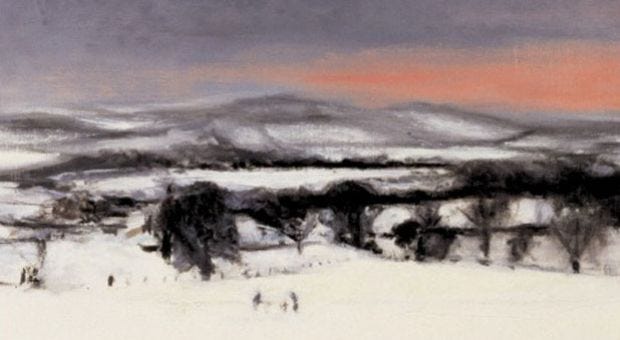
Back in the present, having dropped their supplies off with Captain Evan Shelby near North Mountain, across the Conococheague, Mason and Dixon take a much-needed break for some sledding. But while here, sledding in the light blankets that began their fun, the snow begins falling much harder, and “Both Surveyors feel their Velocity increasing ominously,” (508) which, though a bit on-the-nose, is exactly what’s been happening through this novel. It is the forward trajectory in time on a set path that they have willfully gotten onto but that they can now no longer control.
On this ever accelerating path, one that they originally believed that they had a grasp on, they find themselves accelerating “blind, together, separate, […] [and] Each is aware of how easily a Tree unfell’d, even a Stump left high enough to protrude from the Snow, rearing too quickly to swerve ’round, might mark their personal Termini” (508). Not only do they have no control about when or where they travel, and not only do they have no control about what the line is to be used for, but the line itself is the only thing keeping them safe. An unfelled tree is the thing which could kill them; if the line went unfinished and the trees remained unfelled, then that which they would be hurtling toward would be imminent death. There would be no purpose to keeping Mason or Dixon in the good graces of those who hired them. This, therefore, may be why they are terrified to cease the project — why they may be refusing again and again to admit their own complicity. However, as we see Dixon do, hopping off the sled — thus ceasing one’s no-longer-inevitable acceleration — is possible. One may experience some discomfort and a few bruises because of it, and one may have to evade those Elites for the rest of one’s life, but you could hop off. Who, though, is to say that another may not just take up the exact same mantle.
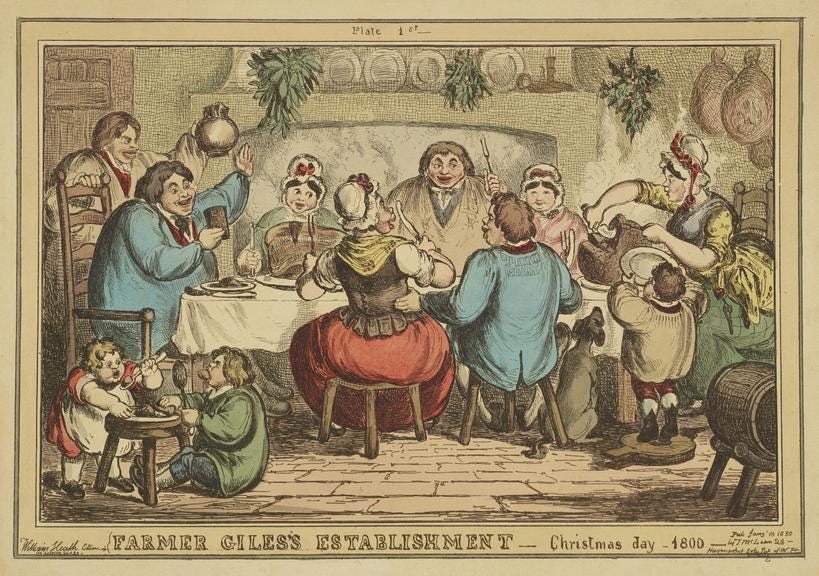
At last, Christmastide comes again. The end of 1765 nears, and the past couple of months (given they were likely in October at the start of this chapter) have gone by with Mason and Dixon’s travel back eastward toward the base of their operations: Harland’s Farm, just outside of Philadelphia. A short distance from the farm, a tavern opens its doors, allowing the patrons (including our surveyors) to come in and drink the day away. The scene is jolly, with music, children laughing, food and drink in abundance, gifts being exchanged. It recalls the first scene of the novel — Christmastide at the LeSpark’s house, where similar activities occurred: joy and abundance in the foreground and the knowledge of what allowed this to exist in the background. The same message lies here. This is what could occur if the west was won. Happiness, joy, indulgence for a few. But at what cost for the rest? The cost is the history which we’ve just read: the Enoch Brown School Massacre, Braddock’s Expedition, the Weavers’ Rebellion, the events at Raby Castle. When greed for land, property, wealth, or power take hold, their repercussions will be apparent — some written about in history books and some forgotten to time. But if it continues, this historical path will accelerate on the path forward until someone who has the means to slow it down has the courage to jump off, accept the repercussions, and stop it from happening again. Otherwise, the line will move ever on, evolving, one day, into something that cannot be stopped.
Up Next: Part 2, Chapter 53
A later chapter will explore how these historically violent acts involving Native Americans and white men are pushed further west with the very progress of the line (2.62). This chapter is an important companion to that one.
North Mountain was a doozy to find. Through research, I kept coming up with the North Mountain in northeast Pennsylvania which could not have been what Pynchon was referring to due to its distance from the Mason-Dixon Line. Thanks to Brett Biebel, who I emailed to figure this out, I learned that it was likely North Mountain in West Virginia. I forgot how odd the geography of the northeastern section of West Virginia was and how close it was to the similarly bizarrely mapped part of Maryland, so did not even think of looking there. Anyway, its location is actually not that important. I just felt like including this since I figured others would potentially struggle to find these mountains when trying to map Mason and Dixon’s journey. So, there you are. Thanks Brett!
Captain Shelby will become an important character once Mason and Dixon head back west in 2.59 (though he will also pop up again in a flash-forward in time in 2.55). So, remember that name.
We first saw him wearing this when he, Dixon, and Maire went to the Cudgel and Throck back in England (1.23, pg. 228) after Dixon had returned from Saint Helena.
The website linked below is the only one where I could find any significant amount of information regarding the strike/rebellion by British Weavers:
https://www.stroudtextiletrust.org.uk/article/background-to-the-local-wool-industry/
The difficulty of finding such an event is also possibly the point of its inclusion. If a Preterite rebellion such as this is so hard to find, how many others are there that are equally hard to find without someone like Pynchon’s guidance. For instance, the Herero massacre was first revealed in his novel V. — well before it was a well-known historical event. Pynchon, here, is likely asking, ‘how many other of these similar events occurred? If this one is still discoverable through some heavy research, how many are not?
Biebel, Brett. A Mason & Dixon Companion. The University of Georgia Press, 2024.
Back when Mason was in New York on his own (2.40), he discussed the idea of wage-slavery with Amelia and Captain Volcanoe. The two were trying to educate Mason on his status as a slave since he worked for a master. Mason did not accept this fact given he knew that he was at least paid and treated well. He similarly believed that even as a wage-slave, he was in a far better position than other wage-slaves, recalling this same Weavers’ Rebellion. He knew that if his job was cut, he would have money and status to fall back on. However, the Weavers would have no such thing. While their “wages were all cut in half […] and a weaver was lucky to earn tuppence for eight hours’ work[,] Mason in those same Weeks was preparing to leave the Golden Valley, to begin his job as Bradley’s assistant, even as Soldiers were beating citizens and slaughtering sheep for their pleasure” (2.40, pg. 407).
Scott, Owen Stanley. Raby: its Castle and its Lords. Barnard Castle: Harry Ward, 1915.
The biographical stuff here (at Raby Castle) on Dixon is very sparse when I attempt to research it. My assumption based on what I can find is that Dixon was being educated at Barnard Castle and surveying the lands of Raby Castle (about 7 miles northeast of Barnard). It wasn’t until the following events that he specifically sought out Emerson to teach him more.