
Mason & Dixon - Part 2 - Chapter 51: The Divine Comedy
Analysis of Mason & Dixon, Part 2 - Chapter 51: Pranks, the Black Dog, Antietam, Staphel Shockey, the Cavern

The space between the Susquehanna and South Mountain, the range at the eastern edge of the Appalachians, is where things began to blur to the greatest extent that we have yet seen. The further west we go, the more magical and less overtly material the world becomes. After South Mountain, however, when we really begin to get into the Appalachian range, is when even the ghosts and spirits turn into something more intangible than before. They are not just apparitions but are “Thatwhichever precedeth Ghostliness” (491).
Given the unknown and unknowable nature of what is coming, one could imagine some hesitancy if not outright fear for continuing on. Perhaps because of this, or perhaps just because of boredom (likely both), Mason and Dixon begin to play a series of pranks on one another. Dixon, for instance, jumps into Mason’s tent with the tail of a coonskin cap in the middle of his face, startling Mason and leading them to discuss their past with hats and wigs. However, Mason quickly realizes that he has potentially insulted Dixon given Dixon comes from a Quaker background, and “Quakers only removed [their hats] during prayer” (Biebel, 193).1
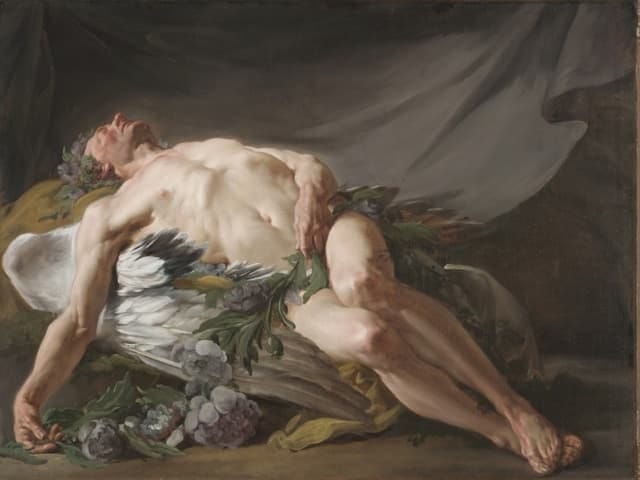
Mason, too, takes an opportunity to play a prank on Dixon, waiting until he is sleeping when he should be awake, and then ringing a bell directly in front of his face. Dixon denies that he was asleep, leading Mason to question Dixon about things that have occurred since he fell asleep.2 In the end, these pranks are nothing more than pranks,3 yet it is revealed that Dixon often sleeps with his eyes open; he, in other words, cannot find solace in sleep or dream — cannot tear his eyes away from the real world which he is coming to better understand.
As the two argue over whether Dixon was awake or not, and what it means for his eyes to remain open during sleep, “From the Forest now proceed Sounds, real ones, that neither Surveyor has heard before, and that each is too embarrass’d to mention to the other” (493). This is the ‘sound that precedeth ghostliness’; it is a rhythmic pulse that one of them thinks may be ‘Indian Drums’ while the other says it is a ‘Dog.’ Either way, it is described as if it is a heartbeat, and no matter who Mason and Dixon ask throughout the camp, it simply evokes uncertainty. Some — from Nathe McClean to Overseer Moses Barnes — also believe it is a dog while others cannot fathom what this new sound could be.
It is not theorized to be just any dog. Overseer Barnes believes it is the ‘Black Dog.’ This Black Dog is a “Creature of British folklore said to represent the devil. It appears at night and foretells death” (Biebel, 193) — also known as the Grim. Being a dog, it naturally marks its territory. However, the survey party realizes that with the Visto they have been clearing, this dog will be attempting to do so on trees “which will no longer be there” (494). And these trees have always been there, just as death has always been here. Is death, thus, this thing that ‘precedeth Ghostliness’? It likely is, given death is one of the only ‘spiritual’ things that has existed before we tried to conceive of posthumous possibilities. But then what happens when we strip away even the comfort of death? If, moving westward into lesser and lesser forms of societal reality, we not only abandon the spiritual or ghostly, but now come to abandon the concept of death itself, then what is left? Death may be that terrible, unknowable realm beyond that in which we live; but without it, answers are even more tenuous. No matter how uncertain death already is, at least it gives us some anchor no matter how terrifying.
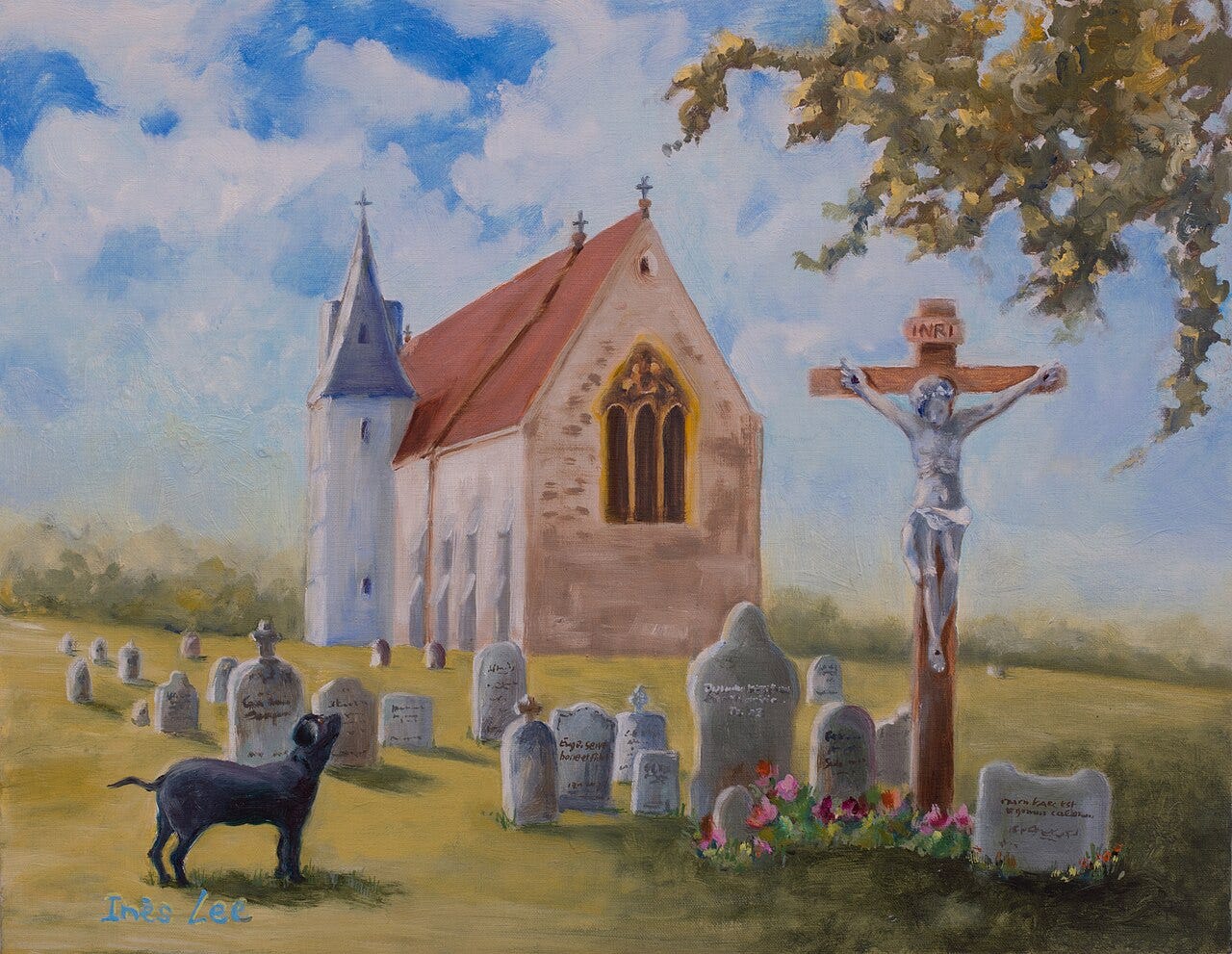
Reverend Cherrycoke, also at this South Mountain camp, suggests “that this is all but a form of Joint Mirage” and that “something very like it [was] reported in the Philosophical Transactions not long ago” (494). But when Mason asks if someone wrote about this ‘Black Dog’ to the Royal Society, the party tells him that he is not supposed to speak its name out loud. These men will sin; they will sever death itself from the world; they will uproot the trees which have grown in this untarnished land for countless centuries before their least familiar ancestors had even lived; and yet they will not speak the name of that which they have brought about. They will not admit that not only are they bringing about an extreme of death that has never been seen before but also are tearing away the concept of death itself. Like many Christians do, they ask if it is not enough for the axmen to bless “their Bits each morning with holy water” or for “the Presbyterians ever brewing Potions, and scrying the entrails of Toads” (494-495). They cannot fathom that if they act according to their scripture and check certain boxes, why it is that what they’re doing so sinful? How could their decision to bring Christianity (in whichever denomination it might arise) to America pose such a threat? Is this religion not a part of the spiritual world as well? Are the ‘Holy Trinity’ and the ‘Cross’ now symbols not to be spoken of because of how they were propagated forward?
No matter what the answers are (and the answers are quite clear), this name is not to be spoken. Death, again, is terrifying enough. But what are they without it?
After a comical scene revolving around the phrase ‘Dog Person,’ the group begins planning to go and investigate the sound. Dixon takes up this mantle, coming back to report that the sound came from the so-called ‘Glowing Indian.’
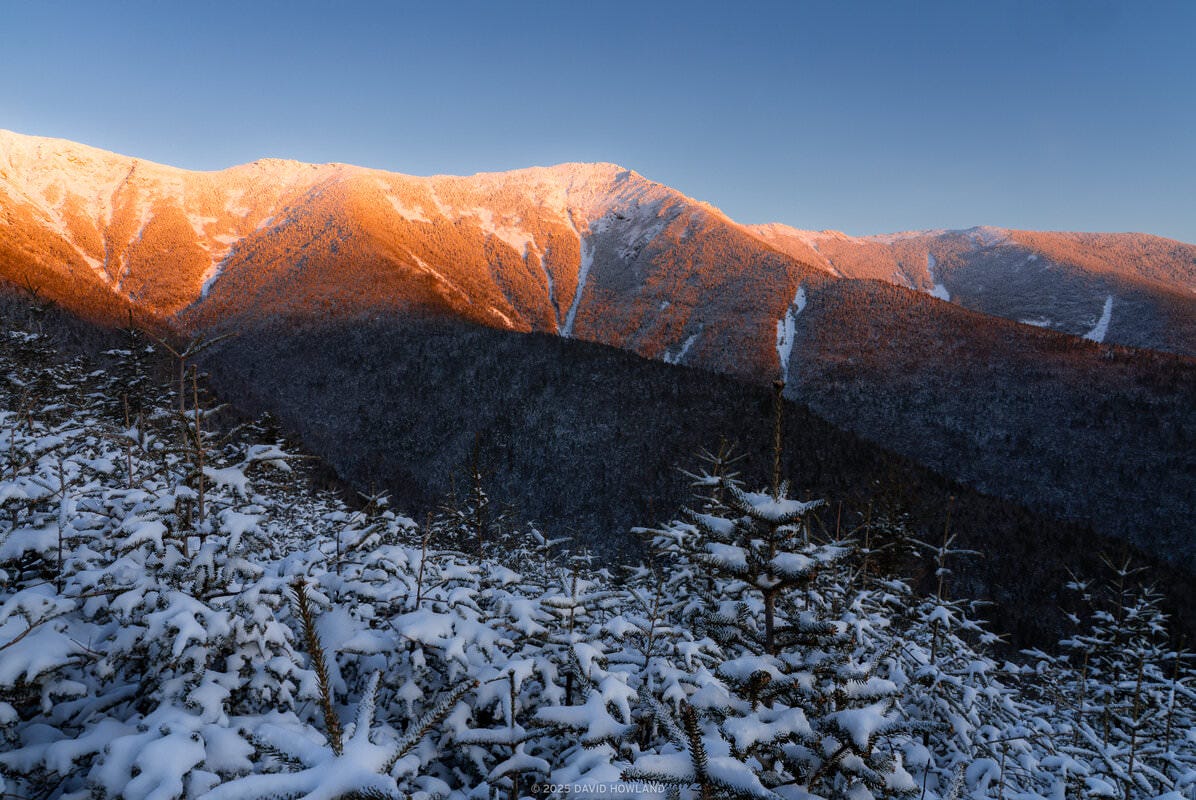
Here be, again, some heavy theorization. First, and perhaps less controversially, is the fact that a giant glowing Indian could be taking the Golem analogy another step further — bringing it from the general progress of technology, to the mechanical Duck, to the Golem, to the Indian, thus making this new analogy for ‘progress’ one that is both eternal and enslaved. It could be progress built in this new world as a purposefully subjugated caste, one that would be exiled and thus made dependent on what came after. However, through some research, I learned of a glowing mountainous phenomenon known as an Alpenglow. This ‘glow’ occurs in mountaintops such as those that Mason, Dixon, and their survey party have now reached (the Appalachians). And it is therefore possible that this glow that is mentioned by Dixon is the phenomenon known as the Alpenglow. This phenomenon occurs when the sun is opposite the peaks of mountains and its refracted light produces a reddish-pinkish glow (sometimes also higher wavelength frequencies of the visible color spectrum) upon the peaks that it can reach. This is similar to the Brockengespesnt — the Brocken Specter — which Slothrop witnesses when atop the Brocken range with Geli Tripping (Gravity’s Rainbow, 3.4). In that novel, it represented the nature of false godhood, giving Slothrop the ability to stand large over the nations surrounding the Brocken range, flipping off the country and such. It was the false apotheosis of man, signifying the beginning of his journey of discovery where he would eventually find out that he was anything but a god, and that the ostensible gods of the new world would be far more terrifying. Here, the Alpenglow takes on something more magnificent and good — being almost Heaven itself. The sun, a one-time venerated God in this land before the white man came to impose its own God upon the indigenous people, refracts through the microscopic water droplets, coloring the whole mountainside in pink and red, then moving down into those other frequencies. It is not an elevation of man to God, but of the natural world to God — perhaps even (given the term, ‘Glowing Indian’) the elevation of this land’s original inhabitants. As we move further west, the white man — for now — holds less power.
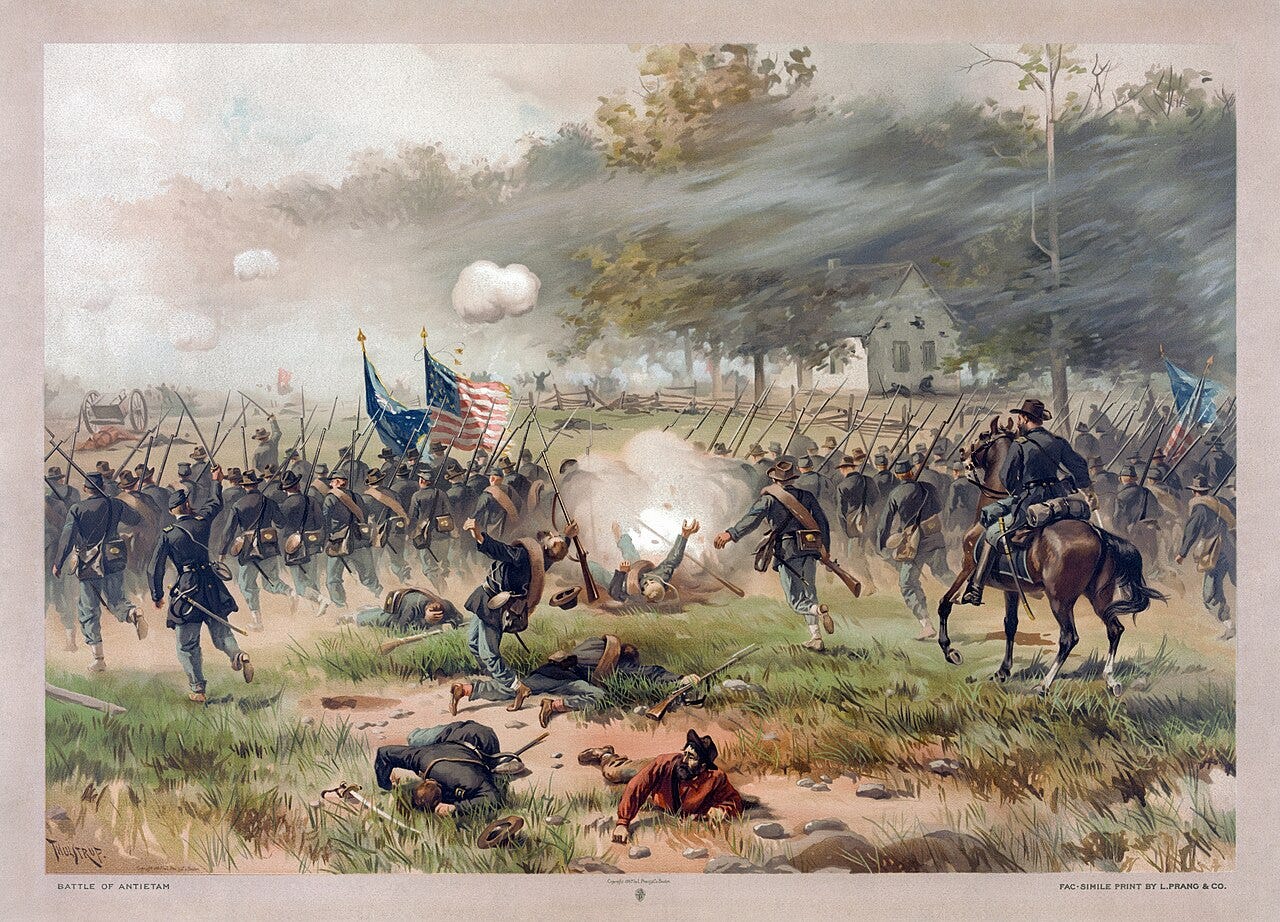
We have now come to the final weeks of September — September 21st to be exact. After their journey back to the West to complete the northern section of the Tangent Line (2.48), they turned back eastward in early June, meaning their journey from Philadelphia to trans-Susquehanna, to the eastern edge of the Appalachians, to now being across South Mountain entirely, took around three-and-a-half months. They have reached “the House of Mr. Staphel Shockey” which lies near “the Springs that fall to Antietam Creek,” (496) likely just north of Hagerstown, Maryland which would put them now around ten to fifteen miles west of South Mountain. The mention of Antietam is also intended to reference “a massively important (and bloody) Civil War battle […], which takes on additional meaning in the context of this line” (Biebel, 194). Mason and Dixon are thus passing by the exact points that the conflict will occur. They are mapping the future war itself.
It is here, at Staphel Shockey’s house that they learn “of a remarkable Cavern beneath the Earth,” (496) which on a certain Sunday they make their way to with Mr. Shockey and his children, leaving the wife “at home with a thousand Chores that Sunday does not release her from” (497) — or is it her husband who does not release her from them? Obviously that is the case given the husband is now venturing out with the survey party for no reason that would benefit his house, and this specific is likely brought up (now that, even though it is not apparent until after the block quote, we are back with the LeSparks) as a little aside to Tenebræ from Cherrycoke.
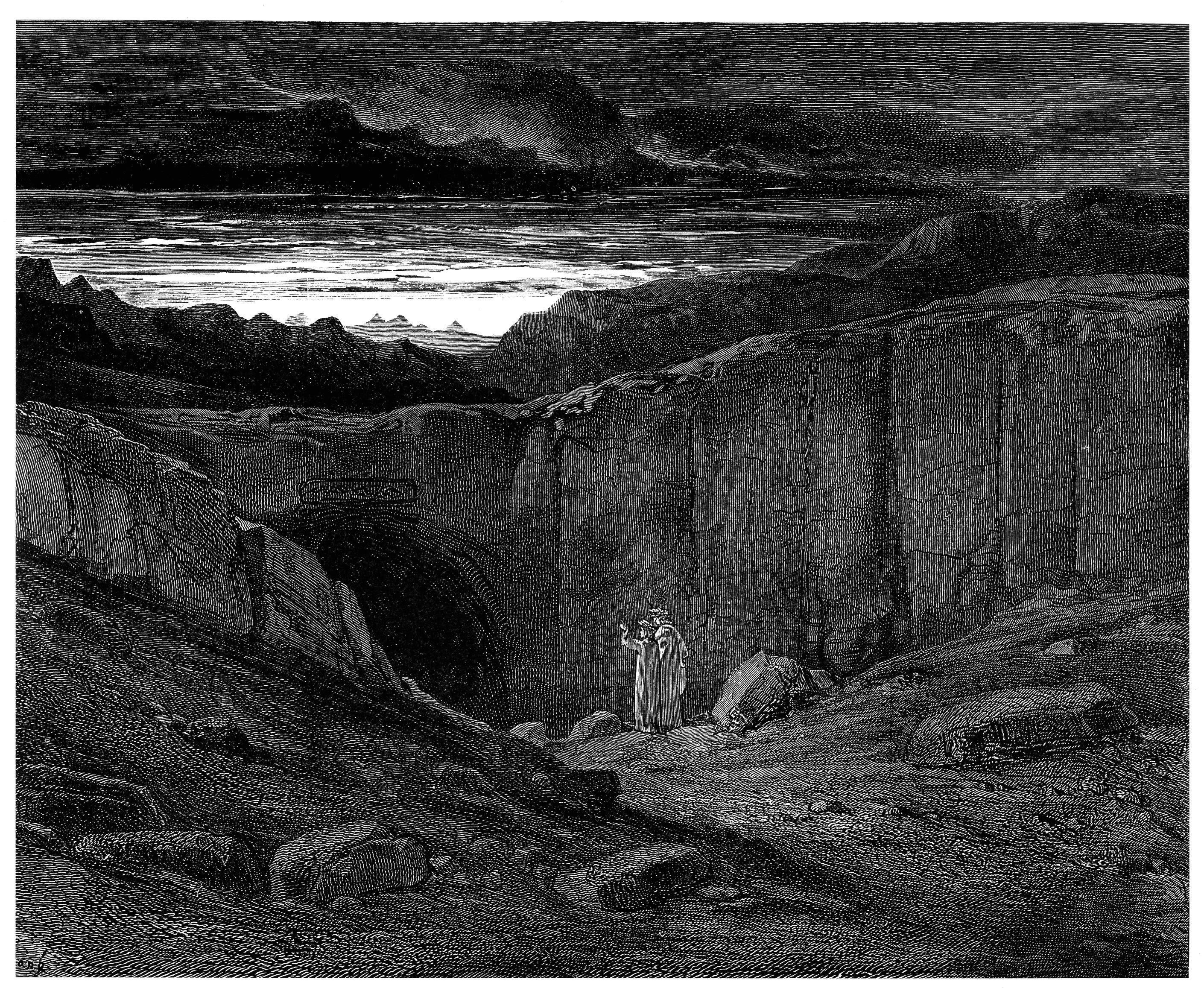
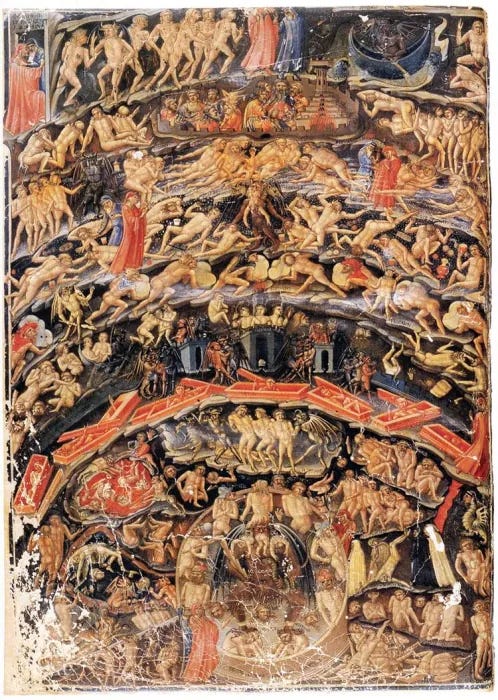
The block quote describing their entrance into the cavern comes verbatim from the historical Field-journal of Mason and Dixon which was reported to the Royal Society. The measurements of the entrance and the carvings upon the walls are recorded along with more symbolic descriptions: “Striking its Visitants with a strong and melancholy reflection: that such is the abodes of the Dead: thy inevitable doom, O stranger; soon to be numbered as one of them” (497). Are they passing through Dante’s entrance to hell? It certainly seems so. They are, one way or another, entering some realm of the dead — entering the realm of the Black Dog after just having witnessed the glow of Heaven.
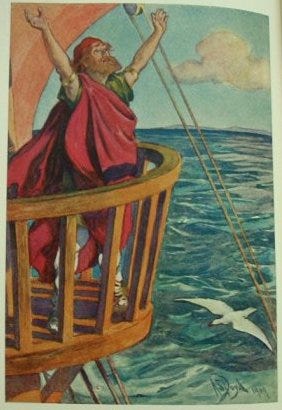
In this cavern, where white men occasionally come to worship their lord, the things that draws the surveyors’ eyes are quite different — Mason being drawn to the architecture while Dixon is drawn to the incomprehensible glyphs carved upon the walls. But Shockey provides some interesting insight — that the Natives did not enter this cavern given the association it had with evil spirits. So, who carved these glyphs? If it were not those who had lived here for centuries or millennia before the Europeans had arrived, then it seems only one answer is possible. Shockey’s sons posit that it was the supposed ‘Welsh Indians’ given the glyphic similarity to ‘Ogham’ — an “Early medieval alphabet. Connected to Irish and Welsh” (Biebel, 194). The Welsh Indians are a folktale of Europe, stating that a Welsh Prince (Madoc) sailed to America centuries before Columbus. But this is not a satisfying or likely answer, though it should be no surprise that the Europeans are attempting to place their roots in America far before they ever even knew of its existence. Instead, the most likely answer is something far more demonic and Satanic.
Mason, in this cavern, pictures it as a place he could furnish — somewhere that maintains its temperature quite nicely in both winter and summer, as if it almost had a central air conditioning unit. This idea of having perfected temperate conditions appealing to the surveyors foreshadows the coming complexes, neighborhoods, and cities filled with homes that can provide said comfort. A type of dwelling which disregards the methods that have been used for centuries to deal with heat and cold, in favor of something that one did not even have to think about to remain comfortable so they could glut on the produce of their empire. But Dixon sees it differently. He “is not quite so entertain’d. The Cave oppresses him. He […] is trying to imagine what form of Life might be calling something as spacious as this Home. And what might become of the Anglican Population out here, should the Dweller show up unexpectedly one Sunday, during the Service” (497). This imagined dweller is that Black Dog they heard barking, the Satan of Dante’s fiery Hell, the antithesis of the godly Alpenglow. It is the emissions of pulverized and ignited carbon which will come back to haunt the men who used it to make their lives more convenient and comfortable. And Mason, despite finding comfort within the cave, sees what it could mean for the coming world.
When they leave and journey back toward the line, Mason has another epiphany. He realizes that all of this is “Text,— and we are its readers, and its Pages are the Days turning. Unscrolling, as a Pilgrim’s Itinerary map in ancient Days” (497-498). He is realizing that which the reader is experiencing — that each of these scenes which he comes upon is a metaphor for what is occurring. That there is some lesson or piece of knowledge to be grasped about this new world and his place within it. And he sees the connection between “their return from the World beneath the World, to the Line beneath the Stars” (498). For this cavern is not separate from that which lies above. They are entirely one and the same. The metaphor of one leads to the reality of another — as above, so below. Or, given hell is making its way upward, as below, so above.
Up Next: Part 2, Chapter 52
Biebel, Brett. A Mason & Dixon Companion. The University of Georgia Press, 2024.
Two members of the survey party, Farlow and Boggs, are also mentioned here. Robert Boggs was mentioned upon the initial formation of the survey party (2.44, pg. 441) and Robert Farlow (yes, the same first name), was mentioned a couple of times — very briefly in the same chapter which Boggs was introduced (2.44, pg. 446) though not in any sense worth elaborating on, and again as the driver of the carriage (with Thomas Hickman) when heading back to Bryant’s farm to gather the Sector (the telescope) to bring back to map the area when the party was first approaching the Susquehanna River (2.47, pg. 460). Neither character is terribly important. I am just noting them as historically real people.
In a way, these remind me of Slothrop’s ‘Bizarre English Candy Drill’ (Gravity’s Rainbow, 1.15), in that (other than being a mild allegory for consumerism) it represents one last time in his/their life before stuff begins to really go off the rails.