
Mason & Dixon - Part 2 - Chapter 50: Invisible Empire, Alien World
Analysis of Mason & Dixon, Part 2 - Chapter 50: Chesapeake, The Rabbi of Prague, Back Inhabitant Taverns, the Golem, America Invisible, Timothy Tox

Still near the foothills of the Appalachians, Mason and Dixon realize the distance they have now come from eastern Pennsylvania. Out here, “Not all Roads lead to Philadelphia,” (484) for we are so far west that numerous transit hubs now feed into the American west. Therefore, Chesapeake, despite being two states south of here (in Virginia) will be as important to western Pennsylvanians when it comes to trade as Pennsylvania’s own capital. The expanse of America is so vast that states will often cease to have internal meaning. Rural areas of one state will interact less with their own capital than they will with whichever happens to be near or whichever happens to find its way via some obscure side road into their town. That is how America is being built — a vast series of winding roads leading into near emptiness, only to provide the ‘Back Inhabitants’ with just enough to survive. But we (as They would say) need this space; we need to claim as much square-mileage as possible despite the fact that each portion of this territory will have three or four major population hubs at best. Natives were being forced west, further west than the settlers have ever even seen, only so that this territory (which would go unused except for a few random side roads leading to minimally populated towns with taverns) would be privately owned.

Mason and Dixon, while heading further west, seek out taverns at many of these crossroads. Pre-Susquehanna, the taverns existed in multitudes, allowing for gluttonous indulgences to be enjoyed for days at a time. But the further west they travelled, especially once becoming trans-Susquehannan, taverns become few and far between, and those that do exist are not often taverns that one would want to spend the night in. One of these nights where nothing is to be found, a light from the sun seeps through the trees. Is it sunset, or some other celestial phenomenon? It lights the trees, the animals living in this forest, the interstitial spaces. It is a land that is largely untouched. To Mason, Dixon, and the survey party, it is quite boring, for with no taverns, what is one to do?! But this moment of purity — a revelation by the sun — shows them what the world once was before the white man found themselves here, desiring to infest every square mile with commerce and deadly sins. Before roads would lead here from bays that never would have known of this trans-Susquehannan parcel’s existence. This is unmolested land. Land where the sun acts as a god and where all which lived within it would be encompassed by its grace. However, once that light had gone, “not all will agree on what they have seen” (485). It is the refusal to admit complicity — the refusal to admit that we are stripping the world of its inherent goodness and imposing our own rule upon it.
As the two continue the trend of seeking taverns north and south of every crossroads, Dixon eventually comes across a tavern known as “The Rabbi of Prague, headquarters of a Kabbalistick Faith, in Correspondence with the Elect Cohens of Paris” (485).1 It is here that he learns of “a giant Golem, or Jewish Automaton” living in the nearby forests, which was “created by an Indian tribe widely suppos’d to be one of the famous Lost Tribes of Israel” (485). Just like Vaucanson’s Mechanical Duck, this Golem had the power of ‘Mobile Invisibility.’ As we saw in the previous chapter, Peter Redzinger’s learned ability to create smaller scale golems led to the commentary on a number of topics ranging from slavery and automation to technological progress and artificial intelligence (and even to materiality and spirituality). Here, we have one larger than the oldest trees in the forest which the Natives have supposedly let run wild.
As usual, we have to build this scene, so bear with the summarization.2 So far, we have Dixon at The Rabbi of Prague tavern, where he learns of a Native American tribe (who the bar patrons claim is a Lost Tribe of Israel) that crafted a massive Golem. Then, this bar is found to possess far more nefarious undertones when a woodsman who talks about the Golem is found to be “holding a tankard in one hand and a Lancaster County rifle in the other” (486) — the Lancaster Rifle, being seen as the emblem for The Dutch Rifle bar in Lancaster where the Paxton Boys committed their massacre (2.34) and also upon the mantle in Lord Lepton’s house where Mason and Dixon found J. Wade LeSpark (2.42). This rifle represents the Elite project’s Satanic drift toward violence and the profit that stems from violence via the sale of weapons to whoever is willing to buy them, no matter the side. The tavern is thus an extension of that same project — a genocidal project that has been now found so far out west that roads rarely even meet it.
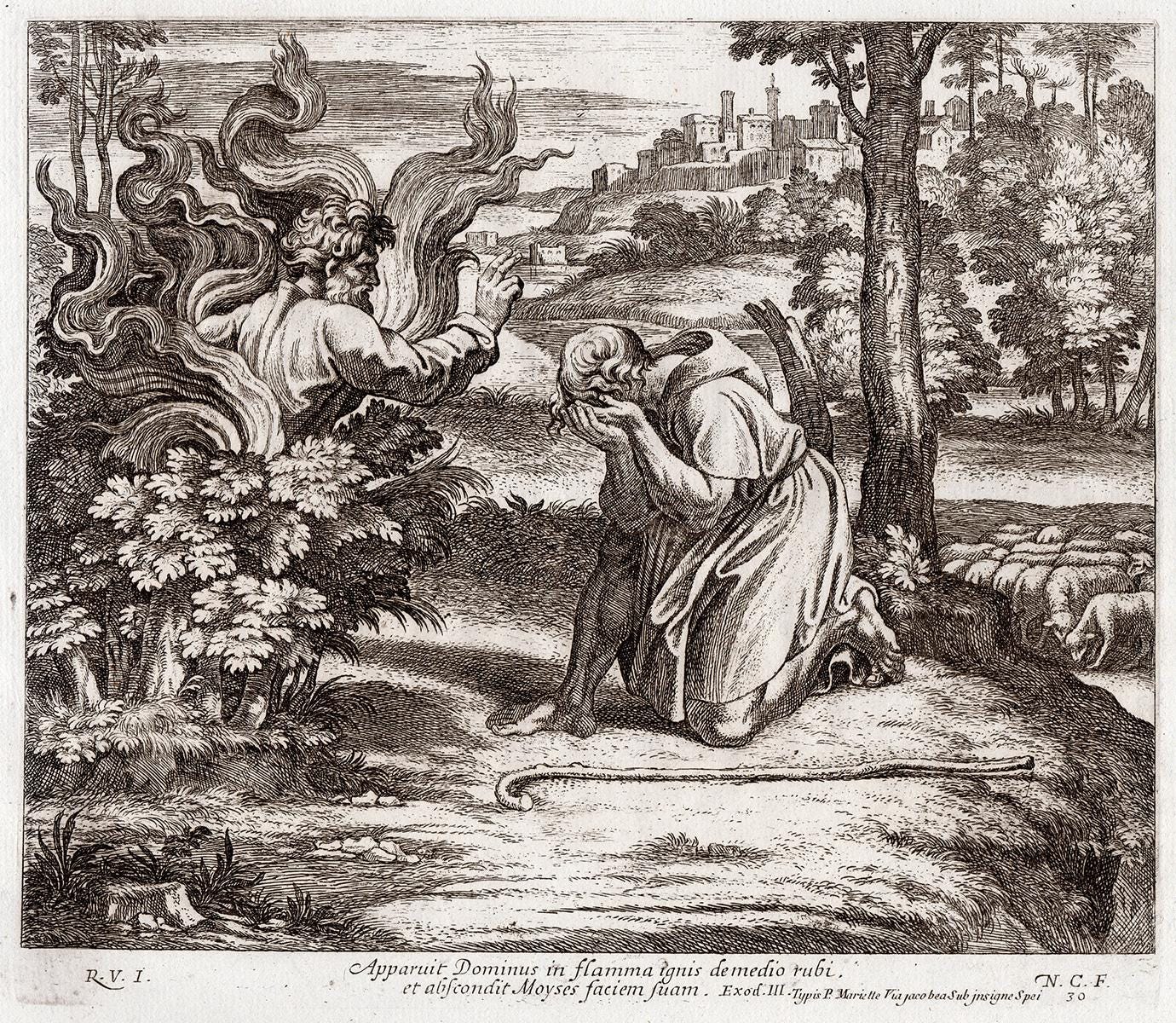
The words and claims of the patrons, therefore, cannot be trusted. And the next claim is that this Golem which the Native Americans have supposedly created has been known to be heard saying “I am that which I am” (486); this originates from the biblical Exodus where “God said unto Moses, I AM THAT I AM: and he said, Thus shalt thou say unto the children of Israel, I AM hath sent me unto you” (King James Version, Exodus 3:14).3 Moses was told this when God was sending him to gather these Lost Tribes of Israel to take them from the land which they currently were inhabiting (Egypt) to bring them back to their true home (Israel). But, in America, it is not the Golem or these supposed Natives who are claiming this — it is the white man bearing the Lancaster Rifle. It is the white man who is forcing these indigenous people further west while inferring that this supposed Lost Tribe is being led in that direction by a God of their own creation to return to the land that they are destined for. In a way, this is a form of spiritual or religious gaslighting, claiming that this American Indian Exodus is not being forced by the Europeans, but is an inevitable Biblical prophecy being fulfilled.
We then see the bar patrons begin to discuss both the Golem and America itself as one of these ‘invisible’ entities similar to the Mechanical Duck in that its naturalization has made it impossible to separately analyze from the world it has now become naturalized in. The Mechanical Duck is no longer a mere invention that we can look at for what it is since it now fulfills another purpose which it cannot escape. The Golem, too, is now a symbol which cannot be uncoupled from every other iteration of that which it symbolizes. So, since it now bears the mark of slavery and automation, how can we view it objectively as a mystical force that claims it is God — that claims it is the protector of this tribe? Spiritual symbols are becoming their own tangle of chains just as history is. And this Golem is invisible as was, apparently, America itself: “America, withal, for centuries had been kept hidden, as are certain Bodies of Knowledge. Only now and then were selected persons allow’d Glimpses of the New World” (487). America, therefore, is also naturalized. And it was naturalized before these settlers even started thinking of analyzing America for what it was or what it would become. One can only assume that because of this, the project did not merely exist because the American continent existed and ‘needed’ to be colonized but existed because the project was going to occur one way or another. America, unfortunately, gave the European colonizers the perfect opportunity and excuse to set the plan in motion. America’s invisibility is not the invisibility of the continent itself, but that of the plan being enacted on said continent.
Out here in the back country, America is not moving so quickly. And as we have seen with the Mechanical Duck, invisibility only occurs during its rapid movement. Therefore, these back country inhabitants, free from the chaos that is Philadelphia and similar cities, free from proximity to the Elites who are running this new country and thus free from much (not all) of the propaganda being spewed, have seen America become visible. The secrets of this country were “denied to all who came to America, for Wealth, for Refuge, for Adventure. This ‘New World’ was ever a secret Body of Knowledge,— meant to be studied with the same dedication as the Hebrew Kabbala would demand” (487). In other words, if America was sought in order to achieve the lie that was advertised, then the naturalization and invisibility would remain. The promise of Wealth, Refuge, and Adventure apply only to those who would have had these three things no matter the country, no matter the city, no matter anything. They who run this project know this, and thus America is visible to them because they see it as an extension of the project as opposed to the New World it is being marketed as. The city dwellers hope that this is the case but are blinded to reality at the moment. Out here in the backlands, America has slowed down just as the Duck will occasionally slow down to allow us to see it for what it is.4 And thus we have these men, evil or good (who is to say just yet?), who understand that this country is only for those “in the service of Greed, [and that] The coming Rebellion is theirs,— Franklin, and that Lot,— and Heaven help the rest of us, if they prevail” (488). The Revolution will separate America from Britain, which seems to be an overall good on most fronts. However, what end will this serve but to further line the pockets of the men who will lead this revolution? Slaves, Native Americans, serfs, and all the Preterite who exist as this world’s majority, will see no difference but that their taxes now take a different mail line.
One of the patrons has more graceful interpretations of the events, because he questions, “what of the way Mr. Franklin and his people stopp’d the Paxtonians before the City, as the Pope halted Attila before Rome” (488). This man, as we discover a bit later, is Timothy Tox, and his question was asked in a bit a jest given he answers his own question when he wonders about Franklin’s motives. Yes, stopping the Paxton Boys from entering his city is commendable to an extent. But is the simple act of turning literal serial murderers away worth calling home about? Tox asks, “What kind of Arrangements were made?” (488). Not only did the Paxton Boys’ actions merit more severe repercussions than being turned away from city lines, but it is likely that this was the extent of their ‘punishment’ since they were also a necessary part of the American project. Hence why Franklin would merely want to appear to dislike the Paxton Boys by sending them away when in reality he was possibly sending them off to continue the project in the backlands.
Tox continues stating that we cannot trust Franklin and his kind because “as long as it remains possible to keep us deluded that we are ‘free men,’ we back Inhabitants will feed the Metropolis, open new roads to it, fight on its behalf” (488). The Paxton Boys are some of these back inhabitants as well, and those like Franklin are trying to please both the evil and the naïve sort, when in reality, Franklin has no interest in this type of person other than what use they serve to the project. He could care less for these men’s health or happiness. As long as they trust in him enough to continue feeding the Metropolis and furthering the American Project’s goals, he will put on that kindly face and pretend that the revolution is for them as much as for his class of Elites.

However, this brings us back to the Native Americans. While Tox and the men at The Rabbi of Prague care for their own well-being, they still view the Natives as “Savages seeking to destroy them” (489) — thus, the Lancaster Rifle and the Golem leading the Natives further West to their supposed homeland. Tox states that “’twill be Deists and Illuminati, and Philosophers even stranger than that, pois’d upon the Mountaintops between, to observe and, who can say? direct the Engagement” (489). Tox knows that this war is to be fought — whether the one against the Natives or that against Britain in the coming Revolution — by the Preterite like him. The Elite will stand upon mountaintops commanding their troops, free from harm’s way, while the Preterite lose life and limb to protect themselves. Tox, therefore, and thus all the back inhabitants, are doing the exact same thing that Jefferson and Franklin were doing back east. We saw Jefferson discussing the coming Revolution where he and his class will separate themselves from Britain, but only for the betterment of themselves. Here, Tox is showing that while the men at the Rabbi of Prague are analyzing America for what it is, they are only doing so in the sense of how oppression will affect white Americans. But when it comes to the Natives, why would Tox or any of these men care? It does not serve their own ends in the same way that protecting Preterite lives does not serve Franklin and Co.’s ends. Or, as Tox puts it in verse:
In pale and Lanthorn’d reveries the Fair
Of Philadelphia lounge, discussing Hair,—
Whilst in the steep Shade of some Western Alp,
A Presbyterian’s fighting for his Scalp.(488)
Franklin and Jefferson, Deist and Illuminati — all they will do will be to sit up in their lounges wearing powdered wigs and getting drunk, while the Presbyterians (the Preterite) fight for their lives. No thought to those Natives being slaughtered or Africans being enslaved, of course.
Timothy Tox finishes with a song against kings. Much of Tox’s writing up to this point5 has been overly sentimental poetry about American idealism and what good America could bring. So now we see it all come full circle. His criticism only applies to those like him, ignoring the plight of the Natives or others he does not see himself connected to. In the same way, Cherrycoke believes he sees the Invisible America for what it is, but despite his mildly revolutionary intent in telling this story, he still helped form the Mason-Dixon Line and benefitted through his nearness to weapons dealers like the LeSparks. And in the same way, Mason and Dixon have glimpsed Invisible America in their numerous epiphanies, but they never stay back to analyze it enough to change their way — or, even worse, they just don’t care enough.
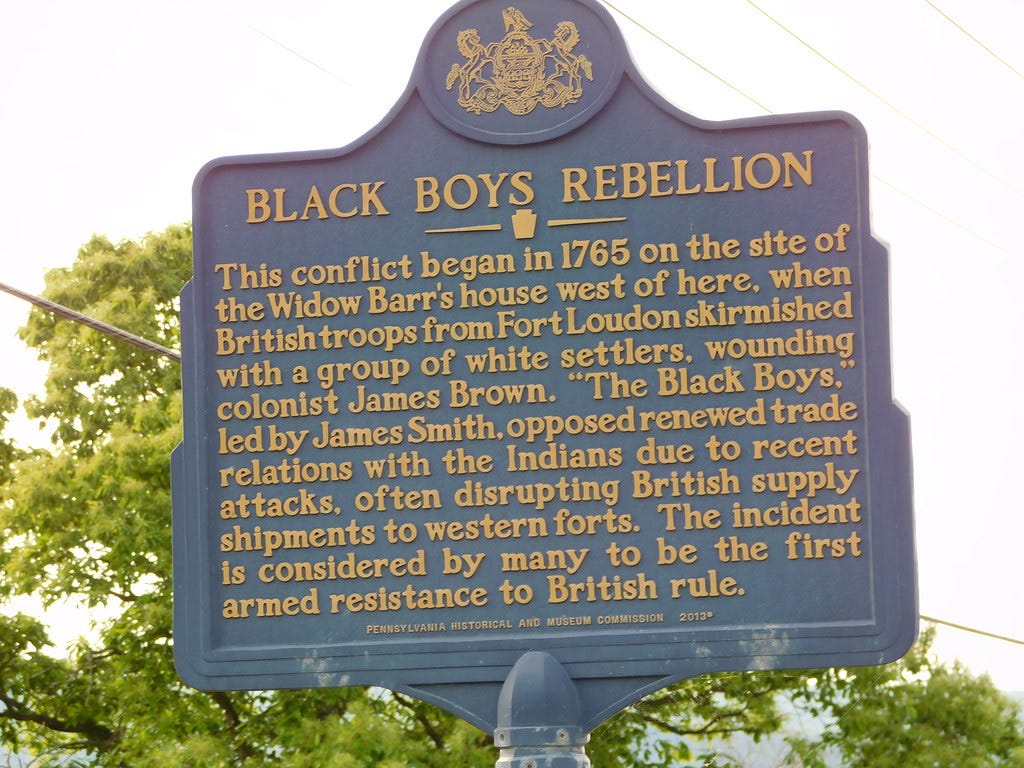
This final poem mentions ‘the Highland Forty-second,’ and soon after that, a group known as the ‘Black Boys’ and a place called ‘Fort Loudon’ are mentioned. Historically we known that in 1763, the Proclamation Line was formed which prohibited expansion west of the Appalachians. This line was devised following the French-Indian War (which included the Highland 42nd) in order to preserve Native American land. Obviously, as colonizers are wont to do, the Americans did not care about respecting these peoples’ lands and so continued to spread west. Because of this, certain Native American tribes began attacking and killing these settlers, leading to the formation of a militia known as the Black Boys (due to the use of black face paint) who fought against Native American attacks. This Proclamation Line also prohibited weapons and goods to be traded across these mountains. However, in March of 1765 (just a few months ago in the time of the story), a group of Pennsylvanians near the Appalachians stopped a caravan of goods carrying weapons and other items west, telling them that that the Proclamation Line forbade trade with the Natives and that they should reroute to Fort Loudon where they could store these goods until the Native Americans who had been attacking them signed a peace treaty. The caravan did not listen and continued on west, leading to the Black Boys attacking and destroying much of the cargo. The caravan, in turn, fled to Fort Loudon, claiming that these goods were from the King and were not, in fact, illegal trade (which was a lie). However, this led to the persecution by the Black Boys and the taking of some prisoners and many firearms. The leader of the Black Boys led those who remained to Fort Loudon to gain back their people and arms, leading to a multi-day fire fight which ended with the return of said weapons.
Thus, here, Dixon asks about the Golem, saying, “No Friend of the King, I collect[?]” and Tox responds, saying, “An American Golem. They thought the Black Boys who fought them at Fort Loudon were dangerous,— those were benevolent Elves in Comparison. Here as in Prague, the Golem takes a dim view of Oppression, and is ever available to exert itself to the Contrary” (490). And the men in the tavern who now hear the Golem walk by, revealed by Tox’s verse, raise their tankards at its passing.
How does all of this mess of metaphors tie together? Well, the Golem is a part of this Invisible Empire. Whether it was actually created by the Native Americans or not does not matter. If it was, then it would have been symbolic of their own form of progress, imbuing the material world with something spiritual. If it was not, then it would have been symbolic of an excuse for the Americans to spiritually justify this indigenous diaspora. But that’s the thing, even if it was the former, it is still being used for the latter. The project that is using this justification is shown to be carried out in two parallel methods: first, from the Elite to those below them, and second, by the Preterite to those ‘below’ them.6 The Elite have set plans in motion which they have said will benefit all — the coming Revolution. Those who live near them might very well believe them. But those living out here who don’t see an ounce of help coming from Philadelphia have come to understand that the Elite do not have their interests at heart. The Preterite, however, use this exact same tactic to justify their own evils. They attack the Elite (near and at Fort Loudon) who are transferring weapons to the Native Americans7 so that they (the white back-landers) can continue expanding without fear of retribution. But even that serves the same purpose that the Elite wish to fulfill.
In the end, these white back-landers will use obscure Kabbalistic means or otherwise to analyze and discover the plight that they are experiencing. They will learn of the class warfare that plagues their world while never caring about the most exploited. That is what America is built upon. Where segregation and police brutality will run rampant as time moves on. (But at least the Revolution will free us from foreign taxes!) Where we will come to understand that class is the thing which at the basest level separates us all but will refuse to admit that other forms of oppression have now naturalized themselves (invisibly or not) into the very roots of our nation. We will fight for our rights against our oppressors only so we can continue oppressing others so to make our own lives more comfortable. That is what America will grow into: a place where the colonizer will thrive because of this Invisible Empire while claiming that all else that lies outside their norm is an Alien World — a place to be forgotten or even destroyed so that the white man can claim their very own parcel of land.
Up Next: Part 2, Chapter 51
Yes, there is a Star Trek reference here. As Biebel states, “The famous Star Trek salute was modeled on a formal blessing sometimes given by Jewish priests” (Biebel, 191). However, I have not seen even a single episode (or movie) of Star Trek, so I will not be elaborating on the reason for this if there even is one.
Biebel, Brett. A Mason & Dixon Companion. The University of Georgia Press, 2024.
And this, honestly, is one of Pynchon’s most complex and layered ideas in the novel, so there is going to be some heavy hypothesizing.
The Bible: Authorized King James Version with Apocrypha, Oxford World’s Classics, 2008.
This parallels the idea of a sound-shadow that we have explored briefly in this novel and very often in Gravity’s Rainbow.
By that I mean the excerpts we have seen in previous chapters of the novel.
Just like Cornelius Vroom having power over his daughters leading them to desire power over the slaves.
It is people like J. Wade LeSpark who probably sold these weapons to both sides, profiting independent of who was buying the weapons.