
Mason & Dixon - Part 2 - Chapter 48: Eastern Promises
Analysis of Mason & Dixon, Part 2 - Chapter 48: Hipster Coffee Shops, the North Line, Fort Pitt, the Wedge Again, Darby and Cope in Disguise, Back West, a Package from Maskelyne

The month of April 1765 has gone by. As has nearly the entirety of May. For the past months, Mason and Dixon had been travelling with their survey party westward until they reached the Susquehanna River where they conducted their heavily estimated and error-prone measurements of said river (and, honestly, of quite a bit of the line itself). Now, near the end of May, they find themselves, due to the letter they received from back east, “turn[ing] eastward again, measuring offsets and marking them as they go” (466). Traveling back east brings them to their past but simultaneously relieves them from wrestling with what they are building, instead allowing them to see that which they have built. Mason and Dixon will now move against the path of the sun — ‘Against the Day.’1

The first thing which the two see upon this return journey east is the gentrification of something that once only existed to intoxicate and stimulate — coffee. The survey party’s process of brewing their pots of coffee involves incredibly specific temperatures, grind sizes, and methods to stir, steep, and filter. Of course, one must also drink the coffee within a specific range of time afterward lest the bitterness and burnt flavors take over. Once that happens — once that which grew out of American exceptionalism and westward expansion lost its supposed luxurious sheen — things would of course revert back into the Empire that they originally stemmed from, as we see Mason do when he swaps that now imperfect coffee with tea. The new Empire being built is really one and the same, just with evolved technologies. So, while its luster on the surface seems new and enticing — not to mention much less horrible than those evil British colonialists! — below the surface lies the face behind the mask.
Dixon doesn’t mind that burnt flavor, however. He seems content with the fact that he gets to experience these new fruits of their labor. Thus begins an argument between the two over the superiority of coffee versus tea, involving tradition, artistic methods of brewing, and diminishing returns. They are, inherently, arguing over the more superior form of commodity consumption — is it better to seek perfection now that it is attainable, to try something new and unseen, to maintain tradition?
Now, back at the eastern edge of Maryland, Mason and Dixon get to finishing up the Tangent Line. But why now? Why were they called all the way back here when they had already made it so far out west? Well, McClean states that “They all live upon this side of Susquehanna […] They don’t want you across it just yet” (467). And there are two reasons they do not want them to cross it, though both really end up being one and the same. The first is because given they (‘they’ being capital-T ‘They’) live here in the east, it is more vital to them that this land is all decided upon before any decisions are made about setting up out west. Here, for now, is where the money and property lie. Their thrones must be chiseled before the colonies arise. Secondly, the further west one goes, the more dangerous things become. While there is some care for Mason and Dixon’s lives, the real worry is that they would die before completing their project, making it necessary to attain new surveyors and astronomers to travel to America to complete the task. An odd dichotomy in this discussion exists where the further west the white man moves, the more danger he will experience. But the further west the indigenous people retreat, thus moving them further from home, the safer they inevitably become. They are told to leave — move west. Yet west can only go so far, and the white man will not stay east for long.
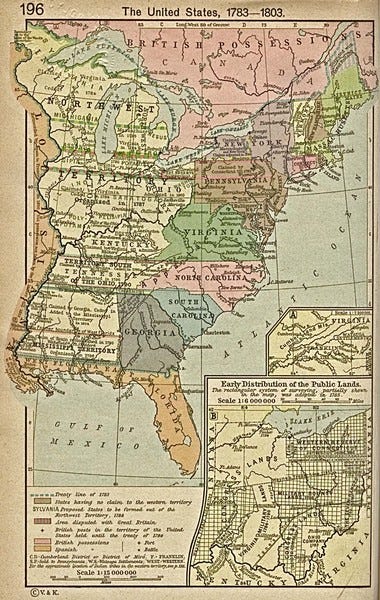
Mason, listening to how the dangers increase the further one travels west, asks about the potential distance they would be traveling: “Won’t that depend upon how far the Proprietors wish the Line to run?” (468). These Proprietors are, as Mason also adds, the Penns, for Maryland’s shared border with Pennsylvania would eventually end while the Pennsylvanian border would continue on, now sharing itself with Virginia “who bear[s] none of the Cost” (468).2 One might imagine here that Pynchon could write an entire other novel, plotting out the events that led to the formation of Virginia’s territory — or, if one were to look down, any of the events that led to the formation of the Carolinas, Georgia, or Florida. Or, if one were to look north... well, you get the point.
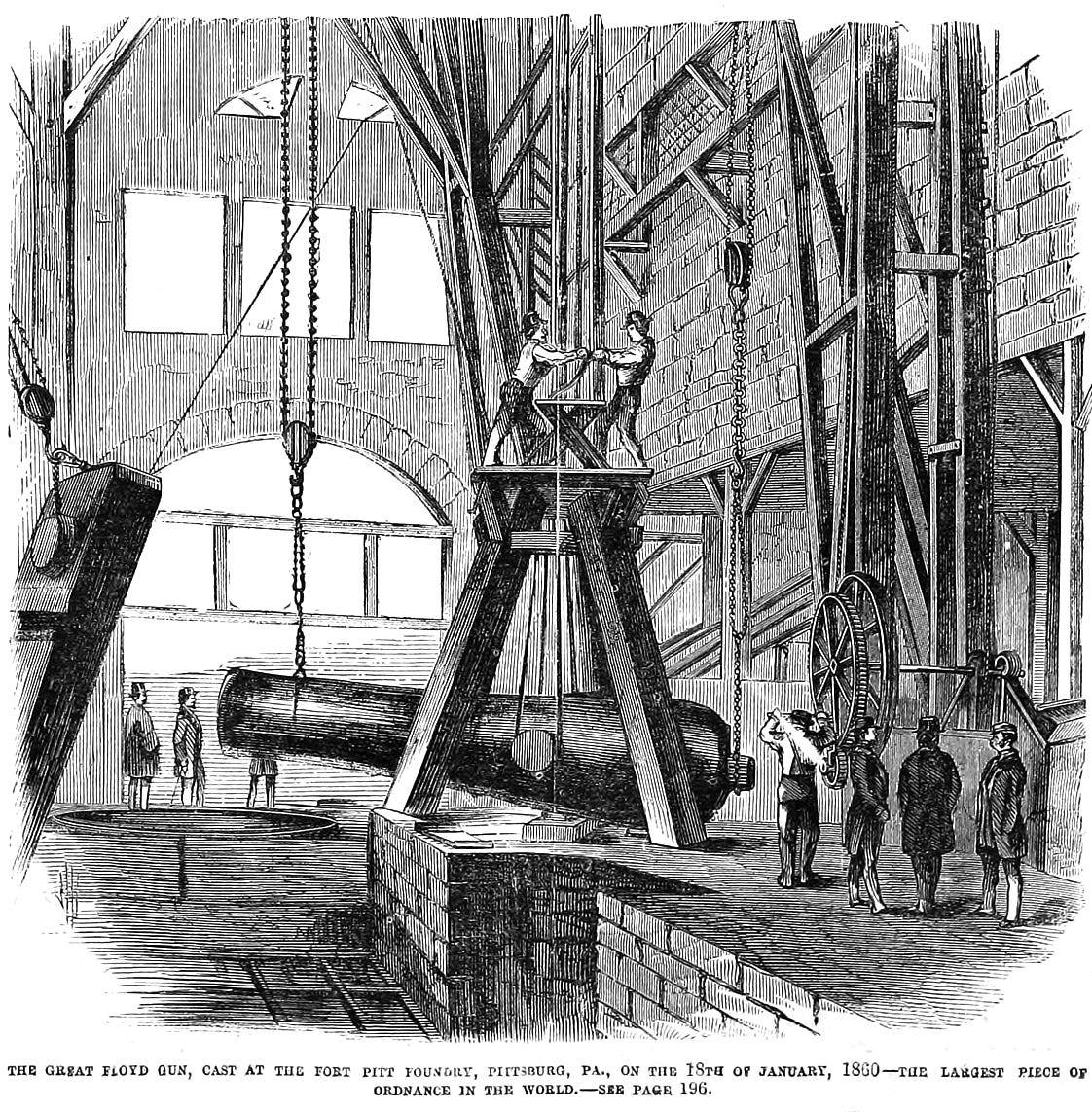
Pennsylvania, extending past where the Maryland border ends, has far grander purposes than merely attaining more land. There is a non-beneficent reason that they allowed Virginia to bear no cost of surveying despite there being about 65 miles of the east-west line (and eventually around 55 miles of the north-south line) that separates them from Pennsylvania. Pennsylvania may have proposed it as a gift; but they had ulterior motives. The reason being, if Pennsylvania could claim these extra miles, then their territory “will include Fort Pitt,” a Fort in modern day Pittsburgh which was notorious for its “Iron deposits, Coal as well, underground mountain-ranges of it” (468). Coal, as anyone who has read Gravity’s Rainbow should know, will be the starting point of the origin of the V-2 rocket and eventually the nuclear bomb. Obviously, there is much in between — its use as fuel that would pollute the skies, its ability to be traded readily and used even more so, its use to make steel and other commodities, all the while leaving its black traces across sky and land. But its end point is weaponry — the death dug up from the recesses of the Earth to produce new forms of death never before seen.3 Ironically enough, coal was not always viewed as a resource. Those who lived here a few hundred years ago — the Haudenosaunee (Iroquois) and other indigenous tribes — in what we now know as Pittsburgh, saw coal as something that the land provided, not something which could be extracted and sold or commodified. They saw it as a part of the natural earth itself. It was not until the colonizers came and saw it as this potential commodity that it became a resource — the same way they would do with South American fruit and various other natural ‘resources’ in other foreign nations.
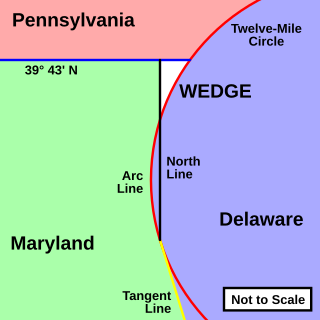
Upon mapping the rest of the tangent line, which would come to be known as the North Line, they realized that it would cross into the twelve-mile circle and eventually come out of the same circle before meeting the Pennsylvania border. This would create what was known as the Arc Line, which can be seen in the picture above. As Pynchon states, that curve would eventually be awarded to Delaware, “thus whittling a tiny Sliver from Maryland,” (468) a trend that seems to be a running joke as of now. With each passing day, the concept of a border becomes more and more comical, not even to mention that the border here was being drawn via candlelight, trumpet, and string.
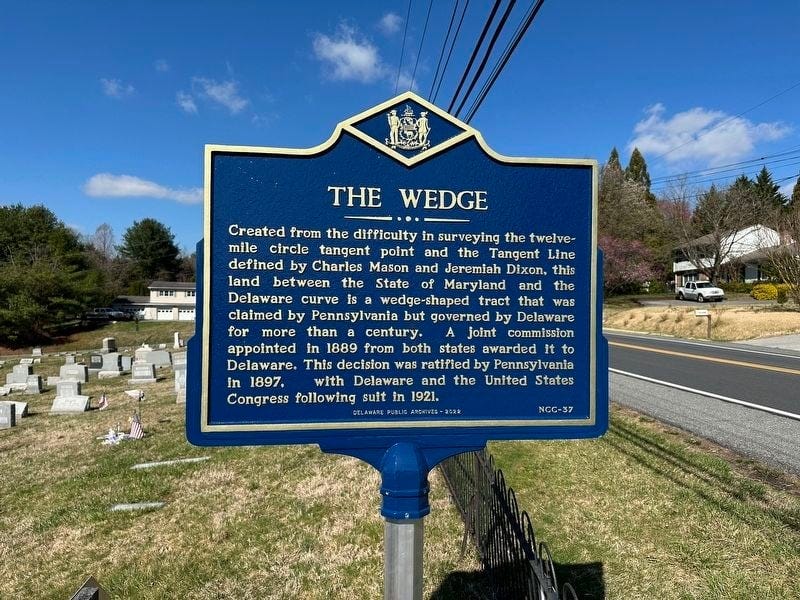
On June 6th, 1765, the North Line, and thus the entire Tangent Line, is completed. But alas, one small section, that known as The Wedge (also seen in the map of the area above), was still disputed territory. Over a hundred years later, it would finally be awarded to Delaware, once again, comically, stripping more potential territory away from Maryland. However, until then, a claimless tract of land bears no owner. We have heard of this Wedge before, though it was within the chapter that told the long story of the perpetual motion pocket watch (2.32) which was one that took place over a long period of time here in America.4 In the analysis of that chapter, it was stated that
This area is an enigma — a pre-Zone ‘Zone,’ if one were to think of Gravity’s Rainbow: “To be borne and rear’d in the Wedge is to occupy a singular location in an emerging moral Geometry” (2.32, pg. 323). […] It is a slate wiped clean of anything that existed before America’s colonization. The difference between this zone and Gravity’s Rainbow’s ‘Zone’ is that the former is a Zone of which various Elite entities are fighting for control over, while the latter is one in which the Elite have deemed to be Theirs independent of nationality and are thus using it to be the blank canvas on which the New World is to be built. Thus, the disparity between the Old and the New Zone, is the difference between Elite control in Mason and Dixon’s time and the time of Slothrop and his contemporaries. One could differentiate them by name by calling them the Old and New World versus the Old and New Zone. The former was to determine who the strongest of the Elite would be while the latter was the Elite realizing that without each other, independent of nationality, They would not exist for long, and so must band together to rewrite the world.
Therefore, taking the original thesis that Mason and Dixon’s trek back toward the east was to review that which would come out of what they have built, we can thus see that the next thing that they saw (after the first being the gentrification of specific commodities and the second being the colonization of the Earth’s resources) was the formation of said Zone — a canvas for the Elite to work their magic upon. It is here, in this proto-Zone, where “Anybody may be […], from clandestine lovers to smugglers of weapons, some hawking contraband,— buckles, lockets, tea, laces from France,— some marking off ‘Lots’ for use in some future piece of Land-Jobbery” (470). All things that the Elite love to indulge in. Those like J. Wade take massive advantage of these lawless lands where not only can weapons be traded and given out to those who would make the worst use of them via legal means, but even by clandestine means where nothing could be traced. So, too, do those like contraband salesmen do the same. And the word ‘Lots,’ one of the few times that Pynchon uses quotation marks around non-dialogue in this novel, clearly has the implication of the future, where Oedipa Maas will execute her ex-boyfriend Pierce Inverarity’s estate, and all the Lots of possessions that he had, including Lot 49. (If you have not read Pynchon’s The Crying of Lot 49, I will not give spoilers here, just a thematic overview of what this inclusion means). Thus, this Wedge is predictive of the accumulation of vast tracts of land used for purposes similar to Yoyodyne as a military industrial facility, or as real estate development such as what Pierce Inverarity did at Fangoso Lagoon.5 The land that belonged to those who lived here for thousands of years will be stolen, its coal and other resources extracted, only to build facilities of death and comfortable suburban life for those who could afford it.
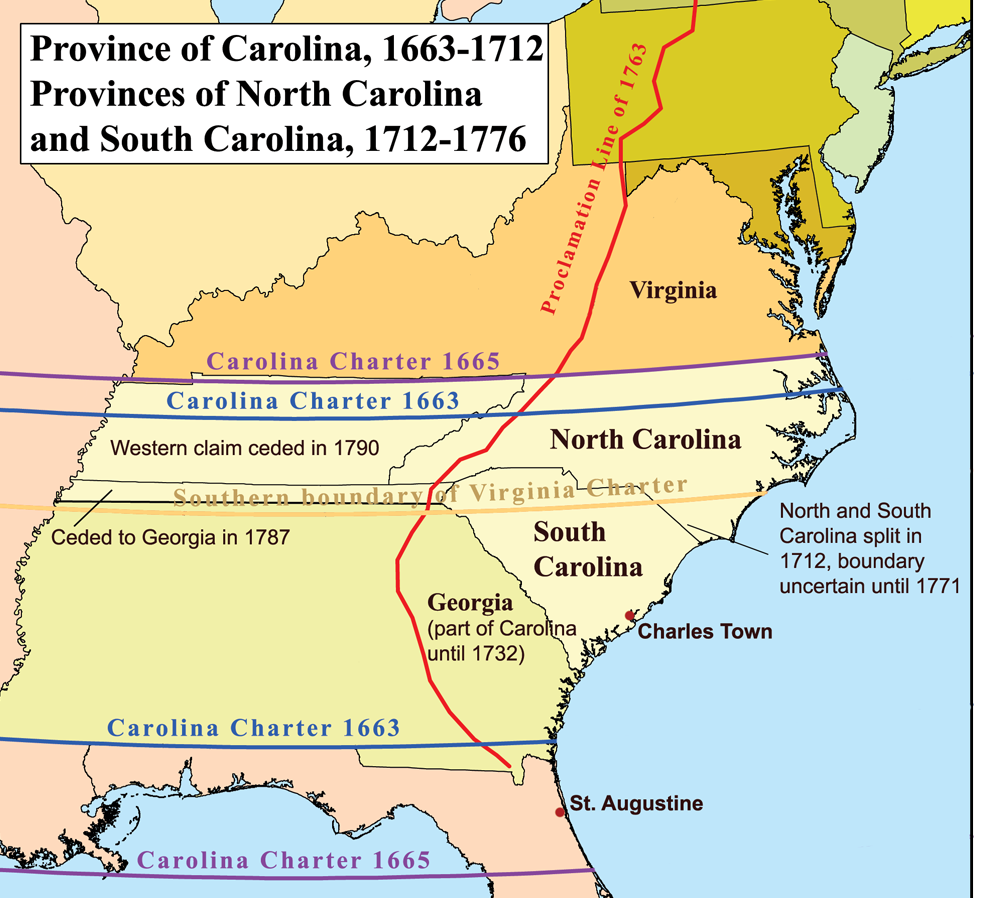
Now that the North Line has been completed, the survey party has been “order’d back to Susquehanna, this time to continue the West Line ‘as far as the Country is inhabited.’ Legally this suggests as far as the Proclamation Line, at the Crest of the Alleghenies” (470). This Proclamation Line is what Mason and Dixon discussed with George Washington on his estate, where Mason claimed that General Boquet’s determined line would not be allowed to be crossed since it would further interfere with indigenous peoples, but which Washington assured him that there was no chance anyone would be obeying that command. And here, given we have the above phrase, ‘legally this suggests,’ Mason may be getting the sense that he was wrong, and Washington was right, all along. (If you look at the map above, it is apparent that Pennsylvania’s southern border extended well past this Proclamation Line).
As they are about to begin traveling back west, Darby and Cope6 begin a game where they pretend to be Mason and Dixon. Men who come across them mistake them as Mason and Dixon and the two play along, sometimes one being one and sometimes that same one being the other. And even when not recognized, they still pretend to be who they are not. Biebel states that “Darby and Cope seem mischievous shadows of Mason and Dixon, as Mason and Dixon are shadows of the historical Mason and Dixon” (Biebel, 188).7 We are seeing representations of representations who are representations of representations — Darbys and Copes who represent Darby and Cope who are pretending to be Masons and Dixons who represent Mason and Dixon. All of this layering suggests two things — complicity and historiography. Both can be discussed at the same time. If the line will come to be known as the Mason-Dixon Line, then clearly the blame (and, in many cases, the glory) will be placed largely upon Mason and Dixon. However, why do they deserve more blame than any other of the party members? Does one’s social position add to or relieve one from some level of complicity? Does a well-recognized name do the same? Nearness to Royalty and level of schooling have certainly both given Mason and Dixon the advantage in terms of their status within this survey party, but as we see here, that does not change a thing. Less of those two things and they likely would have participated in the same sort of plot, just in a different position; and if Darby and Cope had been lucky enough to be born in slightly different circumstances, they may have actually taken up Mason and Dixon’s mantle.
Mason and Dixon argue on whether they should let these two chainbearers bear their more precious instruments, adding to the idea that Mason and Dixon believe their class puts them ahead of everyone else in terms of who deserves the honor of this line (though, they’d likely retract this if any complicity fell upon them). For a bit, Mason says he would be willing to let them bear these Instruments (the word ‘instrument’ through all of this being quite a phallic euphemism). That is, until Darby and Cope reveal that they’ve been screwing up a bit, marking lengths of chain a bit early or late at times so to ensure they don’t run out of stakes. As Dixon cries, “We may be miles off by now,” (473) it brings us back to the last time our surveyors were out west by the Susquehanna where various forms of mathematical corrections and allowances were made, rendering the formation of the line relatively arbitrary. And here, despite Darby claiming that “our Errors have ever exactly cancel’d out,” (473) that same theme is brought back. They’ve gone back east to see the fruits of their labor, only now to understand how much they have been recklessly and randomly building that world.
Now, the natural land (sans a visto of trees) would remain the same. Even if miles were lost, as Dixon feared, all that would be affected would be the length of lines on a map and the longitude which the rulers of certain states believed their lands to end or begin at. So, while nature may remain untouched (and that which was touched will find its way back to life), the political implications are still implicit in the formation of the line and any mistakes that may have been made along the way. And similarly, our ability to navigate this natural world would also be affected.
The end of June nears after a brief aside where Squire Haligast (the same man who has predicted a few things as of now) predicts that they will soon see a ‘Chinaman’ (which will happen quite soon).
On the twenty-second, they come back to Peach Bottom right on the banks of the Susquehanna River where the Pennsylvania and Maryland borders meet. It is here that “both Surveyors [understand] by now ’tis not only a River, being as well the Boundary to another Country” (474). They are becoming enlightened on the existence of these natural borders. No error that they make will change the real map that is the world — so what on Earth are they doing here?
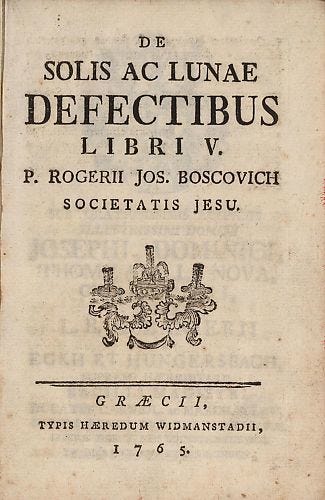
More corrections are made (shocker), and “Just before they cross Susquehanna, a Parcel arrives for them by way of a lather’d Youth riding Express upon a black Barb” (474). This youth drops off a package sent by Maskelyne which not only contains a series of ‘Jobations’ (scoldings), but also “Fr. Boscovich’s Book, De Solis et Lunæ Defectibus,8 publish’d at last” (474). First of all, the scoldings bring us back to Mason’s wrath over Maskelyne becoming the new Astronomer Royale (2.43), as we now see Maskelyne taking advantage of his position of power through these scoldings in order to make his power known. (One could imagine Mason here having another minor breakdown). The book, though, is the most important part of this package. In it contains a warning of the recent discovery of Earth’s mountains’ potential interference with Plumb-lines.
Thus, not only is the natural world mostly unaffected by the act of surveyorship, but it itself is finding ways to fight back. The power and ‘spirit’ that this world contains is something that can — using what seems like magic — render itself further impossible to truly comprehend. And the mountains which will come to test this hypothesis will eventually be the Alleghenies9 — the same ones written about in General Boquet’s Proclamation Line: a line that should not be crossed so to give the Native Americans their own parcel of land, yet which, of course, would be crossed as soon as it was reached. This ties the indigenous peoples to that same natural and spiritual magic that the world emits. They have lived with the earth here longer than the English had even lived on their own lands. And yet here the English are, attempting to fully comprehend this new world with a few tools and a hodgepodge of white men. As if, like Maskelyne and Mason did at Sandy Bay on Saint Helena, taking “symmetrickal readings on the opposite sides of the Crests” (475) would be enough to comprehend this world. As if they could understand in a few years what has always been.
Up Next: Part 2, Chapter 49
Side note: I started doing some scriptless ramblings on the early parts of Gravity’s Rainbow since I realize that the early posts were kind of short and not as good as later ones. If you’re a paid sub, check out the first one HERE. Going to be continuing these until I reach a post where I actually feel like I said everything I needed to say. That may be at the end of Part 1 or, who knows, might be until the end of the novel (though I doubt I have more to say about the last chapter than the 12k words I wrote on it, but we shall see). Free subscribers can unlock the post if you haven’t done so before, in case you want to check it out.
Obviously, ‘Against the Day’ is a reference to Thomas Pynchon’s next novel, both historically and chronologically. Against the Day, among many other things, observes the same idea of looking back at what America has been created by and what it led to. The only way to observe this is not to seek further progress or to follow those who attempt to exploit more of the world, but to take the view of the average folk, traveling against the day rather than westward with the sun, seeing what has been built up around them and how it now functions.
Today, Pennsylvania now shares this border with West Virginia. Virginia and West Virginia were a single state until breaking apart during the Civil War in 1863 due to the western Virginia counties being more opposed to the Confederacy.
Its end point really is the death of a majority of life on Earth due to climate change, but I’m just talking about what Pynchon has written right now.
While it was all told as one story in one chapter, it really took place over the course of Mason and Dixon’s entire stay in America.
As a comical side note, I think the fact that William Penn “leas’d Delaware from the Duke for a term of ten thousand years” (470) is absolutely hilarious.
Originally introduced in 2.44, William Darby and Jonathan Cope were historically accurate chainbearers who accompanied Mason and Dixon on their journey west.
Biebel, Brett. A Mason & Dixon Companion. The University of Georgia Press, 2024.
Translated: On the Sun, Moon, and Eclipses
It may also have been the volcano on Saint Helena that messed up Maskelyne’s Plumb-line measurements.
| “As if they could understand in a few years what has always been.”
This is the stuff. Nice work, Andrew!
The wedge and tangent really are fascinating. Hope to eventually check them and other line items out, google maps will have to do for now.
I completely missed the stuff about the Alleghany’s throwing the plumb line when actually measured vs assumptions of ease during planning, makes me think about the observer effect in physics. TRP delivers again.
Just passed 1/2 way point in against the day, cool it was mentioned today!
Take care, enjoying the revisit to GR and looking forward to your original efforts. Best of everything in that department!