
Mason & Dixon - Part 2 - Chapter 28.1: Conotocarious
Analysis of Mason & Dixon, Part 2 - Chapter 28.1: At Mount Vernon, George Washington, Real Estate, Gershom, Black Hebrew Israelites

The myth has him smiling with a cherrywood grin, and yet here he awaits, lips parted, revealing the uprooted teeth of his slaves.
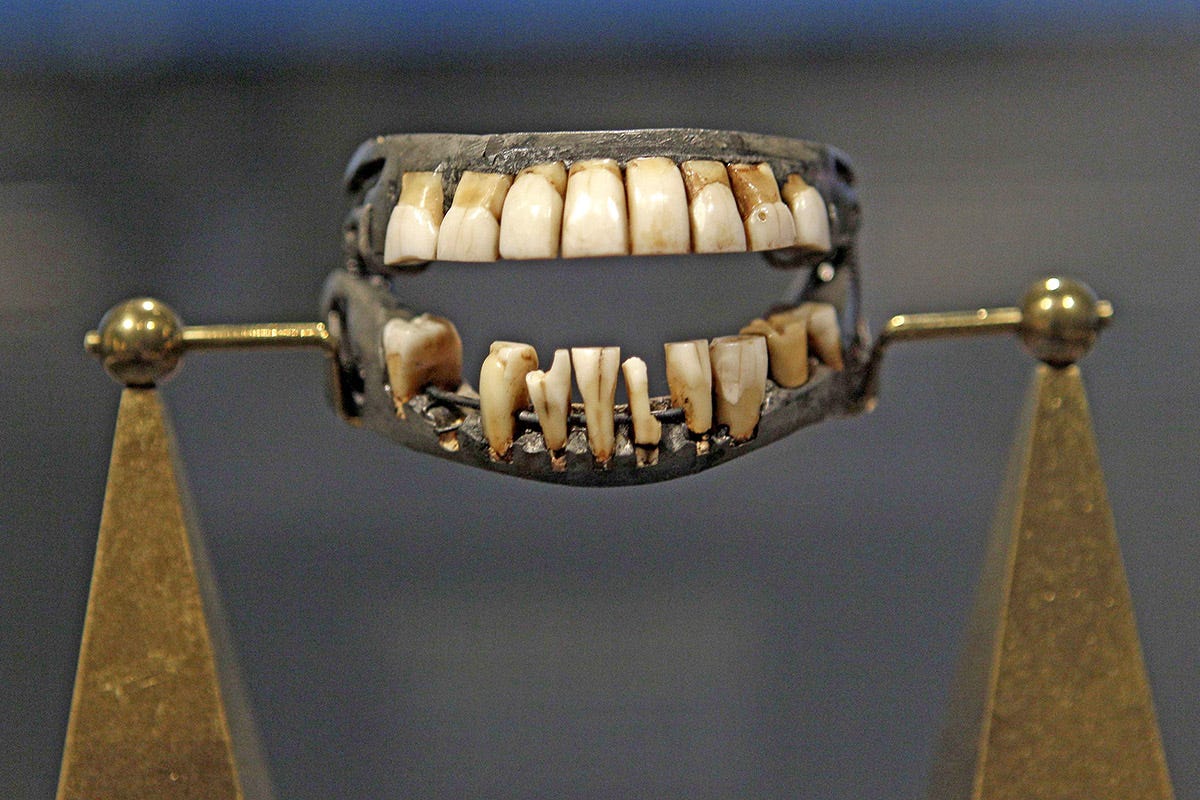
Mason and Dixon have arrived at George Washington’s estate in Mount Vernon, Virginia, just across the border from Maryland and about fifteen miles south of Washington D.C. It is here that we meet a new, interesting class of people, titled in our epigraph as the Virginians, but which will soon become an American and global class unto itself. They are those who “cannot distinguish Fancy from the substantial World, and their Folly absorbs them into itself. They gaily dance the steps their African Slaves teach them, whilst pretending to an aristocracy they seem only to’ve heard rumors of” (275). This, here, is the self-aware Lord; he who understood the fall of feudalism knows that the elegant and luxurious appearance of a King would render the peasantry (the Preterite) distrustful, and even wholly malicious, toward these new capitalist Lords. This is why gilded mansions and castles must be done away with — thrones hidden behind mere metaphors. And more than that, the Lords will adopt the air of being “the incompetent Fool,” (275) acting at times like a bumbling idiot who has no clue what they’re doing and who is at the same level as those below them, perhaps having only come into their wealth and power by happenstance. They will adopt the “[dance] steps their African Slaves teach them” (275) instead of the stuffy ballroom jigs from long ago, will drink cheap ale instead of the finest Cognac, will tell brash, crude jokes that the Elites of times past would have scoffed at, and will feign ignorance of any class plights rather than admitting pride in creating them. Think of Warren Buffet driving his ages-old Honda, Elon Musk wearing ugly graphic tees and joking about outdated memes, Jeff Bezos walking through Amazon factories in average clothes chatting casually with his employees, any of our current or past presidents code-switching and feigning interest in what their constituents have to say, or wealthy Hollywood Elites who dress like the common man and stand on street corners with cigarettes looking dazed and out of it. Now imagine them with their own Elite class; these illusions will not last long when decisions must be made or when no one potentially observant enough is around to call their bluff.
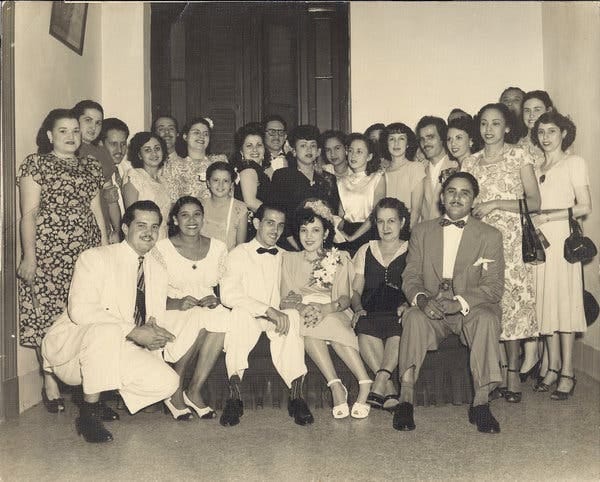
To the Elite, it’s even better when the They are able to relate to Their ‘underlings’ on a more personable and individual level as opposed to just pretending to be of the same general class. Hence Washington’s excitement when he hears Dixon’s Geordie accent, thus placing their origins from the same locale. Again, think of numerous politicians relating their origins from the Bronx or from an urban part of Chicago, or how their families immigrated from Latin America or Cuba. What most fail to state is that their or their families’ origins may have been in regions typically viewed as underprivileged, but that they owned brownstones, plantations, factories, or went to private schools in the better parts of those cities. But when you hear that this powerful individual started at the same level as you, it draws you to them in a way you can’t describe. It’s like hearing your native language in a foreign land.
Now, however, Washington being in a new land, he is also adopting a new form of speech. Many men in Pennsylvania tell him that he “talk[s] like an African,” having been surrounded by their ‘Tithables’ for so long that he is now “sliding into their speech” (276) — a form of ingenuine code switching.
The group, drinking a punch made by Gershom1 — Washington’s so-called ‘Man’ who is really a house slave — move out onto the porch to discuss real estate. Washington knows that Mason and Dixon are here in America to map a line that would solve the Maryland and Pennsylvania property dispute, but that doesn’t mean that other ‘problems’ couldn’t be solved alongside that original. In reality, the whole reason this line is going to be so important is for those other reasons, not because of the original reason itself. So, Washington, discusses how “the West Line must contribute North and South Boundaries to Pieces innumerable” (276); or, in other words, not only will this boundary separate the states, but will separate an innumerable number of townships, cities, and, as we will see in a future chapter, literal homes. If someone with money and power could get in on this mapping, then there could potentially be quite a bit of profit in the real estate market for them: which property will lie on this side versus that? could we move the line a few hundredths of a degree north in this spot? if you’ve the time, can we ensure that this parcel of land stays below this price, or is in the state with lower property tax? And being able to ensure certain locations on this path were demarcated as one territory instead of another could serve a whole plethora of angles beneficial to the market and to those who wish to control (or, already control) the market — tax rates in one state versus another, building code variances, labor laws, gerrymandering, and so on. For instance, while Pynchon was writing this in the 1990s, Starbucks had just gone public and had started its boom, relating to Washington’s comment of “Coffee-Houses [being] in a frenzy of map-sketching and bargaining” (276). These massive corporations would love to be in politicians’ pockets since these politicians have the sway to make things just a bit easier for them. And the politicians, just like in the time of Mason and Dixon, had the power to pay certain individuals to fudge the lines to their liking.
Mason, attempting to subdue Washington’s desire for this mapping to serve him, iterates that “General Boquet’s Proclamation”2 states that “no new Settlement[s] west of the Allegheny Ridge-Line” (277) will be founded by colonizers. As Washington is well aware, there is not a chance that this proclamation will be obeyed. It seems beneficial in the short run, but once the possibilities are realized, the enforcement of this proclamation will be readily ignored or entirely forgotten in the same way that laws against monopolies would be formed and eventually set aside or rewritten.3
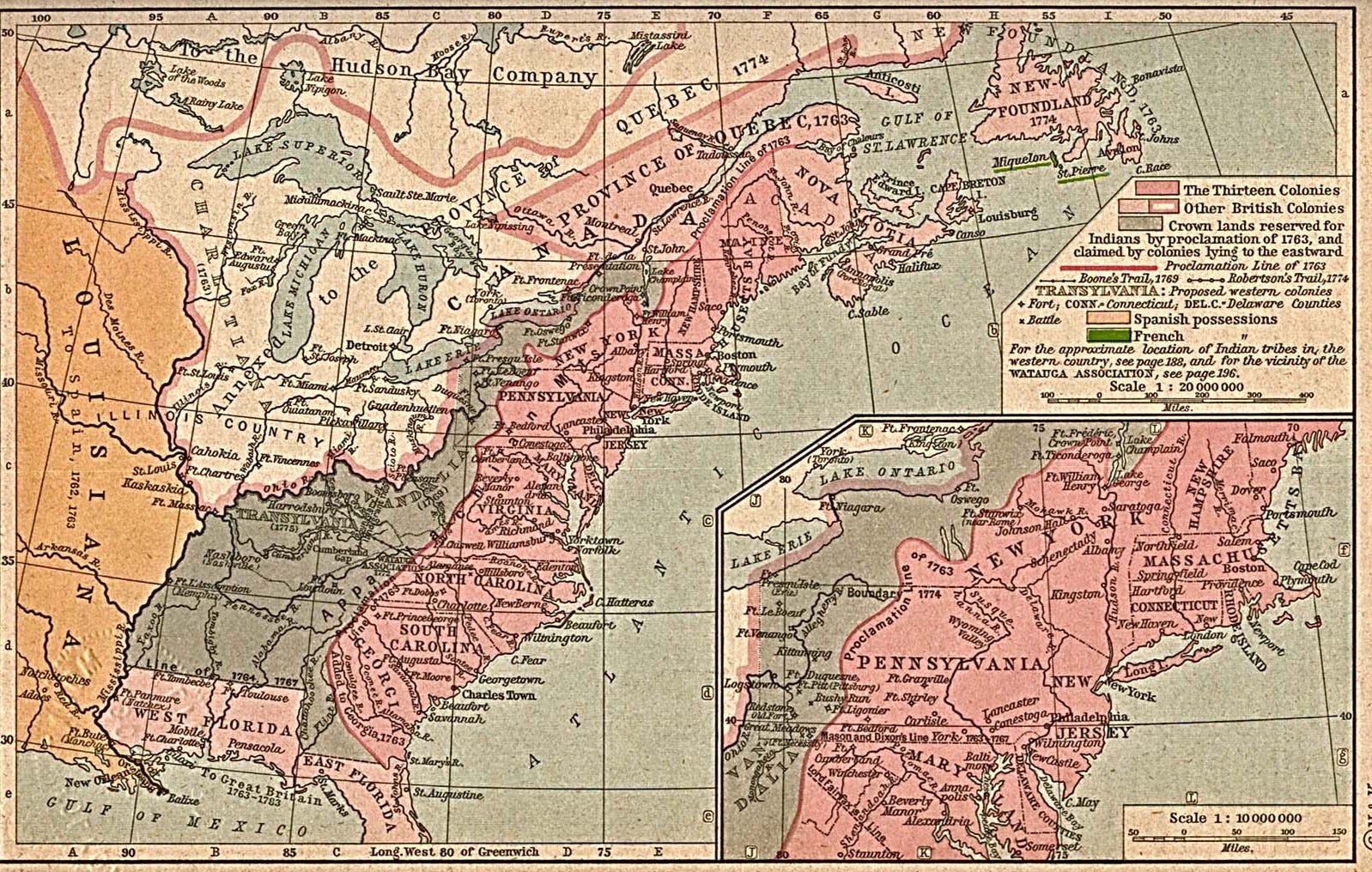
Dixon, still somewhat ignorant (and this time not willfully so), wonders what reason this proclamation would be in place if not to protect the Native Americans, stating, “Why else refrain from expanding West […] but out of a regard for the Humanity of those whose Homes they invade?” (277). Well, contrary to many beliefs, the line was not exactly set to protect the Native American land from further settlement, but to allow for English colonizers to avoid conflict with other European colonizers and allow future westward expansion to occur in a more organized fashion. Because recall, there is not only dispute between English colonizers on which territory belongs to whom (Maryland versus Pennsylvania territory, for one), but also between nations as in the Florida/Georgia dispute between the Spanish and British which was the major tension leading to The War of Jenkins’ Ear (largely discussed in 1.17). If such costly, chaotic, and deadly events could be prevented, then the entire process of stripping this nation from its original inhabitants could be done in a far safer and more cost-effective manner.
Dixon inquires what the smell is on the horizon, which reveals itself to be marijuana. Washington, stating that it is a new crop currently being grown and tested for its profitability, calls his slave, Gershom, to get some of the ‘Hemp’ and more punch: “Gershom! Where be you at, my man!” (278). His summons not only displays the power dynamic between the two, but continues in Washington’s characterization as a self-proclaimed benevolent slave owner — one who may possess slaves, but who treats them like family and gets along with them just fine. His switch over to a Black dialect completely subverts his natural speech pattern. Earlier, it was noted that the Virginian accent definitely began to merge with African American dialect, but this switch was a whole different thing. It was a blatant simultaneous mocking and attempt to show some sort of comradeliness and similarity between master and slave — or, as is often done in our modern world, to demean and belittle those who are being mocked while keeping that belittling under the guise of a light-hearted joke or an attempt to bridge the gap and ease the tension between these two peoples whose history was that of conflict and bloodshed.
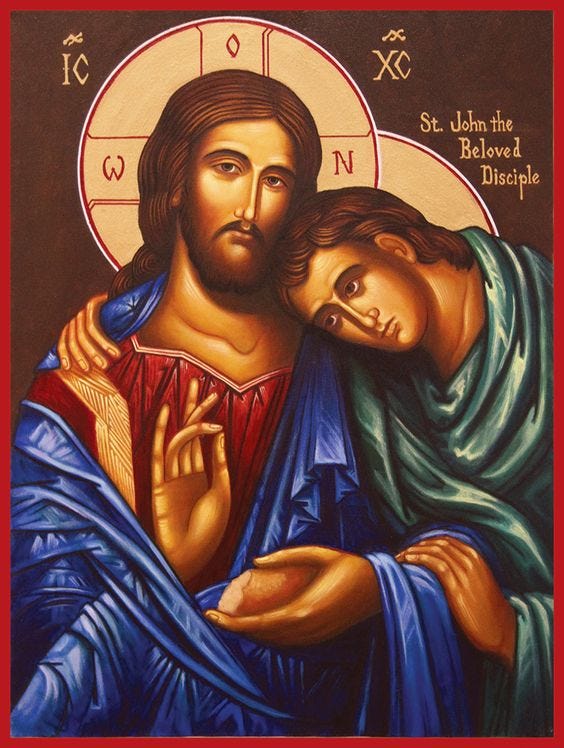
But immediately, it becomes apparent that Washington’s use of dialect is not (not that any of us, hopefully, believed it to be) out of any benevolent intent. For, as Gershom leaves to fetch what he was asked, Washington quotes the Bible: “Truly, Gentlemen, ‘an Israelite in whom there is no guile’” (278). As Biebel states, in John 1:47, “Jesus characterizes an approaching follower as being simple, or pure of heart” (Biebel, 128) by using that same quote. While Jesus intended this to be complimentary on the follower’s ethical and dependable nature, not filled with the desire to subvert or ‘fuck over’ for lack of a better term, Washington is clearly using it to mean mentally ‘simple,’ once again dehumanizing the African and African American people, rendering the common view of them to be naturally subservient and small-minded — a people who are likely quite okay with just following orders.
And Dixon, despite all of his faults, his failures to act when needed, and his willful ignorance on certain topics, is at least willing to call out men when the conditions are safer and friendlier as they now are. He recalls that this Biblical quotation was often used in different contexts, so he is shocked that Washington, here in the supposedly free world of America, would so ignorantly use it to classify a whole people as simple-minded. One could only hope that Dixon’s willingness to call out such blatant bigotry would arise in situations that weren’t only conducive to good humor and jollity; well, as with Austra, he hadn’t done it before, but we shall see if that is true in his future.4
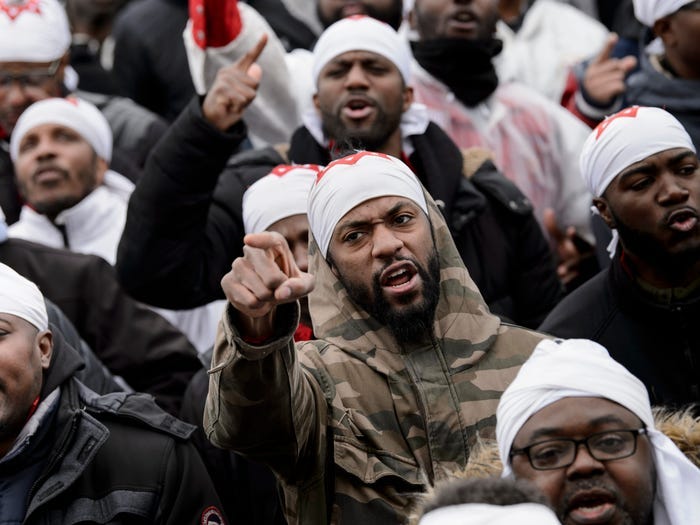
When Gershom returns, he states that the men should not take Washington’s comment on him being a guileless Israelite to heart, for he really is Jewish as well, though of a very specific sect. The first thing that likely comes to mind is the Black Hebrew Israelites, an incredibly controversial group, sometimes labeled as a religion and very often as a cult. Their major belief is that African Americans were the descendants of the diasporic Jews from Israel. Whether or not this bears truth, the statement and belief itself is a removal of the African American population from the purely Christian tradition, bringing them back to an Abrahamic legend which centers them as the first descendants of the biblical patriarchs. In the modern day, the Black Hebrew Israelites are purely deemed to be a hate group. And often they are. However, almost every major and minor religion has sects which hold some of the most extreme beliefs and thus are the ones who are represented by the media. Christians, being the majority in power, are the only ones who are often not included in this media chastisement — that is, unless you are in one of those, what they would call, ‘insane’ branches like the Westboro Baptist Church. Therefore, the African American people’s attempt at elevating their importance above the lowly position which they have been burdened with by the white man is subsequently stripped down to nothing and deemed to be a black supremacist cult. In the same way, many other groups founded by black Americans will be labeled as extremist — see: the Black Panther Party.5
So why is Gershom calling this religious sect to mind?
Possibly, he is, in his own silent and unassuming way, attempting to elevate himself above his ‘masters’ in the best way he can. It may not be a tangible or material elevation, but one of the spirit. Like Mason’s search for the spiritual realm after being entirely unhappy with only possessing and understanding the material, Gershom too has found himself only able to continue on if he leaves behind that which he cannot possess (the material) and grabs onto that which he can (the spiritual). He may not be the master of this house in what we would consider reality, but if he places himself at the pinnacle of the Abrahamic family tree, then at least he knows he is above them in Godliness.
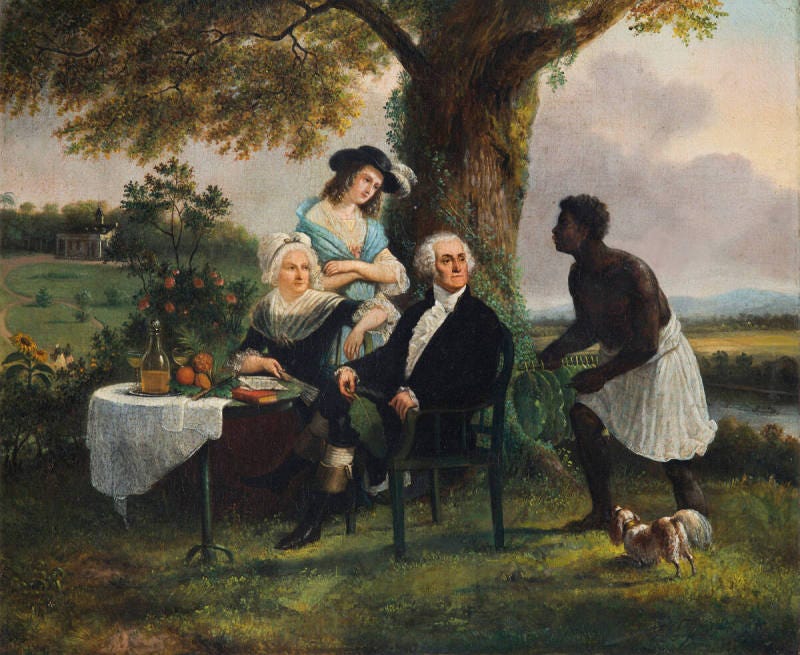
The white man, however, is unable to accept even this intangible elevation, whether they know it or not. They subject him to cooking Jewish meals for them to gluttonously consume; they question his obedience to the specific rules of Judaism when he states that he consumes pork and is “concern’d scarce at all with Dietary Rules” (279). They do not look at themselves as self-described Christians breaking every Biblical law they could likely name and thus question their own adherence to their stated religion. But Gershom (and everything he parallels), well: he’s a bit odd, simple, maybe a touch extreme, and he’s not really a part of the true branch of that religion anyway. Or so they’d say.
Up Next: Part 2, Chapter 28.2 (finishing up the rest of Chapter 28)
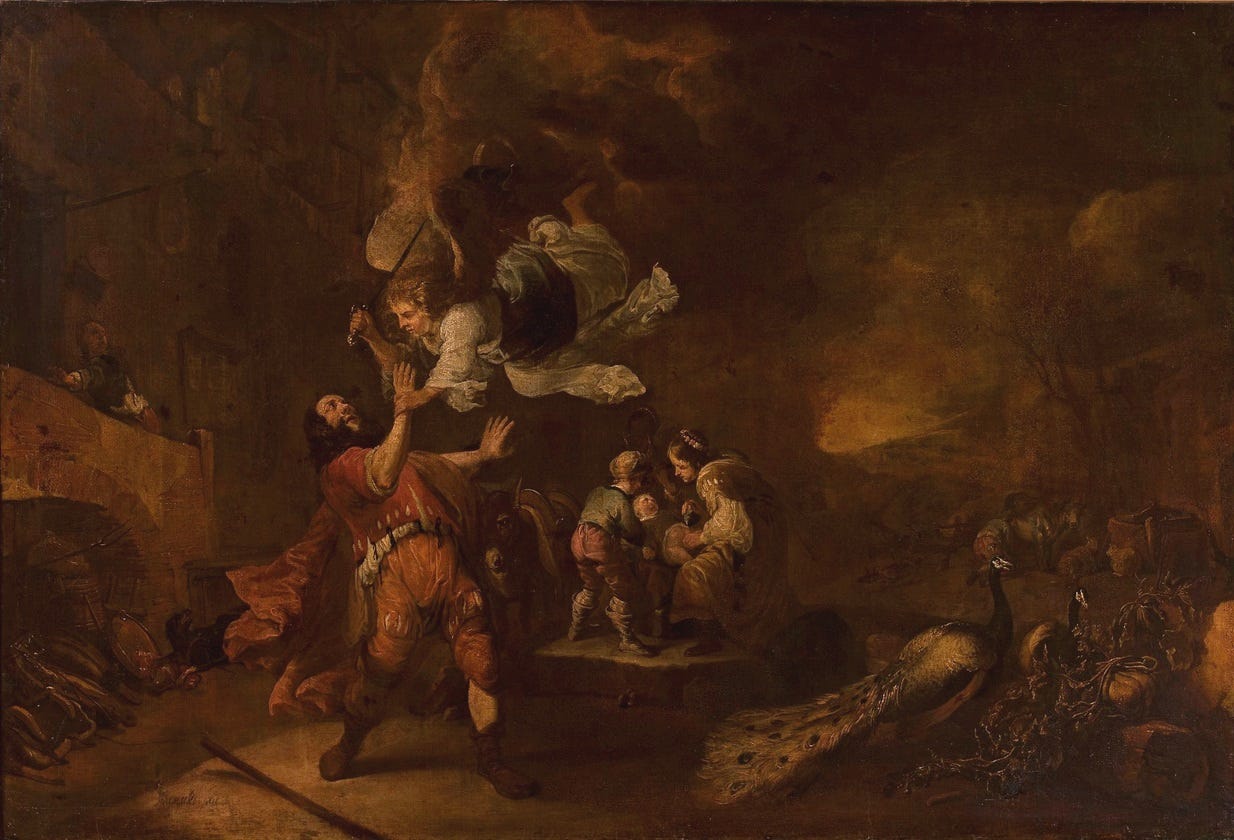
Gershom’s name is certainly interesting. He is an African house slave whose name is a Biblical reference. As Biebel states, “Gershom (or Gershon) was the first son of Moses by Zipporah. After the family was attacked (by God or an angel) at an encampment, Gershom was circumcised by his mother” (Biebel 126). Personally, I won’t even begin to attempt an analysis of his name, because the story of Gershom has been of massive controversy and debate for centuries. It is one of the most difficult portions of Exodus due to translation. If you’re interested why, I would recommend going to check out the Wikipedia article on ‘Zipporah at the inn.’ It’s a fascinating read.
Biebel, Brett. A Mason & Dixon Companion. The University of Georgia Press, 2024.
Formally known as the Royal Proclamation of 1763.
This idea of monopolies was largely discussed in 1.22.
This anecdote reminds me of Oedipa Maas in The Crying of Lot 49, faced with the discomfort of interacting with an egregiously racist gun store owner spewing slurs. As she leaves the shop, she is not only horrified with the normalized bigotry on display, but with her inability to say or do a single thing about it (The Crying of Lot 49, Chapter 6). One would assume that Dixon, often failing to act in situations such as seeing Austra being led like an animal at The World’s End brothel (1.14), was faced with a similar inner turmoil. Instances like this show that he is ready and willing to act if the situation is right, but that he often holds back to maintain his own comfort and safety in the presence of men such as himself.
If you want a lot more of my thoughts on the Black Panther Party and how their attempt (and short-term success) in elevating certain communities out of hunger and poverty was only met with violence, you’d have to read many of my Gravity’s Rainbow essays given Schwarzkommando were a massive parallel with the Black Panthers (Gravity’s Rainbow 3.3, 4.4, and 4.10 being the most heavy on that specific discussion, but many other chapters including it as well). And again, this is not to say that the Black Hebrew Israelites are any bit as revolutionary as the Black Panthers were (or even revolutionary at all for that matter), it is just a comparison to show how so often Black social movements or movements of any kind will be stopped in their tracks or reduced to something lesser than their white counterparts.
Similarly, I am not well read on the Black Hebrew Israelites in general. Whether you believe they are actually an extremist cult, or you believe they are completely misrepresented in the media is exactly the point. You don’t have to hate or love them, or even know much about them, to see why their inclusion here is important. The inclusion means the same thing either way. White religious groups who have similarly cultish and hate-filled members do not receive the same blanket statement critique as these black ones do. This is not an excuse for much of the extreme views of the Black Hebrew Israelites, it is a critique on our nation’s double standard.