
Mason & Dixon - Part 2 - Chapter 73: Happy Endings
Analysis of Mason & Dixon, Part 2 - Chapter 73: The Soap Opera, Illinois, the Mississippi River, Uranus, the Rocky Mountains, Back East Yet Again, St. Brendan's Isle, a Happy Ending

Mason and Dixon left America for good on September 11, 1768, leaving a number of possibilities behind. Still in Part 2, America, we have one last chance to look at the possible and certain futures inherent in this country. So comes the telling of the possibilities that were left behind, told via an “Opera in the Italian Style” (706) — or, put more in colloquial terms, a TV soap opera. This is not some observation on ‘what could have been,’ but rather an observation how stories and tales will be told in the future, and what it means for us to read about them today.
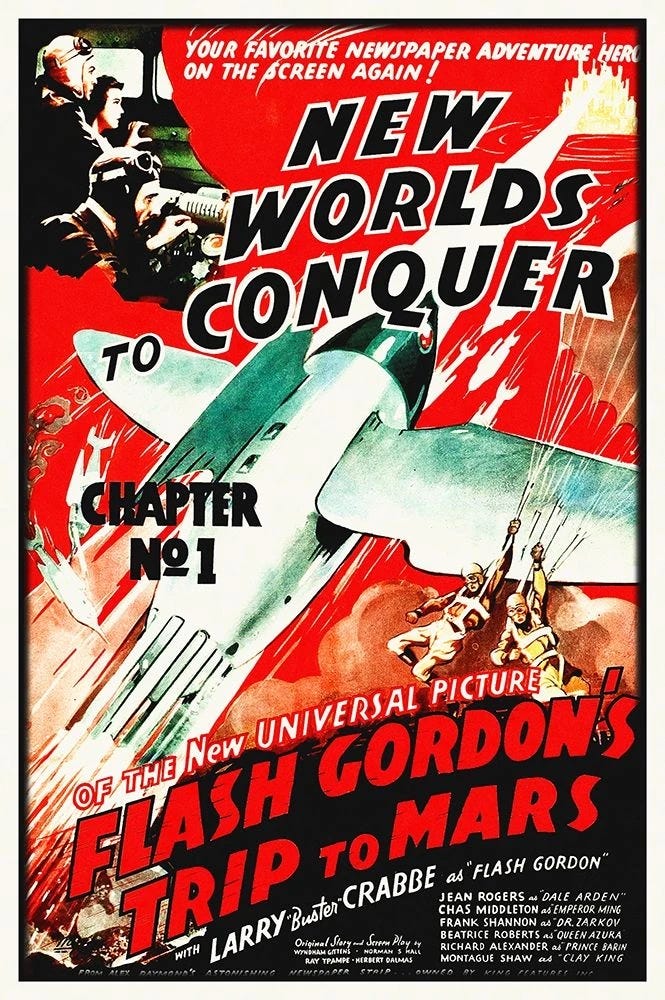
In this instance, not only do we get the possible ahistorical story of how Mason and Dixon left their survey instruments behind and traveled to the Ohio River (2.70), but we get the soap-opera-retelling of what it would have been like if they had been allowed to cross the Great Warrior Path and continue mapping the line and claiming territory along the way. They would run into any number of possible clashes and oddities that stem from America or the formation of the Line. What new Lancasters would they find? Which new Cresaps would they speak to? Which mounds would they observe or creeks traverse? Sure, only forty miles remained between the Great Warrior Path and the Ohio River, but the same number of miles extended between Cumberland and the end of the Maryland Line, and you can remember all the events and troubles that existed in that short stretch. Imagine what forty more miles further west would have entailed. Given this is told in the form of a television show, it is the perfect baseline for exciting programming — not to mention that we see pursuers coming after them once they cross the Great Warrior Path.
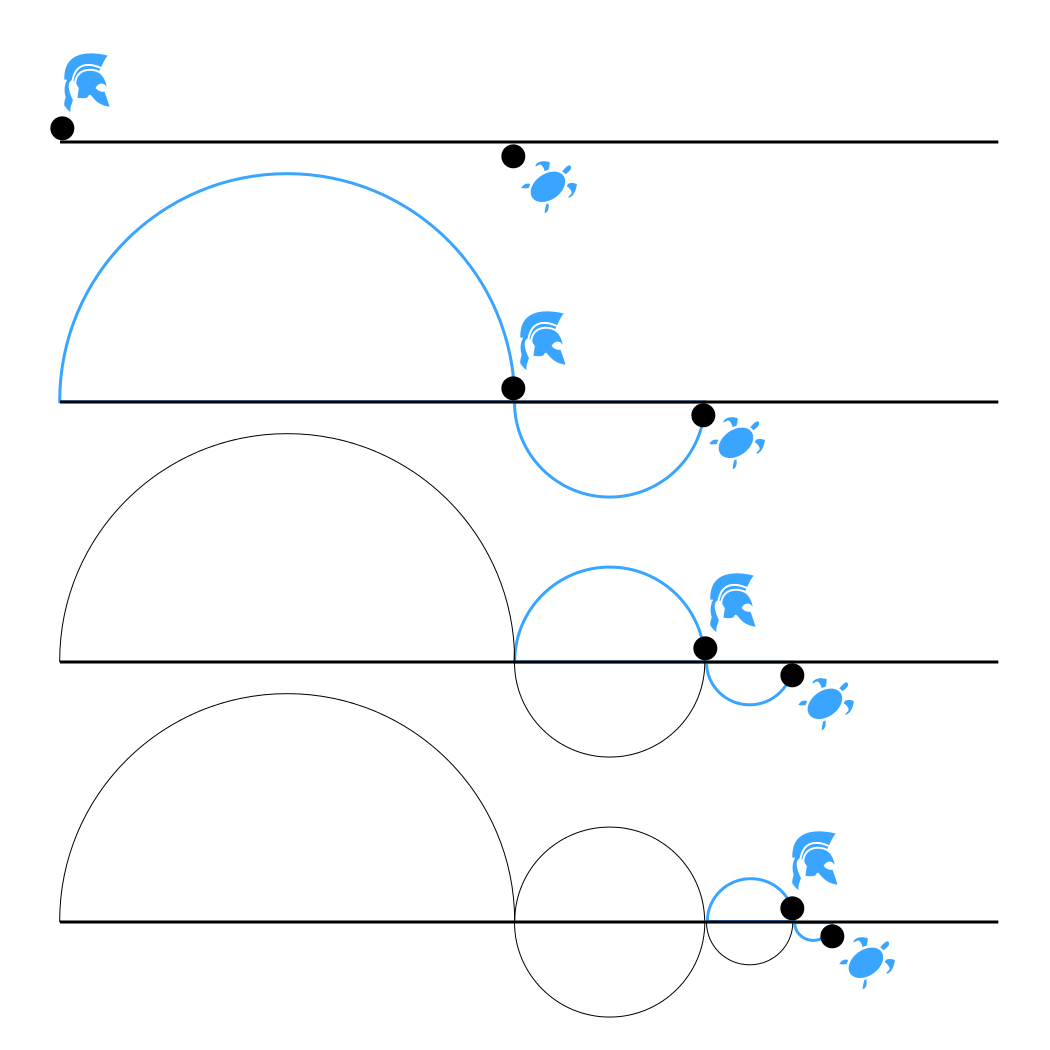
However, Zeno’s Paradox1 is brought up here, not only referencing the most popular of his Paradoxes, but two of the four. The first of these is the classic one that most people know of, often called The Dichotomy. In this paradox, a person seeking to reach a specific endpoint will have to first reach the halfway point, then the next halfway point between the first and the end, and then the next halfway point, eternally reaching these halfway points and never reaching the end. This is westward expansion in a nutshell, having a set end and never truly reaching it. Colonizers will continue to reach the next point, making some excuse to keep going so to continue the expansion west — just like they reached the Proclamation Line only to continue past it, and just like they reached the Great Warrior Path only for two future surveyors to continue the project some years later. And as we know, the expansion of the West, whether it was in America or over the whole globe, would not end there. The second paradox is what is known as Achilles’ Paradox. In this paradox, one racer starts sometime before another. Given the first racer begins ahead of the second racer, the second racer will never be able to catch the first (according to Zeno). This is because when the second racer makes strides to catch up to the first, the first will have already moved on, leading to the impossibility that the second will ever catch up as long as the first never stops moving. This paradox furthers the previous one, showing that on top of the fact that the Empire’s goal will never end, those attempting to stop the formation of the Empire will always be one step behind. The one hope is that these are paradoxes that have no modern validity. Our Western Empire was built upon them, but by changing the means, we can potentially save the end.
We must meet some of the characters in this TV production. The strength of the men on this line is exaggerated, making those like Stig, now a “one-man assault force” (706), appear as titans — superheroes. All the while, this party is now trudging along the line, pursued by those dastardly men attempting to stop their plot, and there are no longer any of those evil themes following them onward — no sense that what they are doing is wrong. Instead, “The Musick, from some source invisible, is resolutely merry, no matter what it may be accompanying” (706). The music moves ever on, continuing forward unceasing just as Mason and Dixon do. There is no stopping anymore — no returning back to the East when the winter appears to be coming on. They have realized now that as the west was further conquered, the dangers became less evident. Civilization could be built up to support and sustain them out here, allowing their endless ‘Westering’ to continue on, keeping them safe, far away, and invisible from any entity attempting to discover and stop them.
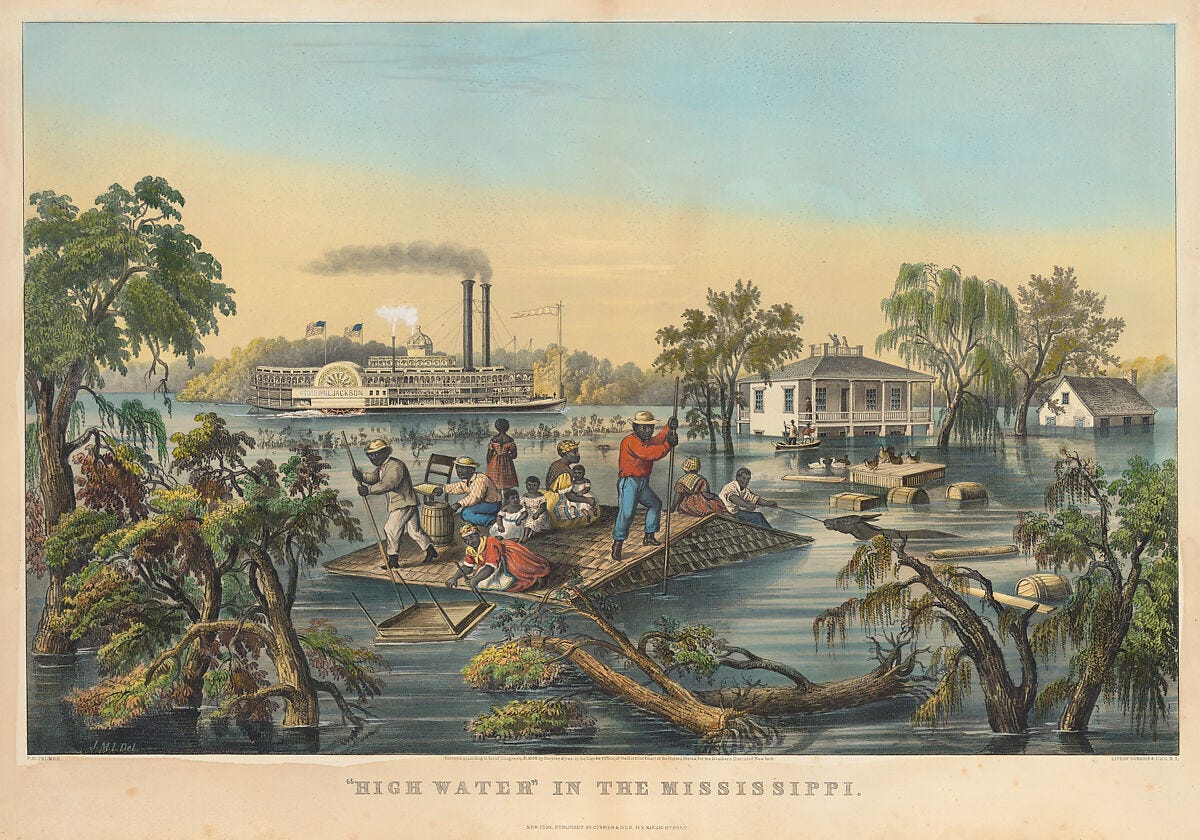
Continuing on, they not only surpass the Ohio River, but move past the state of Ohio as a whole, eventually passing Indiana and moving on “Into the Illinois,” (707) even soon crossing the Mississippi River itself, likely into Missouri. In two short pages, Mason and Dixon have crossed all they had crossed over the course of almost 30 chapters which spanned three years on top of continuing through all of Ohio, Indiana, Illinois, and now reaching Missouri — now reaching the True West on the other side of the Mississippi. It really is television, condensing the exploits of what would have been at least another three years over the course of what feels like three days. There are no nuances, no epiphanies, no revelations, no deaths. Sure, there is the occasional character met along the way, though they are no more than one like Friday from Defoe’s Robinson Crusoe: a servile and mentally simple Native who only wishes to show their new masters the ways of the Old World.
And as they continue on, we see further repercussions of the line, seeing “Laws continuing upon one side,— Slaves, Tobacco, Tax Liabilities,— [which] may cease to exist upon the other, obliging Sheriffs and posses to decide how serious they are about wanting to cross Main Street. ‘Thanks, Gentlemen! Slaves yesterday, free Men and Women today! You survey’d the Chains right off ’em, with your own!’” (708). The victims, according to this episode of the show, are the sheriffs, angry at Mason and Dixon for freeing these slaves by delineating the free north from the enslaved south. But this gives them more credit than they deserve. For, first of all, their goal in forming this line was for property rights alone, and second of all, while they may have ensured the freedom of those who were north of the line, they also ensured the enslavement of those below it. But of course, in TV style, we will only ever see that which we are told to see — that which They want us to see.
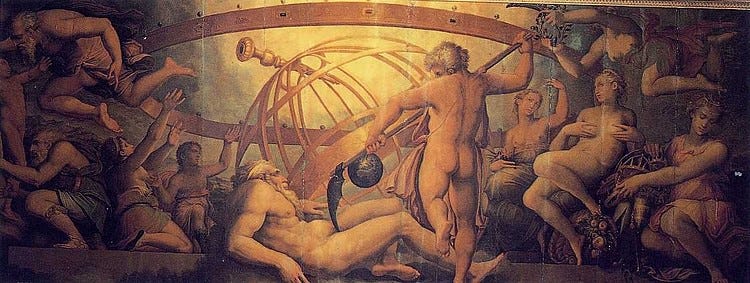
Eventually, in the soap opera at least, Mason and Dixon come a tribe who worships a planetary body that is what we know today as Uranus. The tribe who worshipped this astral body for God-knows-how-long will now see their planet be renamed. Originally, it was a touchstone and waypoint to those tribes who had truly found their godhead in the cosmos, yet which would be renamed according to the capitalist or the Western founder. Historically, Uranus was found by William Herschel in March of 1781 and was reported initially to our very own Neville Maskelyne. At first, Herschel named it Georgian after King George III, King of England and Ireland2 during the finding. Obviously, this was not done under some sort of credence and faith toward the King at the time but rather was done for the potential beneficial possibilities that came from bowing and giving one’s metaphorical peonage to a king. Alas, and God knows for what reason!, this name did not stick. Nor did its second name: Herschel, named after the founder himself. And again, who could possibly guess why such a name would not stick... Uranus, however, holds far more power. This is the God of the sky himself. Not merely the ruler of a small tract of land on a planet near the Sun, nor the man who happened to come across it by chance. While Mason and Dixon may be remembered by name,3 they are nothing compared to the God(s) — nothing compared to the Kings, the sky, the cosmos.
Time proceeds with each ‘episode’ of this television show, and we now see, after what we can assume was crossing all of Missouri, the plains of Kansas, and now on into Colorado, that “they can also both see the Western Mountains” (709) — the Rocky Mountains.4 Though the West is often claimed to be everything west of the Mississippi, this is more of a geographic standard rather than a true colloquial one, for no one really considers Missouri or Kansas to be a part of the West. Instead, the Rockies provide that boundary. Yet, it is here that they stop, for while more adventures could potentially be had and more discoveries could be made, a good story must have a satisfying conclusion which can tell the viewers what it was all for. So, briefly, Mason and Dixon discuss all the spoils they could attain if/when they traveled back east into the ‘civilized’ world: The Copley Medal,5 riches untold, and servants who answered to their every beck and call. Though, as to the last of these possibilities, Dixon claims that he does not think they should go this far given the connotations between servants and the slavery he had witnessed here in America — a tried-and-true character-arc if there ever was one (and one quite good for television, as well).
So back east they turn, solidifying the purpose and worthiness of this westward trek in the minds of the viewers. Plus, Dixon’s heartfelt liberal morality, stopping his exploits at slavery so the television watcher can feel that moral uplift in themselves, but going no further.
Each town Mason and Dixon pass greets them with cries of hate in a stream of unattributed dialogue. This TV-show thus proceeds via the style that many Broadway plays do, such as the ones Dixon saw when he traveled to New York City (2.58). This play that they are a part of is called “the award-winning ‘Love Laughs at a Line’” (711). We are seeing the repercussions and implications of whatever horrors the Line brought to those who lived upon it, yet the real horrors go unobserved. Sure, the menial complaints that these screaming men and women pose are important just as my/your complaints about my/your rent being too high are important. But is this the true horror that the line has wrought? Is my/your rent the true horror that exists in this Western Empire? Of course not. There, in this episode, is no hint of slavery to be seen. The menial complaints are heard, sure. The presence of some ‘Creature’ which “the Line is believ’d to present some Barrier [to]” (711) is even discussed which may very well be the anthropomorphized symbol of slavery. But such a thing, of course, is never directly addressed. We would not want to enrage the public too much. The television show is supposed to be entertaining, not something that is striving to make change! We wouldn’t want to alienate any viewers for their potentially alternative beliefs. The best we can do is present it as allegory, hiding the intention just enough to keep the conservatives happy and allowing the liberals to pat themselves on the back, knowing that they can see the message, as if seeing and shaking one’s head is enough.
Finally, they make their way back to the True East — the Post Mark’d West — where they approach the Delaware River, one surveyor on the south side and one on the north side of the line. It is not clear which one is on which. Is it Mason or Dixon who trods the realm of slavery? who steps in the land of the ‘free’? Considering we have seen time and time again that they are two sides of the same coin — be it Dixon wearing Mason’s clothes to the Paxton Boy massacre site (2.34) or their switching positions on whether to continue onto the Eternal West (2.69 & 2.70) — it really does not matter. They will both believe in the freedom of the slave while contributing to the existence of their chains.
In one of the last episodes of this soap opera, Mason and Dixon drop by to see the McCleans, telling them of their desire “to inscribe a Visto upon the Atlantick Sea” (712). We hear of shops and taverns opening upon the sea so to provide the sailors with all they could desire on their long voyages. Yet, all that this is is another form of pointless progress just as colonizing the moon would be in Gravity’s Rainbow. There is no possibility that these waters or celestial bodies could truly be colonized, but the attempt at doing so would allow us to justify all forms of other ‘progress,’ leading to scientific advances that would, as usual, benefit the Elite and the Elite alone.
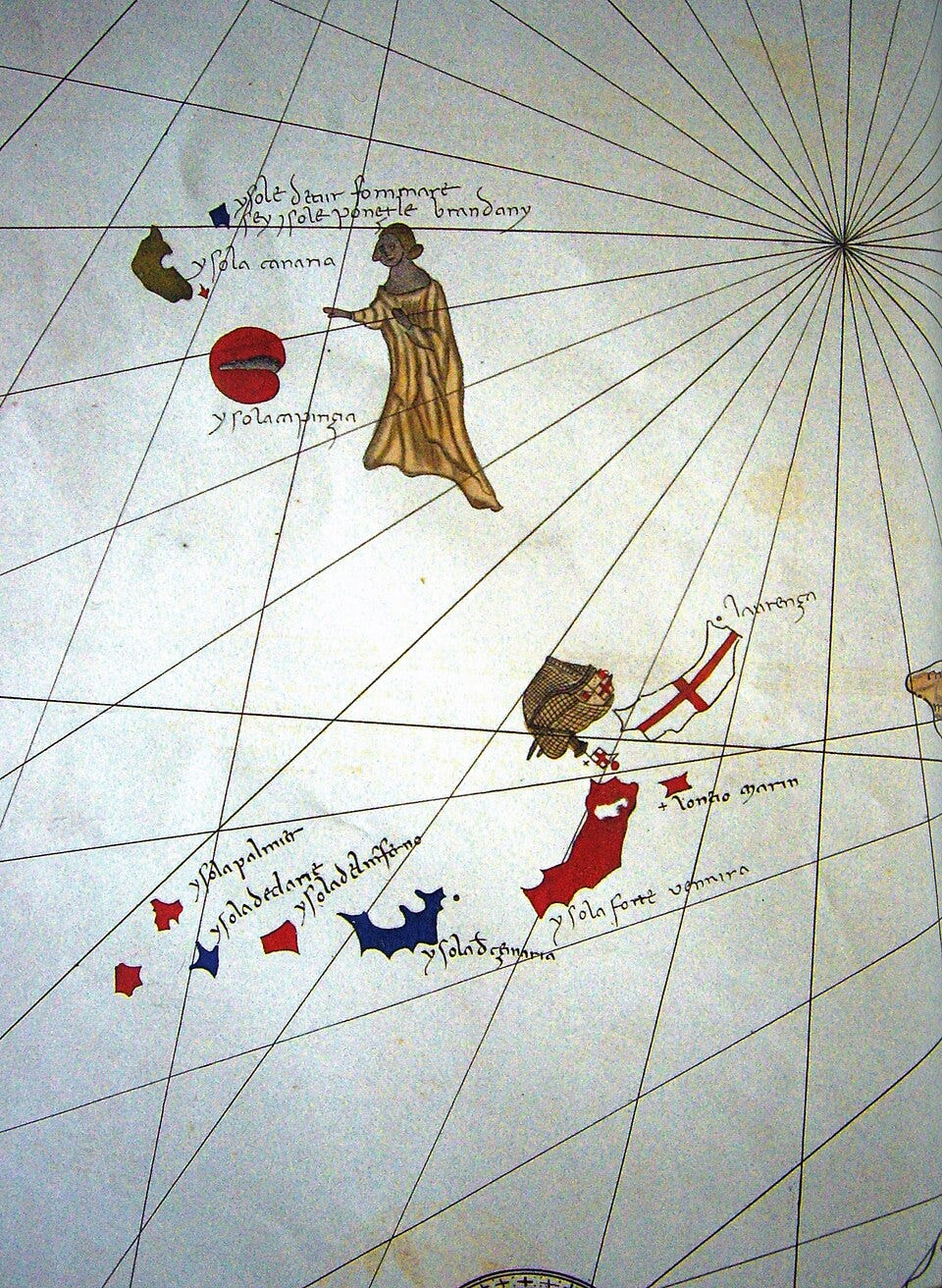
While the literal waters are not something that can readily be colonized, those small isles very well can. Maybe this was the point of the desire to colonize the oceans just as the development of missiles was the point of the desire to originally ‘colonize’ the moon. Here, we learn of “‘St. Brendan’s Isle,’ a combination Pleasure-Grounds and Pensioners’ Home, with ev’rything an Itinerant come to Rest might ask, Taverns, Music-Halls, Gaming-Rooms, and a Population ever changing of Practitioners of Comfort” (712). Saint Brendan’s Isle was a mythical island in the Northern Atlantic Ocean of the coast of Northern Africa, putting it potentially around the same location as Saint Helena. It was said to have been discovered by Saint Brendan and his followers, even given credence in Christopher Columbus’ journals in the 15th-century. Given many islands in the Atlantic Ocean (or the Pacific, for that matter, like Hawaii), were colonized, it is likely that this mythical isle is representing something of the same sort. Pleasure grounds are just a different term for a resort, meaning this Atlantic Island, like so many others, was colonized and built up with such resorts that were “designed to be cordoned off from the actual residents of [these] tropical islands” (Biebel, 245). It is at in one of these Pleasure Grounds where TV Mason and Dixon retire for good, getting the happy ending that they wanted: living in both the exotic and the familiar.
But what did this happy ending require? why was it presented in such a way to the viewers in this soap-opera-fictionalization? was the ending truly happy? even for them? And, finally, is the fact that this was told as an ahistorical aside relevant at all?
First, as we know, this ‘happy ending’ required the very destruction of the world itself. The severing of north and south. The legal justification for slavery. The plundering of the natural landscapes. The furtherance of the goals of men in high positions so to acquire more capital, more land, more people. This question can be answered by reading the previous seventy-two chapters, then coming back here and asking: ‘does the happy ending for two men justify all that came before?’
Secondly, the average viewer of a ‘show’ such as this, whether they had read the last seventy-two chapters or not, will believe that the happy ending was merited. Mason and Dixon struggled, did they not? They knew what the evils were... and the evils would have come about either way, so why should they put themselves in a worse position if it would have changed nothing? And anyway, we love them now, having spent so many chapters/episodes/installations with them. Seeing their bantering and the complexity in their characters, we want them to have a happy ending. And if they deserved it, why do we not deserve it too? Even further, why must we be angered at those like Thomas Jefferson or George Washington? Were they not as complex as our main characters? Did these Founding Fathers not potentially have the same epiphanies? If Mason and Dixon can be excused and allowed to have their happy ending, why could any man not have the same?
Third, what if this ending is not truly happy? They have been led to believe it is so just as the viewer may have been led to believe the same. But why would Mason not have been happier at home with his children who he has not seen in five years? Why would Dixon not have been happier (or at least as happy) in County Durham, surveying castle ground and pursuing its beautiful mistresses? Instead, they are now on a new border between America and Europe, having no identity, calling on employees of these Pleasure Grounds who are only slaves called by another name — the one thing they did not want to be a part of.
Finally, of course it does not matter that this story was told as an ahistorical aside. It is the exact same thing as the commentary on historiography as a whole. All of these stories, fact or fiction, contribute to the understanding of the foundation of this Empire. Of course, it is important to understand (if such a thing is possible) what really is true or false, but that does not mean that an ahistorical account such as this has less to say about our modern reality than hearing about Mason and Dixon’s crossing of the Susquehanna or their tedious mapping of the Tangent Line.
In the end — Happy Ending or not, colonized Atlantic isles or not, reaching the Rocky Mountains or not — Mason and Dixon have left America, leaving behind a Line mapped by chains only to determine where someone could be legally shackled and forced to do one’s bidding, along with the very concept of the ever-expanding New World... the same world which Pynchon, in an earlier novel, once described perfectly:
Colonies are the outhouses of the European soul, where a fellow can let his pants down and relax, enjoy the smell of his own shit. Where he can fall on his slender prey roaring as loud as he feels like, and guzzle her blood with open joy. Eh? Where he can just wallow and rut and let himself go in a softness, a receptive darkness of limbs, of hair as woolly as the hair on his own forbidden genitals. Where the poppy, and the cannabis and coca grow full and green, and not to the colors and style of death, as do ergot and agaric, the blight and fungus native to Europe.
(Gravity’s Rainbow, 3.3, pg. 317)
Soon, however, it will not be a colony. It will be the next progenitor of all that will plague this world.
Up Next: Part 3, Chapter 0 (the next post will be a shorter one, focusing on the title of Part 3 — the final part — of the novel. It will analyze the importance of the title of Part 3 along with describing what is important to look out for in Part 3 while reading).
I wrote more extensively about Zeno and his paradoxes here, if you care to read about them: Zeno and Melissus.
King George III was first mentioned in Mason & Dixon in 2.58 when Mason went down to Williamsburg, Virginia. Specifically, here, he met George Washington at the Raleigh’s Tavern. In the conversation with Washington and the Tavern’s crowd, the idea is brought up that the servitude of the White Man under King George III (also called Georgie Rex) is the same as that of the African under the White Man. Further analogies need not be expounded upon.
Importantly, they are pretty much only remembered by name. Imagine as if this book were never written. The line would be known, and their names would be known. But how much else about them would we know. Almost nothing outside of those historians who choose to study them — none of the rivers they crossed, people they had met, degrees they had mapped, countries/counties/states/islands they had visited, and so on. Their names would be names and names-alone.
There are definitely many associations to be made here with Pynchon’s Against the Day given a major plotline throughout that novel takes place in and around Denver, Colorado and the Rocky Mountains, in general. Maybe Pynchon is foreshadowing the coming events of what western expansion would lead to here — events that would be explored in that coming novel.
The Copley Medal was a “Prestigious Royal Society award” (Biebel, 244).
Biebel, Brett. A Mason & Dixon Companion. The University of Georgia Press, 2024.