
Mason & Dixon - Part 2 - Chapter 72: We Had Five Years
Analysis of Mason & Dixon, Part 2 - Chapter 72: The Meridian's Altitude, the Driver's Whip, On Bravery, a Slave Song, a Final Stint in New York, the Halifax Packet, the Last Entry

The time on their Line is not yet done. Now, we see them traveling up and down the Meridian Line1 which separates Maryland and Delaware, clearing more Vistos and now using what are essentially large scale ‘levels’ to map the elevation on top of geographic locations, giving us the insight of further possibilities of measurement or theft of land. We have had both x/y-planes and even time measured, but why has there been no mention yet of the z-plane (elevation)?2 What implications could the mapping of these ‘borders’ or ‘lines’ infer? if anything. The answers do not come in this novel, for it is a topic only briefly mentioned, but if one realm can be colonized for power, why can another not be taken for the same? And on top of this, ignoring geographic planes, what else out there has not yet been realized as another one of these pilferable realms?
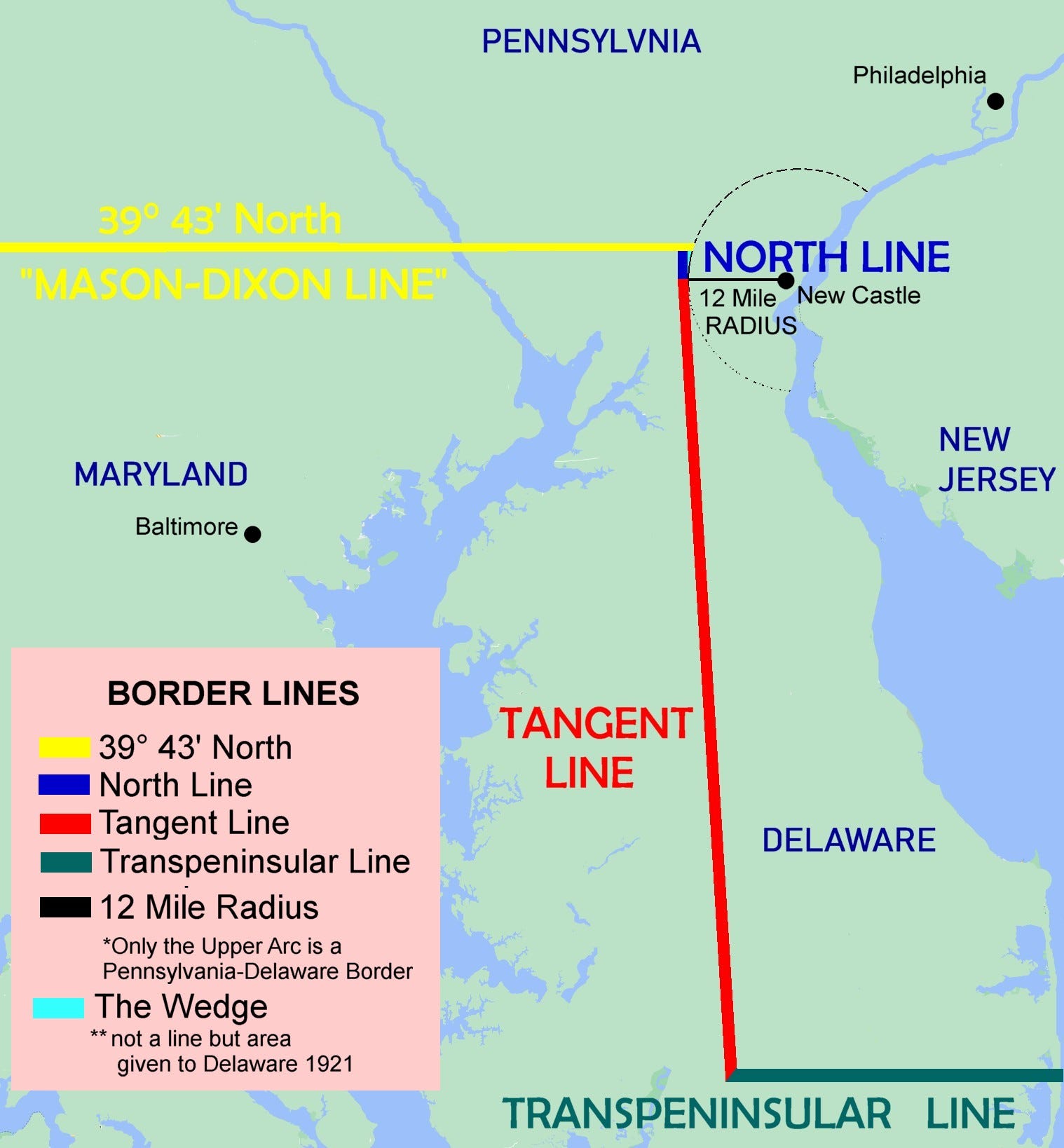
Having spent five years doing all of this time and time again, “There are days when the Routine has [Mason] livid with boredom” (694). And their actions are then depicted in obsessive technicality, describing each menial step by each menial step — a dozen different monotonous actions which in the end only amounts to a single measurement... and “Then they do it again” (695). All of this takes them until the end of June 1767, where now that all measurements are done, they travel south down the Tangent Line and eventually to the west of it until they reach Baltimore, Maryland. Reverend Cherrycoke mentions briefly that it was here, in Baltimore, “when Dixon [would] accost the Slave-Driver in the Street” (695).
Ives LeSpark claims that there was no evidence of such a thing, attempting to keep the history of what and who formed this nation separate from racial tensions, especially if they involve someone who would be memorialized in the nation’s history. Technically, he is correct, for as Ives says, there are no entries in their journal about their journey to Baltimore from June 29 to July 8. However, this so called “‘Driver’s Lash’ does currently stand in a Dixon museum in Bishop Auckland, accompanied by the alleged origin story we’ll see unfold momentarily” (Biebel, 242).3 And more importantly, according to Cherrycoke, we must “place our unqualified Faith in the Implement, as the Tale accompting for its Presence,— these family stories have been perfected in the hellish Forge of Domestick Recension, generation ’pon generation, till what survives is the pure truth, anneal’d to Mercilessness, about each Figure, no matter how stretch’d, nor how influenced over the years by all Sentiments from unreflective love to inflexible Dislike” (696). He is stating that often fictional retellings are more trustworthy than historically documented ‘facts.’ For these stories were not written about once by some singular entity who supposedly knew the truth and who then recounted it in a blow-by-blow retelling with no possibility of metaphorical interpretation. However, in fiction we do not merely hear about how on a specific day of a specific month of a specific year in a specific place, two specific people did X specific action leading to Y specific outcome. If this was the case, it would have been exactly like Mason and Dixon’s description of marking off the altitude of the Tangent Line — rote, repetitive, and meaningless. However, when allowances are made for events that we know have some validity, one can arrive nearer the truth. Whether or not the coming story is completely factual, embellished, or mostly false, the story would likely never have been passed down if there were not insular truth — be it metaphorical or factual.
So comes the story of the Driver’s Whip.
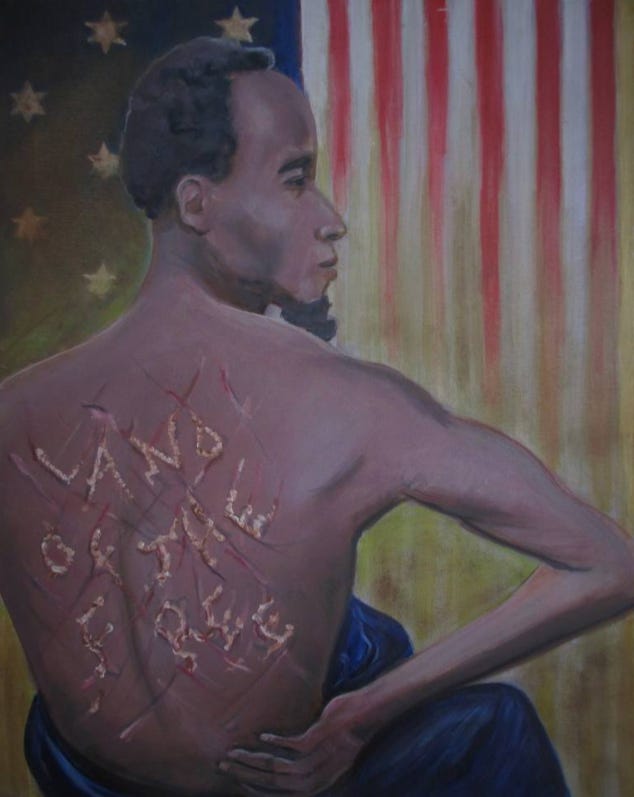
The story of the Driver’s Whip begins with the symbol of the item itself: “an evil thing, an expression of ill feeling worse than any between Master and Slave” (696). This is not merely some symbol of death such as the Lancaster Rifle, for that weapon could also be used for something necessary, be it survival, defense, et cetera (though, in this New World, we do know what it would be used for). The whip, however, is a means of pure control and hate. There is no use for the whip outside of causing purposeful pain so to quite literally control the target to one’s will. Although, as we will later see in this chapter, there is one alternative purpose.
The whip may initially have been developed for animals whose thick skins guarded them against some of the immense pain they could potentially cause, but the whip’s purpose and metaphor would not be fully realized until the slave trade came full force. Nonetheless, those that the whip would be used against would retain the name of those original targets, just as Dixon sees one specific slave driver in an Inn, announcing the day’s sale while calling the slaves “by names more appropriate to Animals one has come to dislike” (696) — a common dehumanization tactic used for similar purposes as the whip is used for control. Having just come off his all-too-late epiphany when he and Mason completed the Tangent Line (2.71), Dixon is especially sensitive to the topic of slavery. Not only is this man contributing to the slave trade that Dixon has just realized follows him to each new colony, but this man describes their purpose in ways that make the typical slave trader seem tame: “cook and eat ’em, fuck ’em or throw ’em to the Dogs, as we say in the Trade, imagine Gents, your very own Darky, to order about as you please” (696). He is describing them as something not even animal, but as some irrelevant, warm vessel to fulfil each and every desire you may have, becoming the symbol of the consequenceless servitude that the Golem provides and the sexual servitude that Austra does as well.4
Dixon scolds this man yet fails to see that his alternative also bears negative connotations. He discounts the need for a slave on ethical grounds and on grounds of safety for himself, whereas his alternative is, as he says, “Engines, for they have no feelings of injustice,— sometimes they don’t exist, either, so I have to invent what I need” (697). And while this obviously is wholly preferable in every possible way to the buying, selling, and ownership of people, these Engines that Dixon speaks of are the same which we see the Iron Plantations of Lord Lepton working toward and that we will see come to a full emergence in the events of Pynchon’s Against the Day. Of course, while there is a lot of complicity we can attribute to Mason and Dixon, this desire for so-called Engines is not an example of that, for there is no way they could have seen the trajectory of that particular evil. Though, it does give rise to the notion that so much technology evolved from the ideas and comforts which slavery was said to bring. And again, while that is objectively and ethically preferable to slavery, can something that is borne out of the desire to maintain slavery without (ostensibly without) human suffering really be considered ‘good?’
So, when the man offers Dixon a slave, Dixon not only turns him down, but sends the man out of the Inn entirely, only for the man to invite Dixon to the pier the next day to at least check out the slaves.
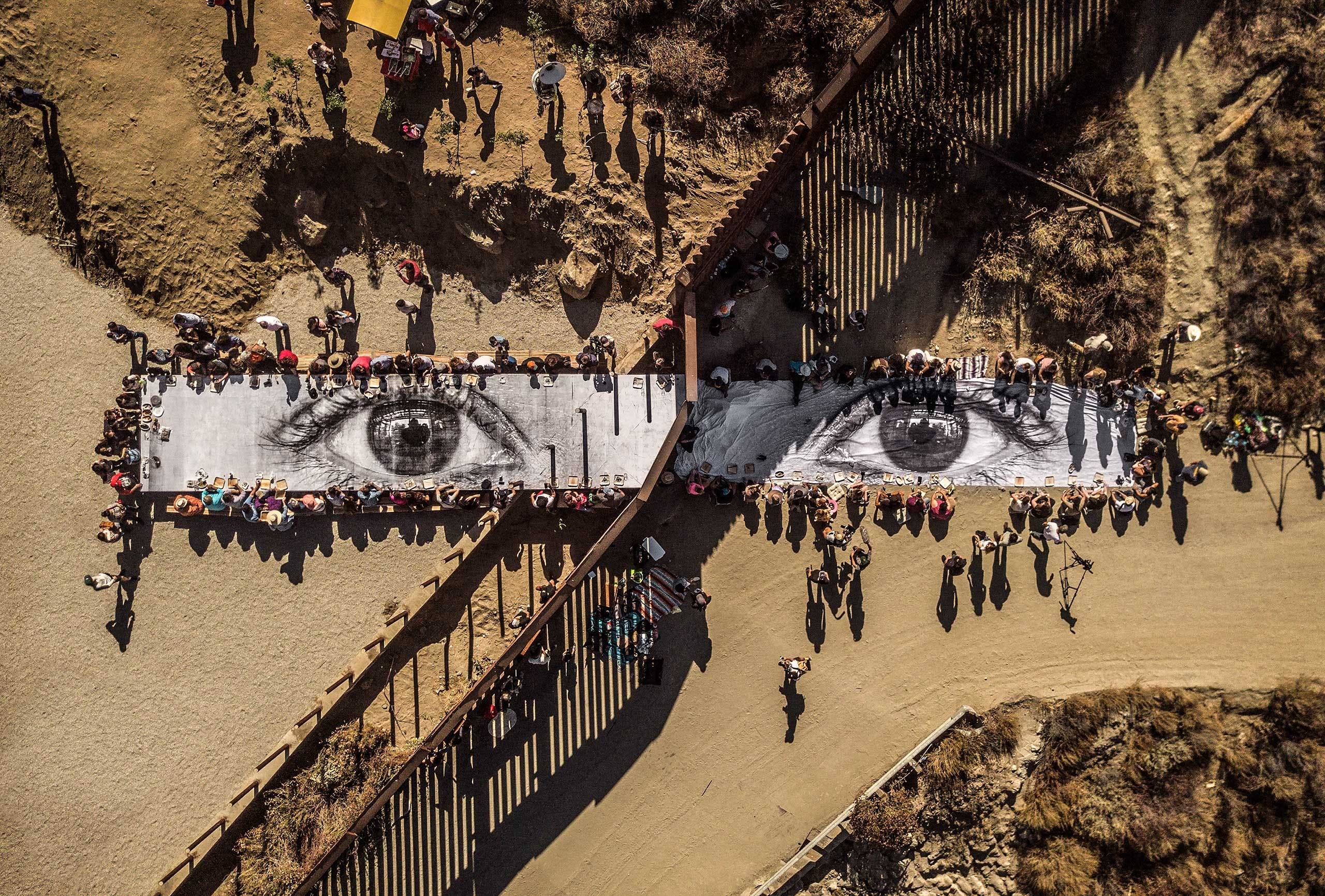
Mason thinks upon Braddock’s Defeat from 1755, pondering upon how its existence gave more meaning and necessity for the white man to create specific borders. The Susquehanna has represented safety for the white man a number of times upon their journey. Everything on the western side became more and more dangerous, especially as further western borders were crossed — mountain ranges, other rivers, creeks, and established lines. But the Susquehanna was that first true border separating the east from the west. Thus, after Braddock’s defeat at the hands of the French and the Natives fighting alongside them,5 the western white man was terrified, retreating back across the Susquehanna to the east, where things were knowable and controllable — where the Natives and slaves had been held at bay, expunged entirely, or reduced to such a menial status that they posed no threat. Mason has come to realize that all of the nuances that these enclosures have provided them have given them what was essentially an infinite number of tasks, goals, and adventures that gave them no chance to simply sit with themselves. He worries that if the tasks were done — if there were no ‘enclosures’ to provide them with the next big goal — then would they still have the same Affection toward each other? In one of the few instances where they were cut off from such enclosures — at Knockwood’s Inn, due to the snowstorm (2.36-2.38) — they immediately were forced to go their separate ways to New York (2.40) and Virginia (2.39) to take a break from the other’s presence.
But now, Mason realizes that their friendship was something entirely more than one which required constant movement and action to prevents such feuds. Only now... it is “far too late” (697). And while the LeSparks tell Cherrycoke to spare them from the romantic aspects of the story, that is not the point. It is not, necessarily, the fact of their coming separation (though, to an extent, it is also that), for they will see each other again. But what it really is is that this realization came far beyond the point where they may have realized they could have lived true, fulfilling lives without having completed such a border. Yes, there were many a factor leading to their desire to continue the project, but earlier realizations such as this could have been the spark that led to a true change. Maybe not this and this alone, but who is to say?
Mason sees that his admiration for Dixon comes from Dixon’s recent bravery. Upon the Seahorse (1.4), they both showed a sense of bravery, though it was one where they had no choice but to put on that face. It was the bravery of being caught up in something against one’s will where the only option was to act. Courage was forced. At the Great Warrior Path (2.70), there was curiosity and potential reward that led to their bravery when they crossed it and headed further west to the Ohio River (even if that was a dream). But again, this was a bravery which was only acted upon because of the potential reward. Now, here, Mason sees Dixon show a form of bravery that neither of them has ever yet shown. An act of genuinely revolutionary bravery where the entire point was to bring about change at the expense of one’s own life, freedom, or well-being. One where there was no reward and no true immediate necessity — just belief, an ethical code, a desire for change.
This bravery occurred when Dixon saw the Slave Driver once again, whipping the black men and women indiscriminately for causing him the most menial inconvenience. He sees no immediate necessity to benefit himself in any way, and he is in no position that forces him to act for his own life or safety. What he sees is the full realization of his epiphany before his very eyes, and he knows that he must act out of the hate he feels for the evils that the project he has been a part of has brought about. So, setting Mason to watch his back, Dixon attacks the slave driver, breaks his teeth, steals the whip, and proceeds to use this instrument not as a means of control, but for the other aforementioned possibility — revenge, retribution, revolution, rebellion. And not only this, but Dixon takes it upon himself to free these slaves, as well. He threatens the Slave Driver never to show his face here again, lest he wishes to face death at Dixon’s hand.
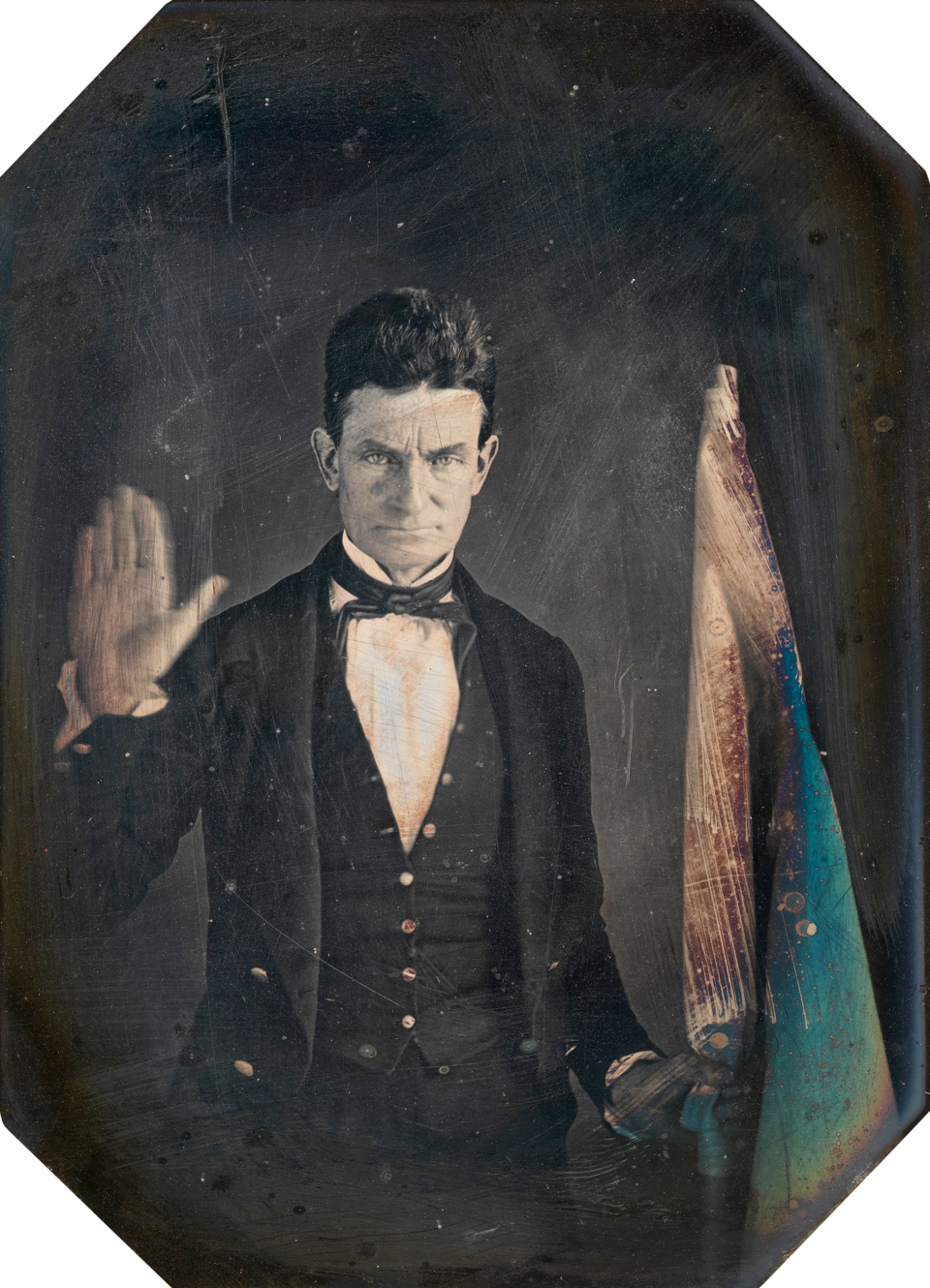
But the questions arise more often than ever before. Did Dixon do enough? Is a single act of rebellion or unorganized and emotionally-driven revolutionary action something that merits acclaim? It most obviously is not ‘enough,’ but does that mean it is irrelevant? For, it is far, far more than most of us will ever even think of doing. The same could be asked of someone like John Brown. Did he do enough? Did his actions proceed through history to cause actual direct change? Were they borne purely out of emotion rather than a desire to incite organized liberation? And on top of this, was it all too late? Dixon, for one, contributed an undeniably massive furtherance of the American and Western Empire to a level that very few could claim. If he would have stopped along the way, coming to his epiphany a year, two, three, or four, earlier, would this have been enough? Would it have been early enough? There is no clear distinguishing line. We have all waited too long. We have all contributed to the Empire in some way however great or small. And yet we do not blame ourselves. Have we acted to the same extent that he did? even if he contributed to a greater degree than us? waited longer than we did?
But nonetheless, this does not strip him from any form of criticism. First of all, unorganized, solitary rebellion amongst a population who wishes for nothing more than more of the same will only further their degree of moral righteousness. They will come to the conclusion that they were right all along, and that these so-called revolutionaries were the outlier — were at fault for the issues in the world today. But another question arises: should we withhold action knowing that there is always the possibility of inciting a further radicalization of the other side? of the Right? Must we wait for true and pure organized groups to even think of fighting for what we know is right? Of course not, yet Dixon still has a qualm. He “understands what Christopher Maire must have meant long ago by ‘instrument of God,’— and his Obligation, henceforward, to keep Silence upon the Topick” (699-700). This recalls when Maire, Dixon, and Emerson sat at the Cudgel and Throck, discussing Dixon’s recent proposition to go to America. While Dixon had qualms, Maire knew what was going to happen, saying that Dixon was “God’s Instrument if ever I saw one” (1.23, pg. 230). He knew that Dixon would be the instrument that the ostensibly Christian world would use to draw their Empire forward. And earlier, they also had the discussion at Emerson’s home where Maire stated, “Jeremiah, here you’ve a Choice at last, between staying at home, and venturing abroad...? For tho’ your Faith teaches equality and peace, I’ve yet to meet one of you Quaker Lads who hasn’t the inward desire to be led into some fight” (1.22, pg. 224). This itself calls into question whether Dixon’s actions against the Slave Driver were done only to be a part of some grand action and/or to once again experience the ‘fight’: the feeling that he was doing something right and to gain the praise and acclaim that came alongside it. Was he (are we) merely acting because he will be perceived as ‘good’? merely acting because it provides him with the self-satisfaction that he needs in order to know that his life is worthwhile? And if so, once again, is this bad? Does it negate the good that can come from action? Limit the good? Or does it matter at all?
There is no doubt that Dixon acted too little, too late — that he contributed to the Empire far more than he acted against it. But nonetheless, all these questions still remain. What have you done lately? What haven’t you done?
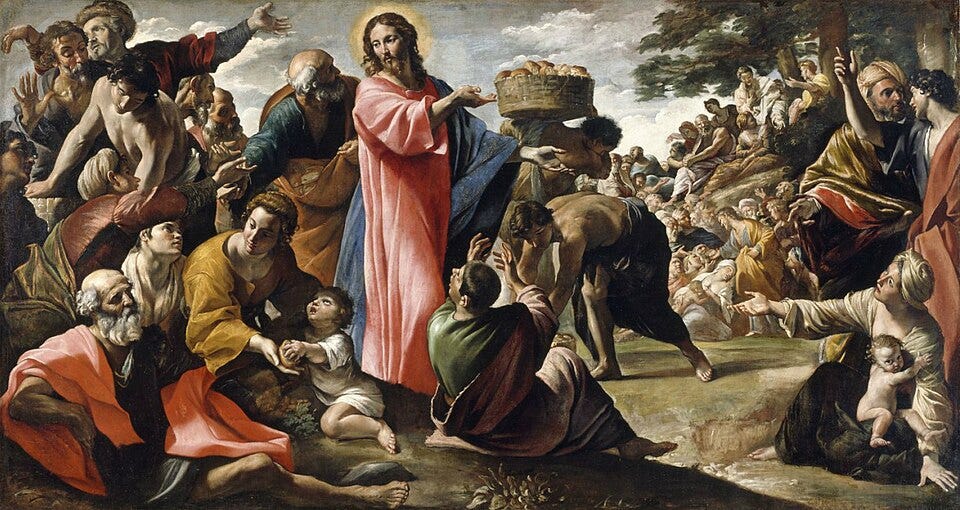
Mason and Dixon must leave town, for it is very unlikely that this action by Dixon would allow them peace, quiet, or safety in Baltimore. On the way out, “Mason imagines the Streets full of Row-Houses multiplying like loaves and fishes” (700) — a vision of Jesus’ holy power and the power of Christianity as a whole leading to the expansion of the New Empire. Essentially, rather than Christianity providing food for the poor, it is providing homes for the rich (or, at best, homes for the white man, be they rich or not). While on their way out, they come across a “small wood Moon-color’d Chapel” where “they can hear a night-Congregation singing” (700). It is reminiscent of Roger and Jessica’s observation of the War’s Evensong in Gravity’s Rainbow (Gravity’s Rainbow, 1.16). There, Roger Mexico and Jessica Swanlake listened while a demographically absurd group of Preterite sang in a chorus, summoning into existence the very fabric of the Warscape and all its associated faculties: the economics, the weapons, the commodities lost and gained, the deaths, the people, the things never to be seen again... The group who sang it was led by a man from Kingston, Jamaica, singing in both Latin and German within an English church. All of these possibilities could only be brought about by the absurdity of a late-imperialist world which necessitated the movement of people and languages across vast tracts of ocean and land. And it is with the perspective of these people that give us the insights into the war that we may have never seen.
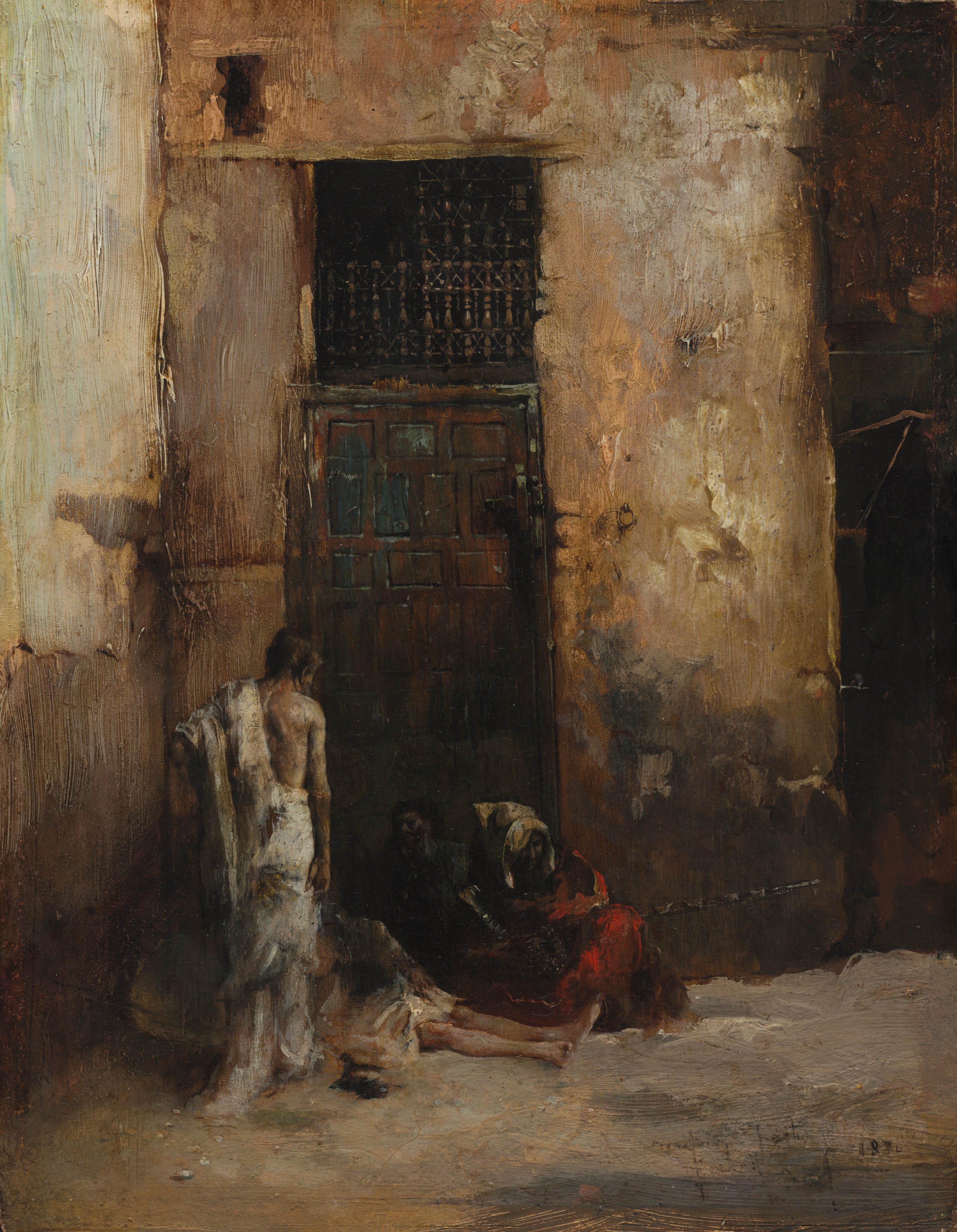
Here, with Mason and Dixon, they view something that, according to Biebel (who is referencing scholarship by Peter Schmidt), “might be a ‘Negro Spiritual.’ That it’s sung by a ‘night-Congretation’ (as slaves would’ve had to meet at night, perhaps in secret) provides supporting evidence” (Biebel, 243).6 Just as the man from Kingston in a foreign land could provide the real context of WWII, so here can those who were similarly abducted from their land and brought to the New World cause that same revelation in their listeners.
Mason and Dixon thus come to yet another epiphany. It is not merely slavery that holds the evil in these lands. In fact, the two now “understand as well that the Line is exactly what Capt. Zhang and a number of others have been styling it all along— a conduit for Evil” (701) in the same way that the Driver’s Whip was “an evil thing” (696). The possibilities of the Visto they had recently created in Delaware comes into view: a world that would take the beauty of the natural lands, tear it up from their roots, and replace it “with Inns and Shops, Stables, Games of Skill, Theatrickals, Pleasure-Gardens...a Promenade,— nay, Mall,— eighty Miles long” (701). While it is true that this particular Visto was not heavily developed in the future of America, the idea remains. Those like Mason and Dixon and they who hired the two have now come to view the natural world as something to buy, sell, and develop upon to further capital interests. They do not see it as Eliza did when traveling through the forests (2.53), or as the survey party did when the light wove through the trees like God (2.50). No, it was there to serve capital and capital alone.
Furthering their ideas of the possibilities inherent in the Vistos which they created (because the Vistos are different than these evil lines, are they not?! so you could hear them say), they then picture roads being built over it with newer and newer vehicles traveling upon them, day by day. Yet, though always unheeded, Zhang warns them once again: all may not be as it seems. What we know or believe today does not represent perfect knowledge. Be it the coming purpose of the American project, surveyorship as a whole, the existence of Vistos, or even the scientific existence of Light itself, our perception of reality is ever changing along with the progress of Empire. What we may think is just or true today will only prove to be evil tomorrow. Or, it will show its face in that it was always evil, and we were just too ignorant (willfully or not) to see it.
Though he is far from death, being only 40 years old (and he would live to 58), Mason begins writing his epitaph — the verse he would want written on his gravestone. Mason’s epitaph is an attempt to alleviate himself from blame for the evil he has brought upon the world with this line. He first claims that “He wish’d but for a middling Life,” (703) essentially saying that all he ever wanted in his life was comfort, happiness, and a few luxuries to boot. He did not need untold wealth or glory. However, one might ask, did he not have that already? Being the assistant to the Astronomer Royale and having been given a number of highly prestigious jobs, could he not have stopped there? But Mason adds the second verse to his epitaph: “Alas, ’twas not so much the Years / As Day by thieving Day,— / With Debts incurr’d, and Interest Due, / That Dreams were sold to pay” (703). Mason, here, claims that he would have settled for that quiet, modest, middling life in England if it were not for the debts and interest which he owed. To an extent, he is revealing the reality of what it is like to live in this world. Many are forced into positions which objectively cause harm to the people, and yet what choice do they have given their position within that world? Must we tell the citizen to suffer on the streets rather than take a job creating plastics, felling forests, selling bullshit to corporations who darken our skies? All of that is true, but this epitaph is just an excuse, for Mason was not the average citizen. He initially came here to find himself — to discover the spiritual part within him in this growing material world. But if the spirit he sought was Rebekah, then when did that search end? We have not seen her ghost, nor have we heard Mason speak of her, for quite some time now. She has been forgotten until now, Mason finding himself caught up in the material pleasures and all the glory that accompanies them once again. His search for the ‘spiritual’ ended when he first stepped foot on this godforsaken Empire; yet here he comes, crawling back just as he realizes what he might have done.
Rebekah’s ghost tells him, “Seems sad, doesn’t it […] Trust me, Mopery, there are regions of Sadness you have not seen” (703). Mason will soon lose his one true friend as they travel their separate ways. He will leave behind the person who has given him the validation he needs, the person who indulged in these material pleasures with him, the person whose goodness gave Mason the solace that ‘of course neither of them was doing anything wrong!’ Dixon was now a ‘revolutionary,’ was he not? And yet, Dixon will soon be gone. As Rebekah says, “When you come out again, he will no longer be there, and the Dark will be falling” (704). The light that blinded his reality, or what he perceived as ‘light,’ will soon give way to the Dark that he had been ignoring. Could they not merely have found solace within each other rather than embarking on the journey which they did? Could these taverns and conversations have not occurred at home, away from the horror that was the coming New World?
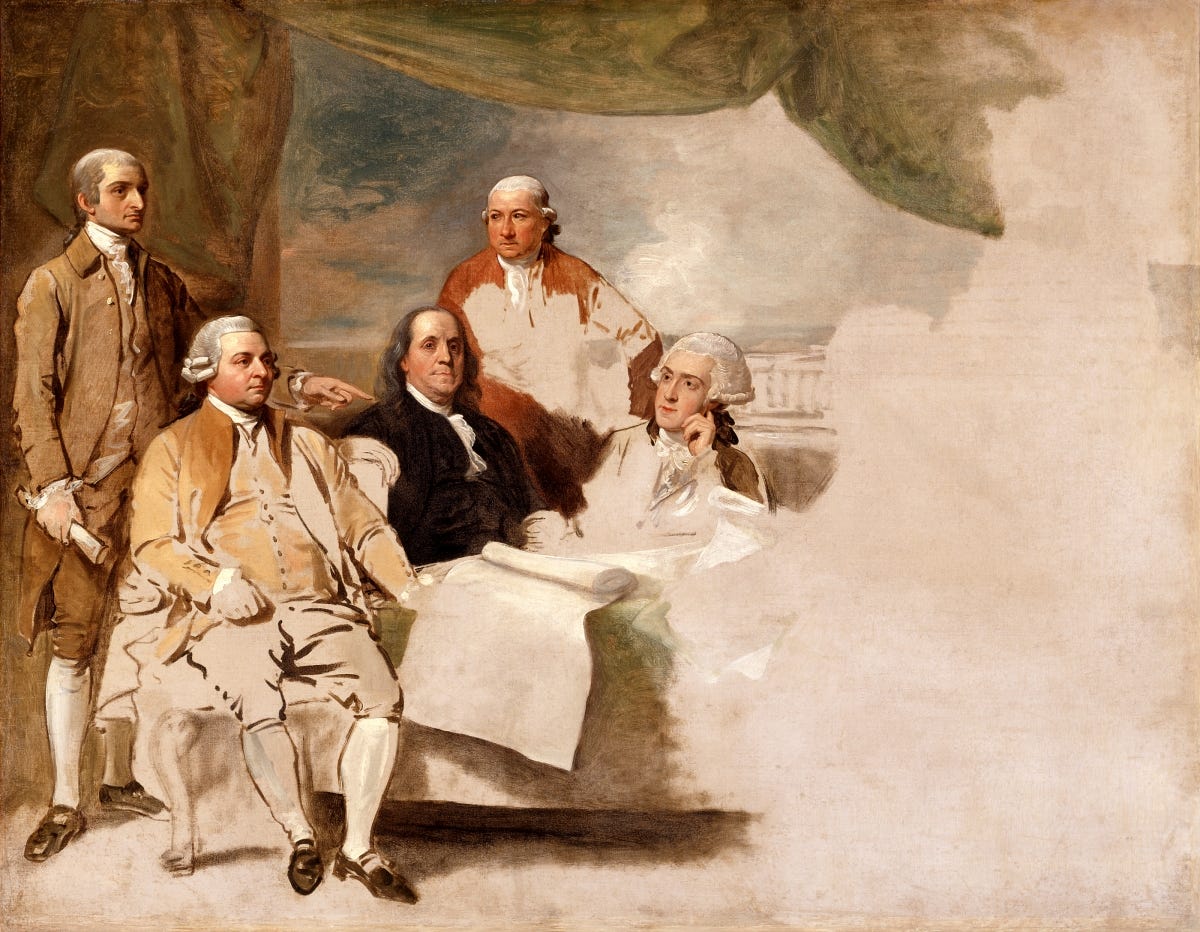
Back in New York City for the final days of their five-year stint in America, they look for those they had both met before. Being New York, “they are berated for their slowness at Corners” (704); the city is growing, and with the increasing necessity of progress, taking one’s time is no longer allowed. Philip Dimdown, having once printed a newspaper trying to instill some form of liberation in this continent (2.38 & 2.57), is nowhere to be found. Captain Volcanoe, Blackie, and the Sons of Liberty, being an ineffective but still worthwhile revolutionary group (2.40 & 2.57), have also gone away. One of the surveyors says, “The Continent is casting off, one by one, the Lines that fasten’d us to her” (704). All that was possible before their arrival has been destroyed — cast off entirely. And as the two wait at the pier, a man in a Slouch Hat — a hat usually “Associated with the military” (Biebel, 244) — approaches them. They ask if he is headed to Falmouth, a port town on the very south-west coast of England, further west than Plymouth.7 And he seems at a bypass: do they mean the Falmouth in England? or do they mean the one in Massachusetts given many of the American colonies have been named after European ‘originals’? America, here, is becoming a distinct entity which is not only associated heavily with the military but is becoming more ubiquitously recognizable than that which has existed for millennia.
Upon boarding the ship — the Halifax Packet — the man disappears, becoming a specter that will haunt the nation.
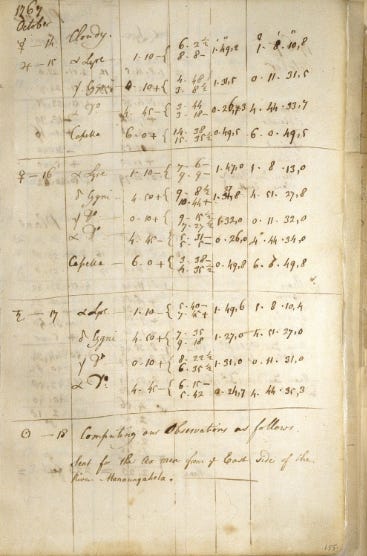
It is September 11th, 1768 — their final day within these borders. Mason’s last journal entry trails off into a line “that thickens and thins again” (705). A Line which ends their journey with the hint of uncertainty, leaving behind the Visto of felled trees, the spikes driven into the earth, and all that was portended on either side while they, unscathed, sail off to safety, comfort, and relief.
Up Next: Part 2, Chapter 73 (the final chapter of the ever-so-long Part 2!). Keep in mind that following the essay on Chapter 73, the next week will be a brief essay on the title of Part 3 along with some things to look out for.
A Meridian Line is a North-South Line as opposed to an East-West Equatorial Line.
Well, technically there has, though it was only the mention of it just as it is being referenced now. This mention was back when Dixon was at the Cudgel and Throck (1.23) and his old friend, Lud Oafery, reminds him of the tunnels they had once explored — underground, unclaimed realms.
Biebel, Brett. A Mason & Dixon Companion. The University of Georgia Press, 2024.
It is even implied that Dixon is thinking of Austra here when he thinks, “he is about to see a face he knows. Someone from the recent past, whose name he cannot remember” (696). This fact, that such an important character in his journey who has gone through more suffering than he could imagine, has been mostly forgotten by him, is telling.
Largely discussed in 2.50 and 2.52.
Article for the Schmidt claim cited below:
Schmidt, Peter. “Line, Vortex, and Mound: On First Reading Thomas Pynchon’s Mason & Dixon.” Schmidt X Crossroads. July 11, 2021. https://peterschmidt.domains.swarthmore.edu/essays/pynchon/mason.html
Plymouth being the port town that they docked in after their battle with the l’Grande, before heading out for Cape Town (1.4). They originally left from Portsmouth (1.3) before that battle necessitated the stop.