
Mason & Dixon - Part 2 - Chapter 71: Too Little, Too Late
Analysis of Mason & Dixon, Part 2 - Chapter 71: Mapping the Line, the Fleur-de-Lis, Remaining in America, Dixon's Epiphany

Now that the physical line has been surveyed over the course of 233 miles (~375 kilometers) plus the 82 miles (~132 kilometers) of the Tangent Line, and especially now that Mason and Dixon have returned to the beautifully cushy and civilized world of the American east, what better time than to head out and drink (excessively!). So once again we find the two heading to a bar — this time visiting a Delaware tavern known as The Crook’d Finger Inn. Here, Dixon starts taking the physical 233 miles that they had traversed and begins mapping out that singular latitude on paper — taking hundreds of miles and turning them into inches. Mason asks, “this is what it all’s been leading to, correct?” (687) — 233 miles to a few inches, miles to millimeters, façades of reality so that the Jesuits or the Royal Society or the East India Companies or the founding-fathers-of-the-New-World or whomsoever-may-have-their-grasp-on-these-nuances could stand their ground and take hold of the coming empire. Yes, that is all it was: a shift “from Direct Traverse upon the Line to Pen-and-Paper Representation of it” (687). This is all a complete disregard of the material world, but unfortunately not for something like the spiritual world that Mason was seeking. It was, instead, a disregard for those miles of trekked landscapes in order to create a cartographic representation so to fulfil economic desires. No, the world will no longer rely on either materialism or spiritualism, nor some combination thereof; instead, it will be based on economics, corporations, politics, and laws.
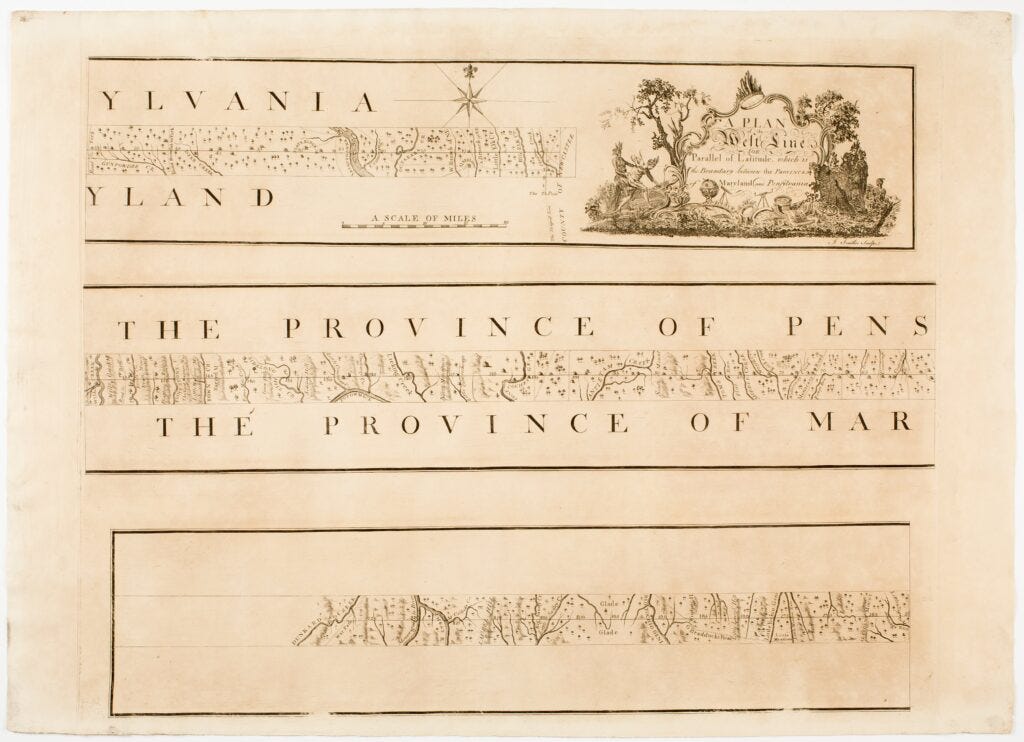
Time passes. Dixon — the true, trained surveyor of the group — has been working on this map for some time now, and eventually he calls Mason over to look at it. Mason sees the Fleurs-de-Lis as the icon for the compass. This seemingly innocuous icon leads Mason to recollect the l’Grand, the French ship that attacked them when aboard the Seahorse as they were heading from Portsmouth to Sumatra (1.4),1 given that ship bore the same symbol upon its flag. All of this argumentation over the compass is merely the desire to disassociate the Line from Death, given Dixon uses this Fleur-de-Lis to show the direction of true North — North being Pynchon’s oft associated symbol for Death. Along with his desire for the map to not be associated with the death that they brought about — or that their actions would one day bring about — he also wants to ensure that the Line and all that is associated with it would be attributed to the correct parties. But all of these worries are mere anxieties on Mason’s part. Anxieties that are surfacing now that their years long project is coming to an end. In reality, he does not wish their job to be done. Despite how horribly detrimental to the world this project has been, its very existence has led to a true and inarguably beautiful friendship, and a discovery of revelatory landscapes he never would have seen otherwise. Mason remembers every ridge, every river, ever city, every tavern, and every creek that they had passed, all represented here on these few inches of ink on a sheet of paper. At the end of the argument, Mason tells Dixon, “This is beauteous Work. Emerson was right, Jeremiah. You were flying, all the time” (689). And it was; whatever evil it may have represented, the craft that went into such a thing was truly incredible — the friendship brought about by it even more so. It is just unfortunate the circumstances that led to these instances of beauty in the world.
As Dixon continues incorporating both the degree of latitude of the Pennsylvania/Maryland border with that of the Tangent Line between Maryland and Delaware, “nearly another Year” (690) goes by, leaving them here in Delaware working on the exact calculations and mappings until June of 1768. Through all this time it appears that they have been ignoring the fact that soon there would need to be some “Agreement to un-couple” (690) — to go their separate ways once again just as they had done on Saint Helena when Dixon returned to Cape Town (1.12) and as they had done after returning to England from mapping the Transit of Venus (1.18). But this time is different, hence the lack of acknowledging the fact. When they parted in Saint Helena, they knew they would be reacquainted in a mere few weeks. When they parted in England, though they did not know they would see each other again anytime soon, they had truly only known each other over the course of about a year, from the very beginning of January 1761 until February of 1762. Now, however, they have spent nearly every waking minute together for the past five years, from September/October of 1763 to June of 1768.
There are hopes of “Plans for the second Transit, the possibility of return to America” (690) given the next Transit of Venus would be occurring in June 1769. There are likely also discussions, though we only hear about their possibility secondhand, of emigrating to America. Legends tell of Dixon wishing to come here to America when Mason did not, but Mason’s field-journal (fair or foul? is the question) did pose the desire to do so, as well. Yet, when the question is actually posed to Mason, at least from Cherrycoke’s perspective, Mason responds, saying, “Stay? Here? Christ no, Dixon.— ’Twas an Odyssey,— now must I return to the Destiny ever waiting for me,— faithfully,— her Loom now mine to sit and toil at, to the end of days, whilst she’s out, no doubt, with any number of Suitors, roaring and merry” (690-691). He pictures himself as Odysseus, returning home after a long voyage across the seas, facing threats to his life, coming back to the ‘loyal’ person who had been waiting for him all this time. Yet, this person is no Rebbekah, it is the Royal Society itself, waiting for Mason to return home so that he can continue dedicating the entirety of his life to it. And he knows that it will not truly be loyal to him in return. It will use him and cheat on him; but he is beholden to it given his desire to be that great scientist and astronomer he could be remembered as.
Part of this year is also spent not just calculating the latitude for the 233-mile border between Pennsylvania and Maryland, but the 82-mile border between Maryland and Delaware, which, despite reading the numerous chapters on the complexity of this mapping, is hilariously described here “‘as if it had been formed by Art’ […] no hostile Indians, fresh food, Cities in easy reach, Obs themselves straight-forward and not even all that many” (691). It is either a justification by the surveyors, by Maskelyne (who wrote the introduction to their publish observations in 1769), or both. This area between Maryland and Delaware was incredibly difficult to map, as was observed in numerous chapters. Yet it was, as many would call it, civilized, providing Mason and Dixon with the comforts they needed to make such a claim. And Maskelyne would be all the happier to back it up.
Most of this year, viewed from the perspective of just looking at Mason and Dixon as friends, is beautiful. And yet,
at the same time, silently parallel to the Pleasantries of teamwork, runs their effort to convince themselves that whatever they have left upon the last ridge-top, just above the last stone cairn, as if left burning, as if left exhibited in chains before the contempt of all who pass, will find an end to its torment, and fragment by fragment across the seasons be taken back into the Tales preserv’d in Memory, among Wind-gusts, subterranean Fires, Over-Creatures of the Wild, Floods and Freezes... until one day ’twill all be gone, re-assum’d, only its silence left there to be clamor’d into by something else, something younger, without memory of, or respect for, what was once, across the third Turning of Dunkard Creek, brought to a halt....
(691)
They are convincing themselves, in the simplest of terms, that they have not done what they have done. They push aside the thought that the line they have created and that the stones with which they have wounded the Earth have had any nefarious intents behind them — that there is no chained evil these objects bear, that there is no torment brought upon the world. They do not see this as a brewing war, where once the world and the cities within it are destroyed (as will be done innumerable times within and because of America). Where one day, nature will come to reclaim it ‘fragment by fragment.’ And realize it or not, it does not end there, though they may tell themselves it does... if they ever admitted it. Nature very well may reclaim the world, ‘until one day ’twill all be gone.’ Be it the nuke, the rising carbon levels, or whatever, there will be nobody and nothing left to ‘respect’ the fact that Mason and Dixon so graciously listened to the Mohawk and stopped the line around forty miles before they wished to. There will merely be time, space, and whatever may accompany that without anything to observe it.
But this idea is not forgotten or ignored by all. In fact, we see “Indian Priests proclaim it forbidden ground” just as we see various Preterite such as “Smugglers of Tobacco, Dye-stuffs, and edg’d implements” (692) flee, leaving all of their goods behind. Similarly, characters we have met before, those who may be complicit but to a lesser degree, such as Stig and Zhang, begin having second thoughts. They are terrified of what they have done, Stig grasping at the tool he was most familiar with and Zhang understanding that the only possible hope they had to negate the evil that this line has brought was to abandon it entirely — to give up what they had built.
After another day of perfecting this degree of latitude, Dixon comes to an enormous epiphany: “Ev’rywhere they’ve sent us,— the Cape, St. Helena, America,— what’s the Element common to all?” to which, when Mason gives an insufficient answer, he adds, “Slaves. Ev’ry day at the Cape, we lived with Slavery in our faces,— more of it at St. Helena,— and now here we are again, in another Colony, this time having drawn them a Line between their Slave-Keepers, and their Wage-Payers […] [T]hey’re murdering and dispossessing thousands untallied, the innocent of the World, passing daily into the Hands of Slave-owners and Torturers” (692-693). And all one can say to that is: ‘no fucking shit.’ There are many instances in the novel where a lack of access to mainstream-media or information-at-one’s-fingertips such as we have today can give the two of them much forgiveness. However, they saw with their very eyes the situation Austra was in at Cape Town, the slaves in Virginia as the both of them traveled down south independently, at Mount Vernon with George Washington, not to mention the treatment of the Natives nearly every step of the way. Dixon’s revelation here is so absurd that — though brutal and depressing — it’s comical. It made itself apparent quite literally seven years ago. And when Mason’s responds, “Christ, what? What did I do?” (693) it becomes even worse. They demarcated the line between slaves and the free. They gave a legal allowance for such a thing to be carried on. And Dixon then condemns himself even more, leaving his epiphany about true slaves behind, and coming to the conclusion that he and Mason are slaves to the current English King, having taken his money to do this job — another equation between wage-slaves and literal slaves.
They simply cannot separate themselves and what they know from reality. Every instance of suffering comes back to those they serve, but they worry about the possibility that they themselves may be harmed when real slaves are killed, tortured, raped, or marred every day. And while yes, they do care about these slaves... is caring enough? Especially if one has led to the laws that permit owning, killing, torturing, and raping these people? Is anything enough?
Up Next: Part 2, Chapter 72
They were originally heading to Sumatra until they were rerouted to Cape Town, South Africa (the Cape of Good Hope).