
Mason & Dixon - Part 2 - Chapter 68: Crossing Over
Analysis of Mason & Dixon, Part 2 - Chapter 68: The Youghiogheny River, Immanuel Ice, Laurel Hill, Ancient Giants, Abandonments, Nameless Tribes

Last chapter began in early July of 1767, just past Cumberland, Maryland where Mason and Dixon spent some time with Cresap. Now, it is August 8, 1767, and they have reached the point in Braddock’s Road just around 191.5 miles (~308 kilometers) west of the post marked west. This would place them less than a mile (less than 1.6 kilometers) from the Youghiogheny River, and about five miles (~8 kilometers) from the end of Maryland itself.
Mason and Dixon had recently heard about “Three agents for Philadelphia land-speculating Interests [that were] said to be out here this summer, scouting real estate,” (658) which Mason admits he is not content with. Now, initially this appears to be a commendable realization; however, it is turned on its head when Mason admits that the reason he has qualms with this land-jobbing is because it would remove the rights of settlers and could mean jail time for surveyors. The act would essentially be taking the stolen continent that was transformed into public American land and transforming that into privatized American land (though, at this point, it would not really be American land but would take on the title of whichever development corporation paid to put their name on it). And, of course, all of this would be further stripping the Natives of what was originally theirs, but there seems to be no qualm there. Therefore, right before crossing the Youghiogheny River (or, as they call it, the Yochi Geni), fearing much of what was to come (for them, at least), Mason and Dixon called the survey party to an assembly and scared those who did not prove necessary to the project into abandonment — namely, musicians, entertainers, and the like.
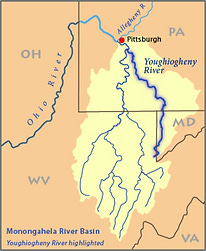
Before crossing the Youghiogheny, Mason and Dixon “arrange to keep the Sector at the House of Mr. Spears, where Braddock’s Road meets the Bank of the Yochio,” (659) which is right where America’s first federally funded highway (the National Pike) crosses the river today, around 2 miles (~3.2 kilometers) north of the border. And to cross this river, Mason and Dixon find a ferryman named Mr. Ice, likely a predecessor to Gabriel Ice in Thomas Pynchon’s novel Bleeding Edge, a neo-conservative tech entrepreneur and hyper-capitalist synonymous with someone like Peter Thiel. Mr. Ice, like Gabriel Ice will one day do, provides a service to anyone who is able to pay, bringing them from one side of the river to the other — or, in other words, providing them the ability progress their lives for a cost at the detriment of something that, to them or to him, does not really deserve any rights to begin with.
While crossing the river (likely still in August), Mr. Ice recounts to them a story about the Lenape raids upon his family and community which resulted in many dead and taken men. Biebel compares this fictional account to something that actually did historically occur: “After Braddock’s defeat in 1755, Lenape warriors conducted a series of attacks on settlers. The most famous incident was the Penn’s Creek […] Massacre, where fourteen settlers […] were killed and eleven taken captive. […] Ice is likely referencing a fictional raid in line with these examples” (Biebel, 233).1 Mr. Ice is thus justifying his commodification of furthering the act of colonization and capitalism via the horrors that were done unto his family by the Natives who he hopes to harm with his actions. It should be no surprise that this discussion pops up immediately after the chapter which presents American ‘mythology’ as the reworking of Native American mythos (2.67), essentially showing how the colonizers reworked stories to blur the reason why Native Americans may have sought revenge and, instead, justified the reason for why the colonizers sought to steal more land and kill more Indians; or, as Mr. Ice states, the Natives showed “No mercy, no restraint, pure joy in killing. It cannot be let go so easily” (660). In the same way will a future Gabriel Ice (or Peter Thiel) find a way to justify their own position in furthering the realm of capitalism based on a false mythology of the American Empire. And all life stops or slows as he tells this story, just as all life will stop if his actions are allowed to continue.
Continuing that theme of reworked American mythology, Mr. Ice recounts the story of ghost-fish that are massive and much like dragons, which he posits that Mason could catch. Mason responds with “Who, Sir?” (660) refusing — at first — to admit that he himself could possibly be complicit in the destruction of the Old World and Old Mythos in favor of the New. He also tells of how these fish “never come to rest. They never know an Instant of Tranquility” (660). These old iterations of mythology have been forced into fleeing the colonizer. “And what of those who seek them[?]” (660) asks Mason. He is terrified, once again coming to see his very own complicity in the formation of the Line. Of course, Ice answers that those who seek these fish garner a form of ‘respect,’ which immediately alleviates Masons possible guilt. If the fish are “no longer classifiable as living Fish,” (660) then seeking them is equivalent to conquering death itself, a horrifying possibility that itself is a feat that someone like Peter Thiel would adore and, in turn, would seek to convince his patrons that this was the ideal path forward.
Immanuel Ice, whose name is now revealed, then attempts to bring Dixon over to his side as well, claiming that due to the horrors those like him and other white men have experienced at the hands of the Natives, they have a right to use their “Tragedy for the mere accumulation of sixpences” (661) — to utilize the falsified American mythos to push capitalism forward. Since Dixon still will not buy into this, Ice continues by calling the Peace of Westphalia to mind, referencing that this act brought the Thirty-Years War to end and subsequently gave statehood to numerous nations such as Switzerland and the Netherlands, and even more broadly gave justification for the original formation of the first actual nation-state borders, indirectly leading to Mason and Dixon’s project of forming these same borders here in America, and in turn leading to those like Immanuel Ice (and eventually Gabriel Ice/Peter Thiel) profiting on the existence of states such as these. Immanuel, whose name literally means ‘God is with us,’ also claims that “God will seize and shake you like wayward daughters, and you will thenceforward give nothing away for free,” (661-662) essentially perverting the very inherent value of Christianity as an at least partially beneficent scripture into what it would come to mean as America progressed.
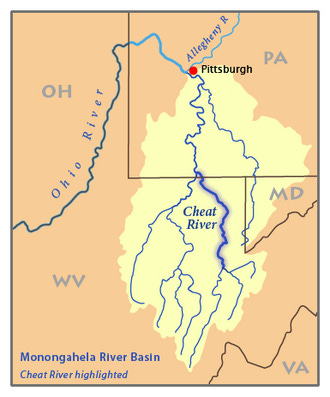
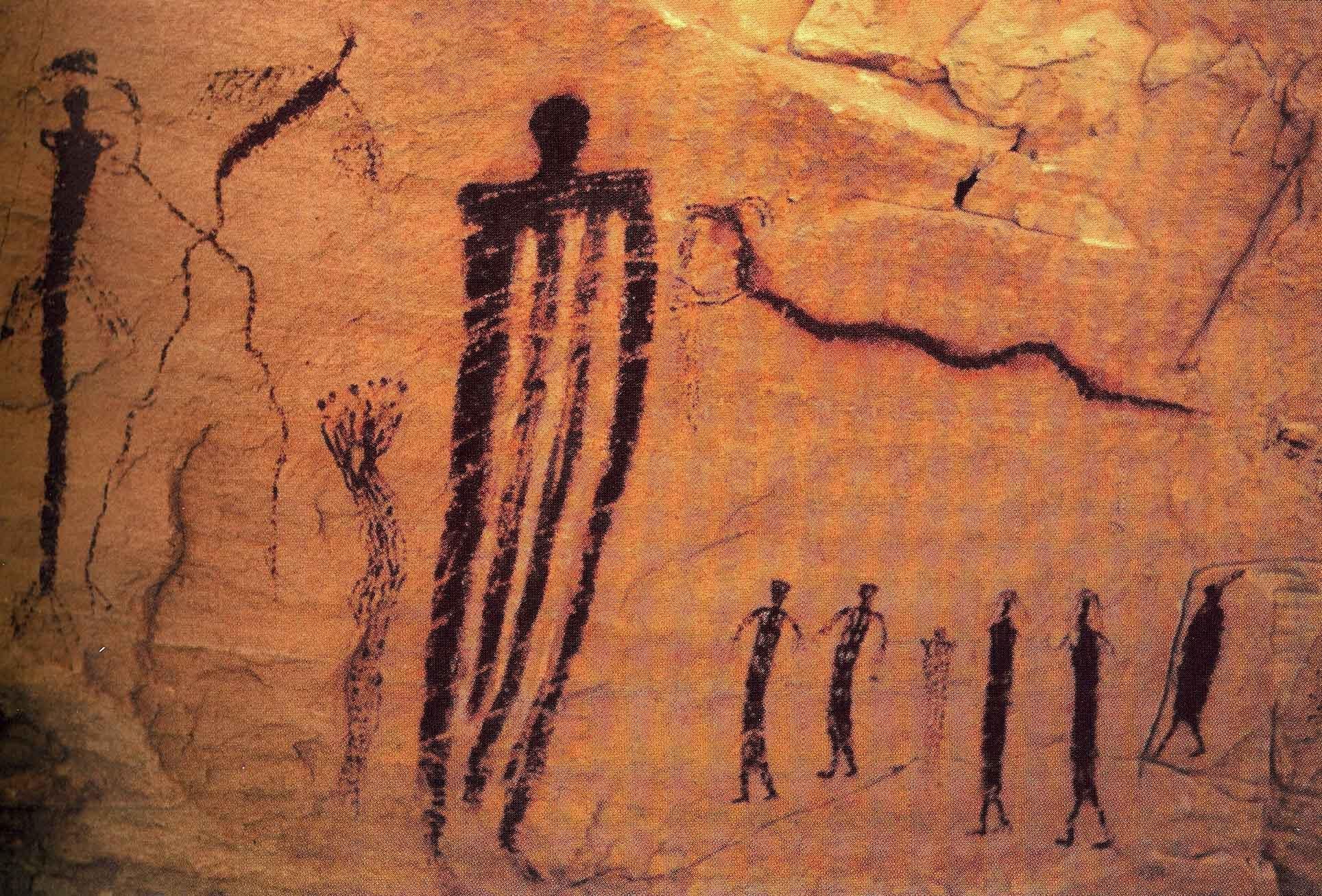
All of this discussion upon the crossing of the Youghiogheny River bleeds over into the next portion of their journey, giving a very specifically American theme to the further crossing of the West. “Between Laurel Hill and Cheat” (662) is Mason and Dixon’s next waypoint. This would place us between the western edge of the Laurel Mountains and Cheat Lake, somewhere around 20 miles (~32.2 kilometers) west of Youghiogheny River or 16 miles (~25.7 kilometers) west of the end of Maryland, right around the very small town of modern-day Springhill, Pennsylvania.2 It is in this part of the country that many more “Old Forts” (662) begin to arise — the Old Forts being another name for Effigy Mounds (Biebel, 234). The Mohawks who are still guiding the survey party through these lands claim that these Effigy Mounds were built by a Nation of Giants, given the Effigy Mounds were built well before even the then-current Native Americans could recall. Though, of course, given many of the inscriptions around these Mounds, we can recall that the colonizers stated their origins to be due to those like the Welsh Indians (2.51), again justifying the European colonization of America since, supposedly, Europeans predated even the Native Americans in America. This idea is only concentrated when the stories of these so-called Giants are said to have returned, “loud as ever, seeking to reclaim their Country. Redeem it” (662).
Ironically, there is a blurring of mythos here. The Europeans have killed the ‘Giant’ of Jack and the Beanstalk, having stolen his property while simultaneously killing him in the process because he sought revenge. Analogously, we see the Europeans doing the same thing to the Natives given they stole the land and killed them after revenge was sought. However, they also here claim that they were the original Giants who were now coming to reclaim their territory/property. America, in turn, is the origin of the ostensible victim who also happens to be the aggressor — an entity that is seen today in various entities from America to Israel, to those not too far gone like Nazi Germany or Fascist Italy.
Mason3 begins to theorize that “The finer the Scale we work at, the more Power may we dispose. The Lancaster County Rifle is precise at long range, because of microscopick refinements in the Finish, the Rifling, the ease with which it may be held and aim’d. Those who control the Microscopick control the World” (663). Whatever this ‘microscopick’ may be is not specified, though the more microscopic one gets, the more scientifically progressive and technologically advanced one becomes. This is exactly why those like Mason and Dixon — or, more likely, those who have hired them — have been seeking to map this country to the fraction of a degree. And with the recollection of the Lancaster Rifle, it is not just meant to recall precision in surveyorship, but precision in the progress of the military industrial complex as well — the exact entity which Mason and Dixon are contributing to without admission. To this, the Natives mercilessly scold them:
You had Powers and we respected them. Yet you never dream’d of us, and when at last you saw us, wish’d only to destroy us. […] [Y]ou sold us your Powers,— your Rifles,— as if encouraging us to shoot at you,— and so we did, tho’ not hitting as many of you, as you were expecting. Now you begin to believe that we have come from elsewhere, possessing Powers you do not.... Those of us who knew how, have fled into Refuge in your Dreams, at last. Tho’ we now pursue real lives no different at their Hearts from yours, we are also your Dreams.
(663)
These Natives understand everything, merely not the extent. They laugh at the Americans for what they are trying to achieve — believing that the European colonizers are attempting this supposedly complete colonization, yet are lacking the ability to fully do so. They see the fabricated mythos. They see it all. And yet an evil so widespread has never been theorized possible, so they laugh rather than weep — rather than fight.
Certainty begins to diminish the further West they travel: “the Visto has grown sensibly wider” (663). Since the line itself is supposed to be at an exact latitude with some room for error, it makes no sense that the Visto would widen. Because of this, we can assume that the calculations that the astronomers are making have begun to grow tenuous the further west they travel, perhaps verifying what they were told last chapter — that “Distance is not the same here, nor is Time” (2.67, pg. 647). And with this increasing uncertainty comes a feeling of dread. If we are unable to make logical sense of the world around us using the same tools that have always served us well, it will instill an immense fear within. This is why after crossing the Cheat and now that they have begun approaching the Monongahela (which was the area right near the Great Warrior Path that Mason and Dixon were told they could not cross), many of the helpers begin abandoning the party. These men are replaced either by other Natives or by new Axmen who did not know how things used to be.
The Natives play on their fear, referencing that the further west they go, not only will time and space begin to warp, but nameless tribes who even the Mohawks do not know will emerge. To the survey party, this is a horrifying idea given many of the men (especially the less educated ones) likely believe the Native Americans to be a more homogenous whole rather than a series of tribes who may never have met one another. So, to hear that there is a nameless tribe which the Mohawks do not know is tantamount to the supernatural or alien. All of this is yet another reason why the project is progressing as such. The white man simply cannot not know things. They must have utter control and comprehension over the land and its people so that they can manipulate these realities to their will. Not a stone can go unturned, not a person unsurveilled, not a square-inch unmapped, not a potential traitor left alive.
Up Next: Part 2, Chapter 69
Biebel, Brett. A Mason & Dixon Companion. The University of Georgia Press, 2024.
They are only around 36.5 miles (~58.7 kilometers) away from the end of the line.
It is possible that it is not Mason. A lack of dialogue attributions confuses who is speaking. It could be Mason, Dixon, or Crawfford — or technically someone else — but perhaps the confusion is the point.