
Mason & Dixon - Part 2 - Chapter 65: Measuring Time and Space
Analysis of Mason & Dixon, Part 2 - Chapter 65: The East Line, On the Degrees of a Circle, the Refinement of Latitude, the Birth of Christ

About three months after the contest between Stig and Zepho1 (2.63), the survey party has returned east to the very start of the line at Bryant’s Farm. It is here that they spend the whole of November 1766 running the line east from the ‘Post Mark’d West.’ Today, looking at the map of the Mason-Dixon Line, we would not see the Line extending East from this point; in fact, even the Post Mark’d West itself lies just inside Delaware, a bit East of the Mason-Dixon Line. So, one may wonder why Mason and Dixon would spend an entire month mapping more than eleven miles of a line that was not even going to be used as a border. Well, this East Line was important to “Pennsylvania’s 1681 charter [which] defined the territory as extending westward from the Delaware River five degrees of longitude” (Biebel, 227).2 In this original charter of Pennsylvania, the origin of Pennsylvania was to begin exactly five-degrees of longitude west of the Delaware River. Essentially, just as they had found the perfect latitude of the line (in 2.30), now they must find the exact longitude of where the line would start. The Post Mark’d West, therefore, was only an estimation of where the line would begin since it really did not matter which longitude they were beginning at. If the estimation was off, they would basically just be losing or gaining a few miles east or west. But if the latitude was off, then the entirety of the line they would have mapped would have been wrong. Hence, their time spent here taking the line east.

Zhang questions these five degrees, asking Mason and Dixon, why are they not extending it five and a quarter degrees? referencing the fact that the Chinese Circle (in the 18th-century, at least) had 365.25 degrees in order to match the exact number of days that the Earth takes to revolve around the Sun. Therefore, removing five and a quarter degrees would mirror the seizure of that same number of degrees from the Chinese Circle that the Western Circle possesses. Zhang mentions that this loss of degrees is a “Bit like the Eleven Days taken from your Calendar” (629). For, the change from the Julian Calendar to the Gregorian Calendar (discussed largely in 1.19) was a switch from exactly 365.25 days to something different, leading to a loss of Eleven Days. Zhang thus posits that, because of this seizure, some slice of their Earth may have gone missing just as those eleven days had. As always, these discussions serve to prove the absurd and arbitrary reason for measuring such natural phenomena like time and space. Eleven days were not really lost when the calendar changed, the manmade calendar simply had to shift to account for another manmade change. Time was always going on in the exact same manner, just as daylight-savings time makes us feel as if an hour is lost or gained while no other being but humankind would ever notice a difference. Time is merely a measurement of change, and we cannot interrupt the fact that things are always changing at an equivalent rate. In the same way, space is space. What we call an inch on Earth will always be an inch, and the difference in degrees of a circle merely proves that the segmentation of degrees within a circle is another arbitrary measurement, but this time of space. For instance, a circle with a circumference of four meters could be segmented off into 360 degrees, 365.25 degrees, 180 degrees, or even 4 degrees. In these cases, the distance between degrees on the surface of the circle would be 0.0111 meters, 0.0109 meters, 0.0222 meters, or 1 meter, respectively. But no matter what, the circle would always possess the same circumference, area, radius, and all associated traits we could give it. Just as with time, our segmentation of circular space into degrees is just an arbitrary means to make better sense of the world in which we live.
However, our segmentation of time and space have massive implications in regard to how we use these phenomena. For instance, our segmentation of time into specific years has implications on our age just as our segmentation of time into weeks has implications on how often we must work. In the same way, while the difference between 0.0111 meters and 0.0109 meters may seem pretty much irrelevant, what if that circle was far larger, say, a circle that surrounded the Earth. For instance, let’s go to the fortieth-parallel where the circumference of the Earth is not one meter, but 19,066 miles (30,683 kilometers). Therefore, with a 360-degree circle, each degree would encompass 52.96 miles (85.23 kilometers), and with a 365.25-degree circle, each degree would encompass 52.20 miles (84.01 kilometers). The difference here is not thousandths of a meter, but three-quarters of a mile (a bit over one kilometer). It may still seem like a small amount of space, but have wars not been fought for parcels of land smaller than this? And, even more importantly, we are still only talking about length, not area. With the extension of three-quarters of a mile, knowing how far north Pennsylvania goes, the actual area of land acquired would have been massive. Pennsylvania, from around the Post Mark’d West, extends north around 158 miles (254 kilometers), meaning an extension of three quarters of a mile east could have gained them 118.5 square miles (190.5 square kilometers) of territory.3 Changes such as this could therefore have enormous implications.
Likely, Zhang is just messing with Mason and Dixon, but he continues on. These degrees were lost because of the method that the West utilized to measure space. If they would have adopted Eastern practices, the territory that was now lost to them may have led to the failure to possess wonders such as “The Fountain of Youth, the Seven Cities of Gold, the Other Eden, the Canyons of black Obsidian, the eight Immortals, the Victory over Death, the Defeat of the Wrathful Deities[.] Histories ever Secret. Lands whose Surveys will never be tied into any made here, in this Priest-tainted three-sixty” (630).
Mason and Dixon, probably contemplating much with these revelations, then question Zhang’s sanity and humility. But Zhang snaps back, claiming that his dealings with the Jesuits, the Wolf of Jesus (Zarpazo), and all else he has been through, has rendered him incapable of shame. He has saved Eliza4; what shame could he possibly feel after that? He is merely speaking his truth.
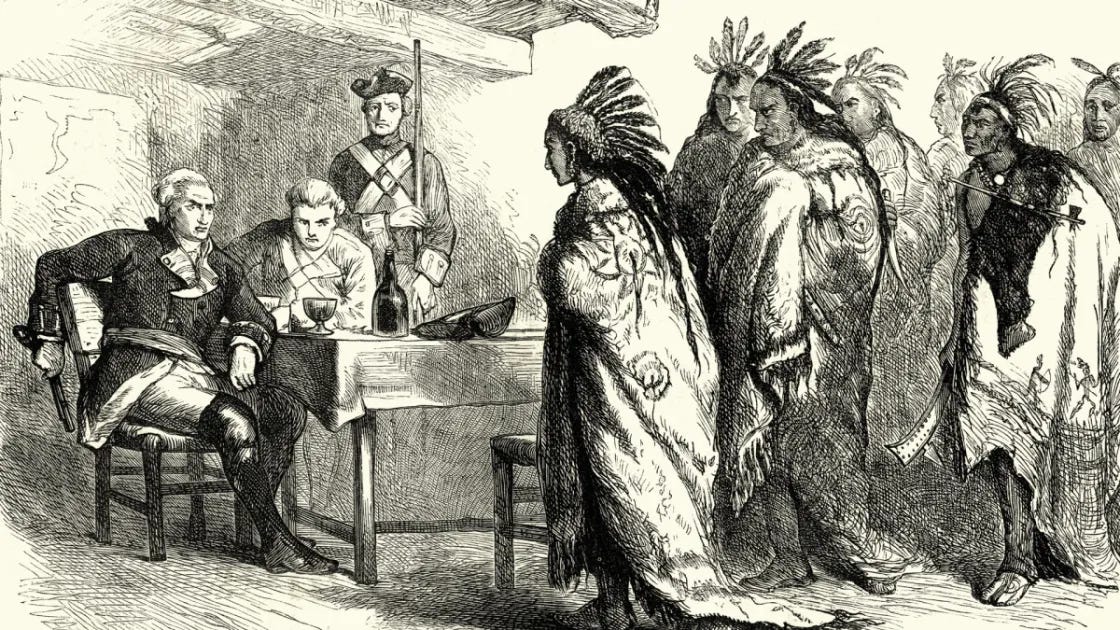
In early December of 1766, Mason and Dixon return to Harlands’ Farm5 where they take on another project, measuring an exact degree of latitude for the Royal Society. This is just another somewhat unrelated job to refine the measurement of space, for as we have discussed above, small changes can lead to massive implications. But, while this may be the case, the job to refine a degree of latitude is serving as a means by which to buy time while They make a decision whether or not to “take the West Line west of Allegheny” (631) — if they should break the ruling of General Boquet’s Proclamation Line and therefore steal more land from the Native Americans than was ‘legally’ allowed.

During this refinement, Zhang arrives and leads Mason and Dixon to once again question the reality of time. He calls into question Jesus’ very birth. According to our current dating of Christ’s birth, the switch from BC to AD would signify the year in which he was born. However, being born on December 25th (on what we today call Christmas) would signify that his birth did not trigger the immediate change from one calendar to another. This could easily be justified by saying that given the year was almost over, they might as well wait a few days to start the year over from zero.6 However, a few things mess with this timeline. For instance, based on certain estimations, “Herod died in four B.C.,— yet the Gospels have him alive when Christ was born,— the taxation decree that brought Mary and Joseph to Bethlehem may’ve been as early as eight B.C. There are a number of these...strange inconsistencies” (632).
Two threads can be followed here:
First of all, as we have seen time and time again, the imprecision and untrustworthiness of history is now seen with the inconsistencies of Christ’s birth. We have multiple Gospels in the New Testament which all catalogue the life and death of Christ, each giving slightly different accounts of the story, some even entirely contradicting the other. Then when observed through a historical lens with other testimonies around the time period (such as the death of Herod mentioned above), even the Gospels themselves falter. History, once again, is not as objective or linear as it is often made to be. All or none of these gospels may be correct.
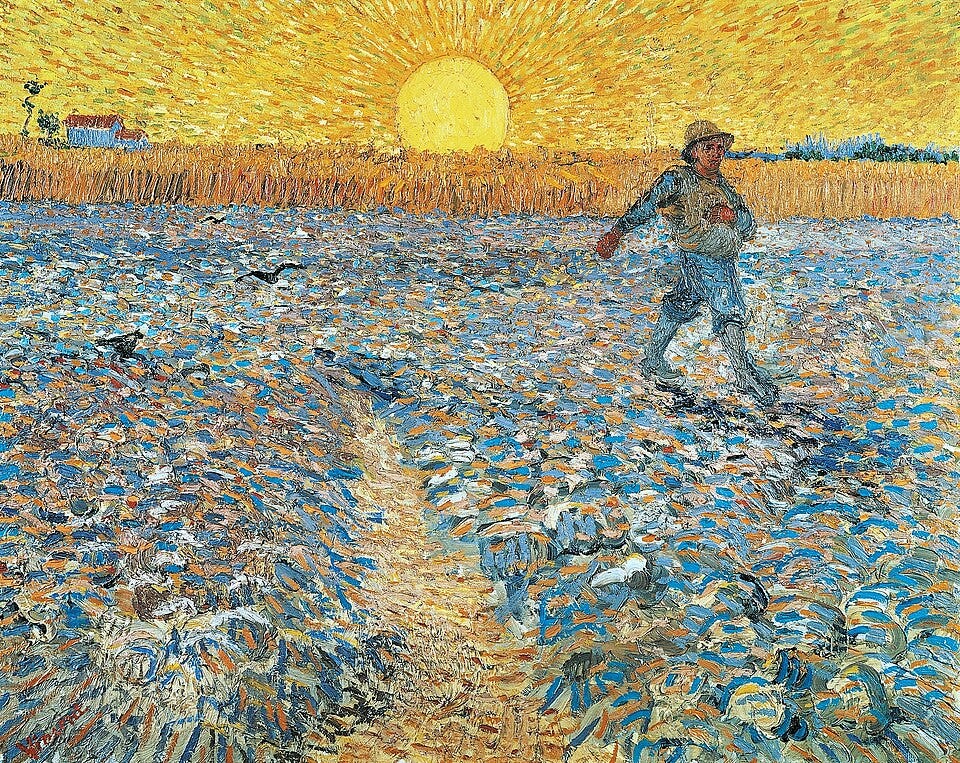
Secondly, there are other implications into why Christ’s birth was dated as December 25th. The 25th was the date of the winter solstice which would be heavily symbolic, especially in regard to Mithraism given on that day the sun would once again begin to overtake the darkness that was encompassing the Earth. Therefore, based on this, the day of Christ’s birth was not set because it was his literal birthday, but instead was chosen to align Christianity with a far more popular spiritual worldview at the time, thus allowing Christianity to garner a sort of following that it may not have done without such an association. It would have been like trying to implement a far more conservative regime in a world that was used to something more liberating. But since this more conservative regime was desired by the Elite, associations needed to be made.
Therefore, the birth of Christ has those exact same implications as the measurement of time and space. Specifics may seem irrelevant or menial on the surface, but when extended out into far vaster realms, their ability to cause change is shown to be much greater. Sure, altering the degrees of a circle may only have extended the territory of Pennsylvania some small distance to the east, but imagine what those miles could have encompassed. In the same way, the birth of Christ, the AD calendar, or the very disregard of how history is actually written, may seem dismissible when it comes to one singular event. But similarly imagine, as time proceeds and grows from that one point, how much is affected by it, snowballing into greater implications over time. There are vaster, more pronounced, and potentially purposeful implications that grow from such a thing. Be it the birth of Christ or the formation of the Mason-Dixon Line, what measurements of time and space have been altered or warped so to affect our lives today? Have their effects grown and grown with each passing moment? changing from mere distance to area, rising exponentially, again, and again, and again?
Up Next: Part 2, Chapter 66
The contest was on August 5th, 1766. Zhang likely told the story of Hsi and Ho (2.64) around that same day.
Biebel, Brett. A Mason & Dixon Companion. The University of Georgia Press, 2024.
Zhang is hypothesizing changing it by a quarter of a degree, which therefore has smaller implications for claims on territory, but the point remains the same.
Eliza is the ‘her’ that Zhang refers to when he says that people were whispering to him, “You should have left her in Quebec” (631).
Not Bryant’s Farm. Bryant’s Farm is on the latitude of the Mason-Dixon Line technically in Delaware. Harland’s Farm is quite a bit north of it, in Pennsylvania, and was their base of operations.
Pre-AD, years were not tracked in a continuous and international way as they now are. Rather, they would have been more localized and based on the reign of kings (i.e. the Third Year of the reign of X).